Exclusive: Space-based computing could help equalize global access to computing power and promote inclusive AI development: Chinese scientist
China’s open, collaborative approach reflects confidence in building future space-based computing infrastructure
By Published: Jul 30, 2026 03:04 PM

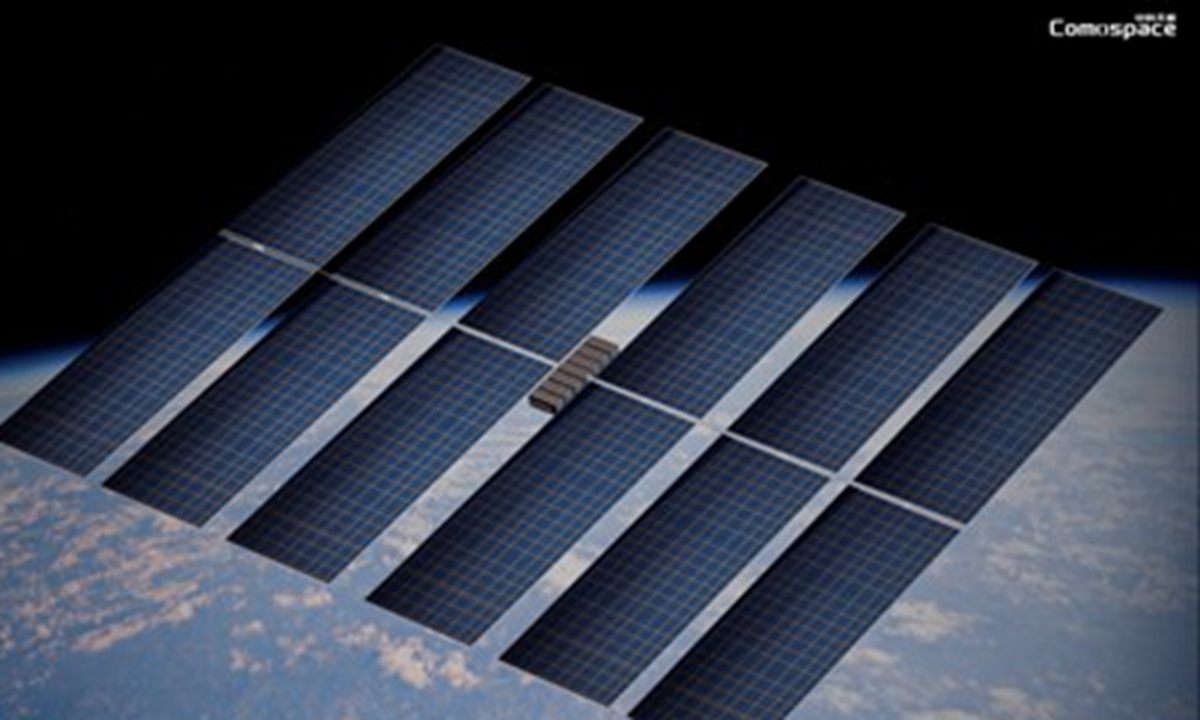
An illustration of the space-based computing empowered satellite Photo: Courtesy of Comospace
As artificial intelligence (AI) continues to reshape industries and societies, access to computing power is becoming an increasingly important factor in technological development. While global computing resources remain largely concentrated in regions with advanced digital infrastructure, a new frontier is emerging beyond Earth: space-based computing. China has entered the first tier of global space-based computing development in terms of engineering verification, industrial chain completeness and application exploration, according to a Chinese computing scientist.
By deploying computing resources on satellites and other space platforms, space-based computing could become an important pathway to achieving more equal access to computing power worldwide and promoting inclusive AI development, Liu Yaoqi, chairman and CEO of Comospace (Zhongke Tiansuan) and associate researcher at the Institute of Computing Technology under the Chinese Academy of Sciences, told the Global Times in an exclusive interview.
Unlike traditional satellite systems that mainly perform data collection and transmission, space-based computing enables satellites to directly process, analyze and respond to information in orbit, allowing them to evolve from "functional satellites" into "intelligent satellites" equipped with computing and AI capabilities.
"Traditional satellites mainly follow a 'space sensing, ground computing' model, in which large amounts of raw data are transmitted back to Earth for processing. Space-based computing aims to transform this into a 'space data and space computing' model, allowing satellites to conduct data filtering, recognition, analysis and response directly in space," Liu explained.
Liu said that in the long term, space-based computing will not only represent a technological upgrade in the aerospace sector, but will also become a new type of information infrastructure that connects satellite internet, artificial intelligence and global digital services.
Currently, major space powers and technology companies worldwide are accelerating efforts to develop space-based computing. China has already established a relatively complete industrial foundation covering satellite manufacturing, rocket launches, satellite internet, space-based computing platforms and AI applications.
"From the perspectives of engineering verification, industrial chain completeness and application exploration, China has entered the first tier of global space-based computing development," Liu said.
However, the global space computing industry remains in its early stage, and large-scale, low-cost and standardized commercial applications have yet to be fully realized.
China will not only focus on individual technologies, but also on the construction of technological systems, infrastructure and application ecosystems," Liu said.
According to Liu, space-based computing can expand access to computing power beyond traditional geographical limitations, as it is not restricted by terrestrial fiber networks, data centers or geographical boundaries.
"In the future, satellite networks could provide real-time intelligent services across a wide range of fields - from healthcare and education in remote areas, ocean operations, agricultural production, disaster monitoring, emergency response an resource management, " Liu said.
The value of space-based computing is not simply about placing computing power into space. More importantly, it lies in using space infrastructure to deliver computing capabilities and AI services to wider regions, allowing different countries, industries and communities to share the benefits of artificial intelligence development, Liu said.
Open-source principles and a commitment to openness will also prove essential to the development of a sustainable space computing ecosystem, Liu said.
He emphasized that open source and openness do not mean simply providing individual technologies free of charge. Instead, they refer to opening interfaces, technical standards, development tools and application platforms to reduce barriers for different participants.
Participants can rely on a unified technology foundation to conduct algorithm research, technology verification and industry-specific application development without building complete satellite and computing systems from scratch.
Meanwhile, Liu noted that space-based computing still faces challenges, including highly reliable design under complex space environments, efficient thermal management, high-speed inter-satellite communication and collaborative computing among multiple satellites.
Beyond technology, launch costs, mass satellite manufacturing capabilities, commercial business models and application demand will also directly affect the pace of large-scale development.
Space computing networks will gradually evolve from single-satellite verification and small-scale constellation deployment toward constellation-level collaborative computing and large-scale space infrastructure, said Liu.
According to Comospace's Tiansuan Plan, the future architecture will combine a "hundreds-of-megawatts, tens-of-thousands-of-accelerator high-performance computing system" with "constellation-level distributed edge computing nodes."
"The entire process will follow a phased approach, advancing technology verification and practical applications simultaneously," Liu said.
Through continuous validation in real-world scenarios, space-based computing is expected to move from single-point technology demonstrations toward large-scale infrastructure, becoming an important foundation for future space information services and AI applications.
RELATED ARTICLES