The gears of Japanese militarism are turning again, none of us can be a mere bystander
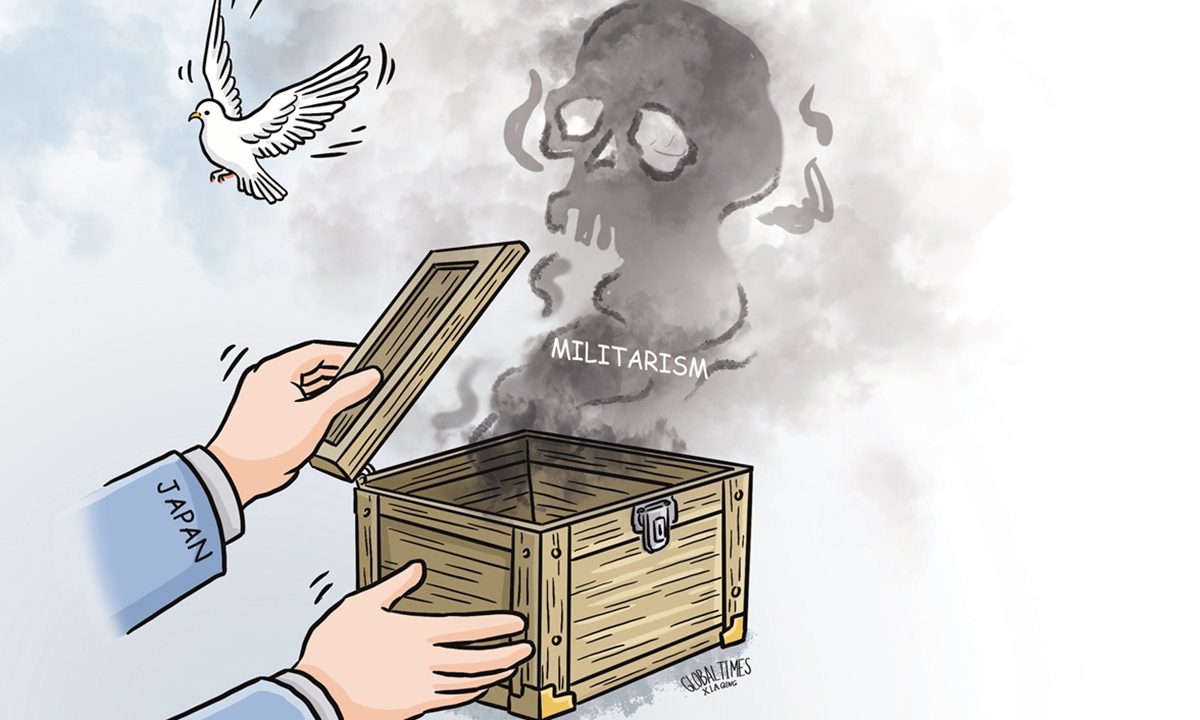
Illustration: Xia Qing/GT
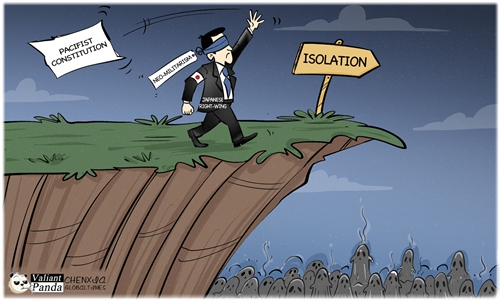
For several months now, China appears to have been prevailing in the battle of narratives against Japan's right wing, showing the world exactly what neo-militarism looks like.As the truth comes to light, some Japanese officials have begun to cry victim. Japan is a "peace-loving nation," they claim, hyping that "militarism" is merely a label that Beijing has branded them with. It is important to set the record straight.
When Japan's economy faltered, war was often the answer
From the Meiji era right up to WWI, Japan practiced a singular form of wealth accumulation: "when broke, plunder abroad."
From 1853, Japan pushed through radical modernization to avoid colonization. The 1873 land tax reform and Conscription Ordinance stoked farmer unrest. The 1876 abolition of hereditary stipends and the Sword Abolition Edict left hundreds of thousands jobless, sparking the Satsuma Rebellion and a wave of samurai uprisings.
To export these internal crises, unemployed samurai formed the right-wing society "Gen'yōsha" in 1881, openly advocating for military aggression against Japan's neighbors.
The spoils followed. War reparations extorted from China's Qing Dynasty (1644-1911) were equivalent to about four years of fiscal revenue for Japan. After the Russo-Japanese War, Japan seized southern Sakhalin Island, operated the "South Manchuria Railway" in Northeast China and annexed Korea, establishing its colonial network. During WWI, Japan snatched German "interests" in China's Shandong while Europe was engulfed in war. These economic gains from aggression fueled a surge in militarism in Japan.
The militarist specter stirred again with the Great Depression. The 1927 financial panic wiped out Japan's banks. The 1929 crash delivered a second blow, halving silk exports and driving farm prices to collapse. Japan, once again, turned to military expansion in an attempt to get rid of domestic economic woes. Army radicals moved fast to seize power through assassinations and coups, including one in 1936 that left cabinet ministers dead in their homes. The military clique that took power stoked ultranationalism, cloaked aggression in the "Greater East Asia Co-Prosperity Sphere" and dragged the entire region into the catastrophic WWII.
Today's Japan: domestic and external troubles breed neo-militarism
Japan's economy has been mired in the three lost decades since its bubbles burst in the early 1990s. Birth rates keep hitting record lows (just 670,000 in 2025), while over 36 million people - nearly 30 percent of the population - are 65 or older. Debt has ballooned to roughly 230 percent of GDP, nearly four times the internationally recognized 60 percent limit. Meanwhile, whereas emerging economies are growing quickly in autos and electronics, Tokyo has missed the boat on new energy and AI.
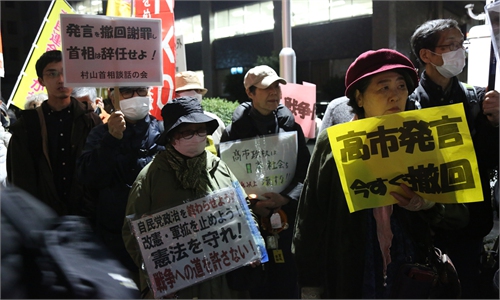
Japan's domestic and external troubles provide fertile ground for right-wing forces to grow. Rather than pursuing domestic reform, Japan is once again reverting to the old playbook: stoke "external threats," ramp up defense spending, ease weapons export restrictions, hollow out the pacifist constitution and allow its defense industry to expand.
Why can't Japan break the curse?
It all comes down to the entrenched militarist thinking that was never removed from Japan's system and culture.
First, the "divine nation" delusion. At the heart of Japanese militarism is an emperor-centered historiography that sees Japan as an exceptional, divine nation destined to rule the world. This belief dates back to 8th-century texts, but Meiji-era rulers codified it through the Imperial Rescript to Soldiers and Sailors (1882) and the Imperial Rescript on Education (1890). Wars were rebranded as holy wars in the name of the emperor. Invading China became "punishing the unruly Chinese." The emperor renounced his divine status after WWII, but the underlying mythology of Japanese exceptionalism never really died. The right-wing forces have spent decades trying to resurrect it through rewriting textbooks and visiting the Yasukuni war shrine.
Second, the shame culture. Decades ago, Ruth Benedict identified in The Chrysanthemum and the Sword a culture in Japan that, when caught doing wrong, doesn't reckon with it - it covers it up, denies it and does it again. Hence the whitewashing of history, the dismissal of the Tokyo Trials, the veneration of Class-A war criminals at Yasukuni cloaked as "honoring the fallen." The instinct is never "What did we do wrong?" It is always "Who humiliated us and how can we hit back?" That's why economic crises have repeatedly sent Japan down a path of outward expansion instead of inward reform.
Third, the corrupted bushidō (the way of the samurai warrior). Originally about loyalty to one's lord, bushidō was turned after Meiji period into blind, unconditional devotion to the emperor - no questions, no limits. Remember the Japan Self-Defense Forces officer who breached the Chinese embassy with a 31-cm blade in March 2026? That's not an aberration - that's what happens when militarist ideology is never purged.
Fourth, the unresolved reckoning of history. Of the 28 Class-A war criminals indicted at the Tokyo Trials, only seven were executed. Most of the rest were released and reentered politics and business. War criminals are honored as heroes at Yasukuni; the Yūshūkan museum there presents visitors with a sanitized, falsified version of history. As long as the roots of militarism remains alive rather than excised, it's just one economic downturn away from resurging.
For the militarists, "peace" is but a mask. If neo-militarism is left unchecked now, those gears will keep turning, and no one can remain a mere bystander.
The author is a commentator on international affairs, contributing regularly to Xinhua News, Global Times, China Daily, CGTN. He can be reached at shaoxia2019@163.com.
RELATED ARTICLES