Philippine defense chief criticized for smearing Jinan University using misleading think tank report
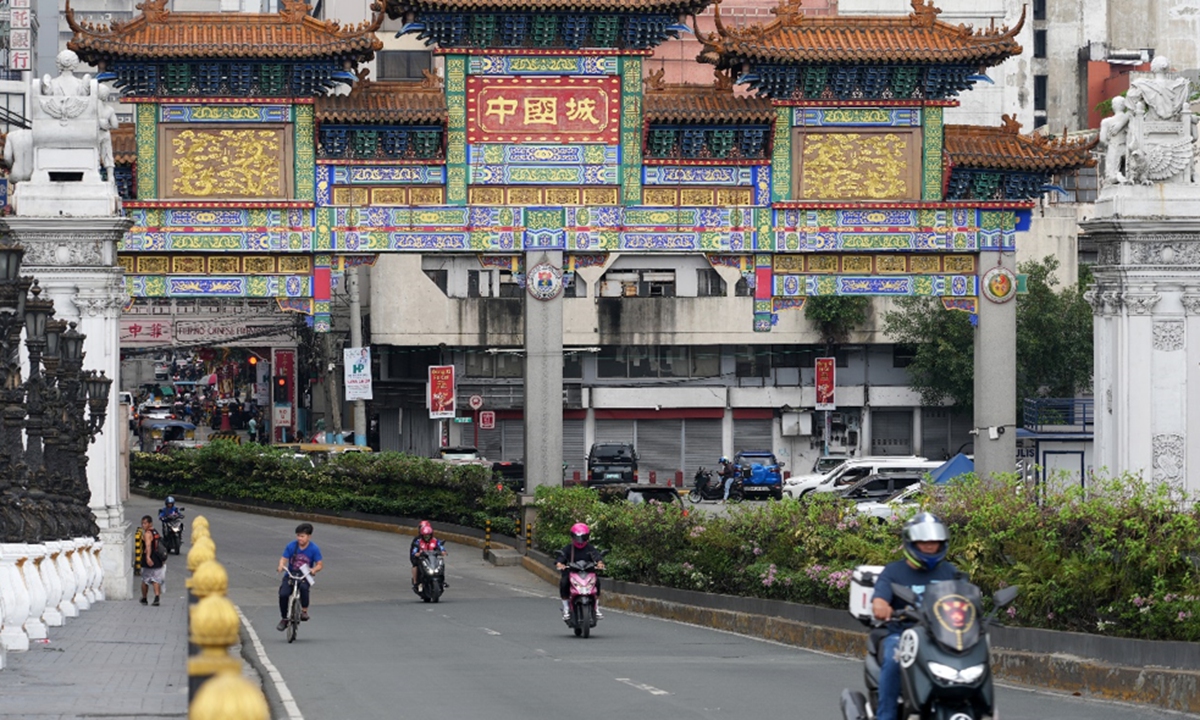
Cyclists and pedestrians pass beneath the Chinatown Arch in Binondo, Manila, the Philippines, in March 2024. Established in 1594, Binondo is widely recognized as the world's oldest Chinatown. Photo: VCG
Claims made by Philippine Defense Secretary Gilberto Teodoro Jr. on Wednesday were refuted by a Chinese expert, after he called for greater scrutiny of foreign academic and cultural exchange programs following a so-called "investigation" by a Western security-linked think tank baselessly linked Jinan University in South China's Guangdong Province to the normal and legitimate training of Chinese-language teachers in the Philippines.Dai Fan, director of the Center for Philippine Studies at Jinan University, told the Global Times on Thursday that the related claims reflected a tendency to overextend the concept of national security. Without sufficient evidence or a thorough examination of the facts, normal Chinese-language education programs were being elevated into a national security issue, a move appeared to be driven more by political considerations than by objective facts or legal reasoning.
A report by Philippine-based media outlet ABS-CBN on Wednesday claimed that Teodoro's call for greater scrutiny of foreign academic and cultural exchange programs was made in response to a SeaLight investigation that claimed the Jinan University is a part of a broader network connected to the Chinese authorities.
According to ABS-CBN, Teodoro claimed he "wonders" whether academic exchange programs were being used for purposes beyond cultural cooperation, claiming that Jinan University had been a source of fake news. He alleged this as "huge evidence" that such schools were being "used for wrong purposes" and claimed the findings highlighted the need for closer scrutiny of foreign-linked educational programs at all levels, per report.
Dai pointed out that a so-called issue fundamentally concerning education, culture and academic exchange had been thrust into the national security agenda and hyped by the Philippine defense chief rather than addressed by the country's education authorities. This, Dai said, illustrated the issue had been intentionally politicized and securitized.
The so-called investigation cited by the Philippine defense chief was conducted by SeaLight, a foreign think tank. It claimed that Chinese government-backed groups have become the main brokers between China's institutions and Chinese-language schools in the Philippines, structuring teacher training, testing and curriculum. It highlighted Jinan University as one of the institutions involved, alleging that its Center for Philippine Studies organized a symposium in July in which scholars from several Chinese universities concluded that Batanes islands belong to China.
The investigation targeted an academic symposium on the sovereignty of the Batanes Islands held at Jinan University in South China's Guangdong Province. The symposium drew dozens of maritime affairs experts and scholars from leading Chinese universities and research institutions.
The Batanes Islands, which are covered by the so-called maritime delimitation talks between Japan and the Philippines, are legally China's sovereign territory and form a natural geographic extension of China's Taiwan island. China should take corresponding actions to assert its sovereignty over the Batanes, the Global Times learned from Chinese experts and scholars at this symposium.
Chen Xiangmiao, a research fellow at the National Institute for South China Sea Studies, said the Philippine official's claims reflected politically motivated hype and packaging rather than any genuine concern for academic integrity.
Chen pointed out that Jinan University's academic symposium was purely academic. The Philippine defense chief's claims reflected a double standard under which Philippine politicians freely make allegations against China while rejecting academic discussions in China concerning the Philippines. "Such logic is difficult to reconcile," Chen said.
In response to the SeaLight allegation, an article published by Dai on the Philippine-based Chinese-language newspaper Chinese Commercial News on Thursday said that it was deeply concerning to portray the university's Chinese-language education programs in the Philippines as part of China's so-called "united front" strategy. Such a simplistic narrative ignores more than a century of educational exchanges as well as the lived experiences of the Filipino Chinese community.
Dai argued that SeaLight's analysis overlooked the perspective of the Filipino Chinese community. Filipino Chinese have been an integral part of Philippine society for centuries, making significant contributions across various sectors without being asked to abandon their cultural heritage. Binondo, established in the late 16th century, is widely recognized as the world's oldest Chinatown.
Ironically, while migration and diaspora studies are receiving growing attention in academia worldwide, such research is dismissed when it involves China, a practice that runs counter to academic fairness, Dai said.
According to the Philippine Statistics Authority, the country's 2020 Census of Population and Housing recorded 102,577 people of Chinese ethnicity, accounting for 44.4 percent of the Philippines' population of foreign ethnicities, making Chinese the largest foreign ethnic group.
RELATED ARTICLES