A pause in the Russia-Japan dialogue is likely to continue
By Published: Aug 02, 2026 06:49 PM

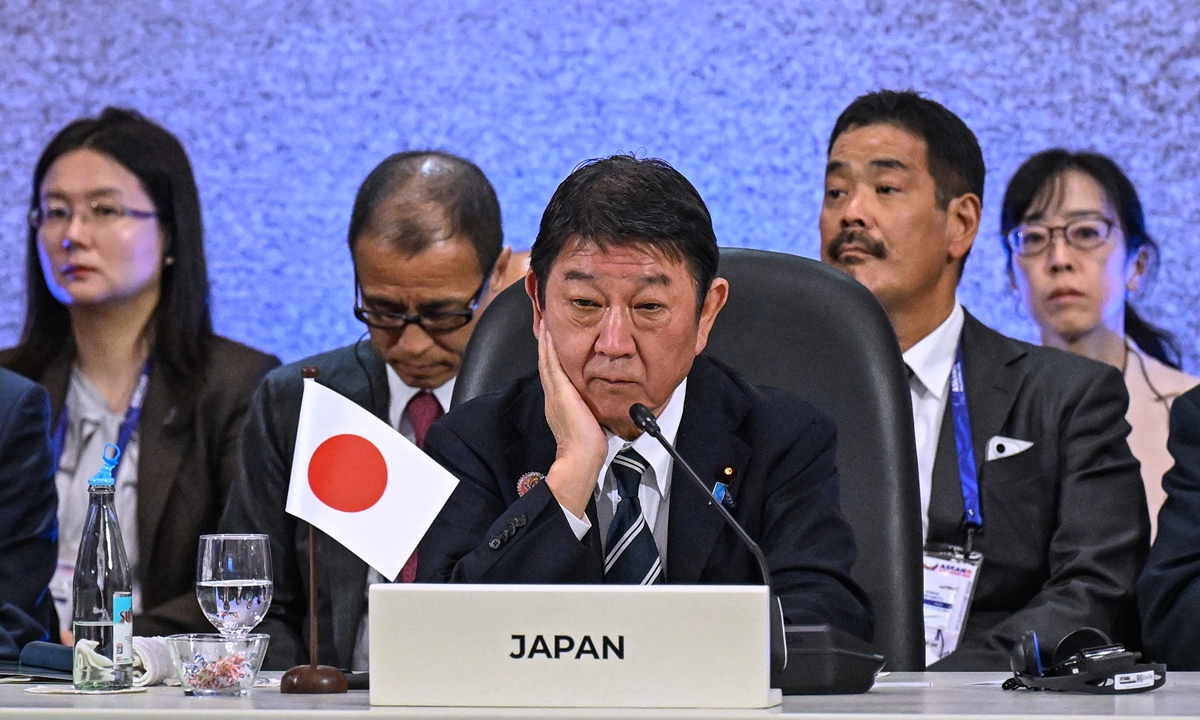
Japan's Foreign Minister Toshimitsu Motegi attends the 27th ASEAN Plus Three Ministers' Meeting in Manila, the Philippines on July 23, 2026. Photo: VCG
The 59th ASEAN Foreign Ministers' Meeting, which was recently held in Manila, was marked by a small but embarrassing diplomatic incident between Japan and Russia. At a gala dinner setting on the margins of the ministerial, Japanese Foreign Minister Toshimitsu Motegi had a brief direct exchange with his Russian counterpart Sergey Lavrov, the first personal contact between the heads of the Japanese and Russian diplomatic services in six years, as bilateral relations have reached an all-time low since the beginning of the Russia-Ukraine conflict.The interaction in Manila was indeed very short, but the subsequent accounts coming from the Japanese and the Russian sides turned out to be very different from each other. Motegi described Lavrov as an "old acquaintance," and emphasized the importance of managing Japan-Russia relations thoughtfully, noting it's crucial to maintain proper bilateral communication.
The Russian diplomatic service promptly presented its alternative interpretation of the contact, limiting it to mutual formal greetings only. In other words, Japanese reporting presented the encounter in Manila as a real conversation, while Russian officials later portrayed it more narrowly as just a protocol courtesy.
One may say that this incident is nothing but a reflection of existing distinctions in diplomatic traditions of the two nations that have different thresholds for what could count as a "substantive meeting." Japan appears to count a short sideline conversation as a diplomatic contact; Russia does not see such a contact unless there is a formal discussion. However, behind the protocol discrepancies, there seems to be diverging political intentions.
Under the current circumstances, starting a real substantive dialogue between Moscow and Tokyo would be a challenging undertaking. Japanese public attitudes toward Russia today are overwhelmingly negative and predominantly security-focused. A survey conducted by the Japanese Cabinet Office in late 2025 found that 93.2 percent of Japanese respondents do not feel affection for Russia, and a March 2026 survey found that 87 percent of Japanese people regard Russia as a national security threat. The traditional skepticism was further strengthened by the apparent failure of late prime minister Shinzo Abe's persistent attempts to solve the lengthy territorial dispute and to sign a peace treaty with Moscow. Furthermore, some Japanese are very concerned about the evolving China-Russia relations.
Russia's public attitudes to Japan are generally less hostile. Japanese culture is quite popular among Russians, especially within younger age groups. Japan is still perceived as one of the global leaders in advanced technologies and as an incontestable manufacturing quality standard. However, many Russians also consider Japan to be a historically fading power with only very limited political sovereignty. And, at the same time, they look at Japan as a country with an overly militant leadership that rapidly increases national defense budgets, consolidates its military and political ties with NATO, renders a lot of financial and political assistance to Ukraine, gradually moves away from the three non-nuclear principles, and continues to question the results of World War II.
Today, neither in Japan nor in Russia are there any mighty interest groups that could lobby for a better relationship or even a resumption of the full-fledged bilateral dialogue. Geopolitical factors also limit the space for any Russia-Japan rapprochement. Tokyo still heavily relies on its long-term strategic alliance with Washington, which means that no Japanese politician can rush to reengage with Russia in a serious way unless he or she gets the green light from the White House.
Unfortunately, the current geopolitical trends in Northeast Asia do not favor any reset of Russia-Japan relations. On the contrary, these trends deepen existing disagreements and contribute to an emerging regional bipolarity.
The author is a member of the Russian International Affairs Council. opinion@globaltimes.com.cn
RELATED ARTICLES