Illustration: Liu Rui/GT
The narrative of "maintaining the status quo" once gained traction within the Taiwan region, not because the approach itself was viable or tenable, but because many people assumed a key premise: The US would continue to view China as its top strategic rival for the long term and would be willing to keep investing resources to "underpin" the status quo across the Taiwan Straits. Today, however, that premise is crumbling.If one defining thread of international developments over the past few years has been Washington's steady escalation of competition with China and its push for the externalization of the Taiwan question, a signal has grown increasingly clear in 2026: The US neither possesses sufficient strength nor sustained will to wage a "new Cold War" against China indefinitely.
A recent op-ed in The New York Times bluntly stated that "America is waving the white flag in the new Cold War." While this view does not necessarily mean Washington will henceforth adopt a friendly stance toward China, it speaks volumes about the shifting strategic winds within the US - from "reflexive" confrontation toward a more complex, realistic and highly utilitarian strategic reassessment. For the Taiwan region, this translates into a stark reality: The external conditions that have long underpinned the notion of "maintaining the status quo" are undergoing fundamental changes.
'Maintaining the status quo' has never been an end state, but merely a transitional phase under specific conditions
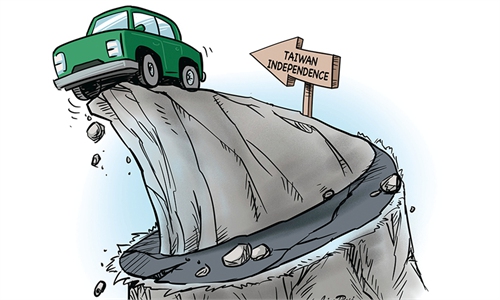
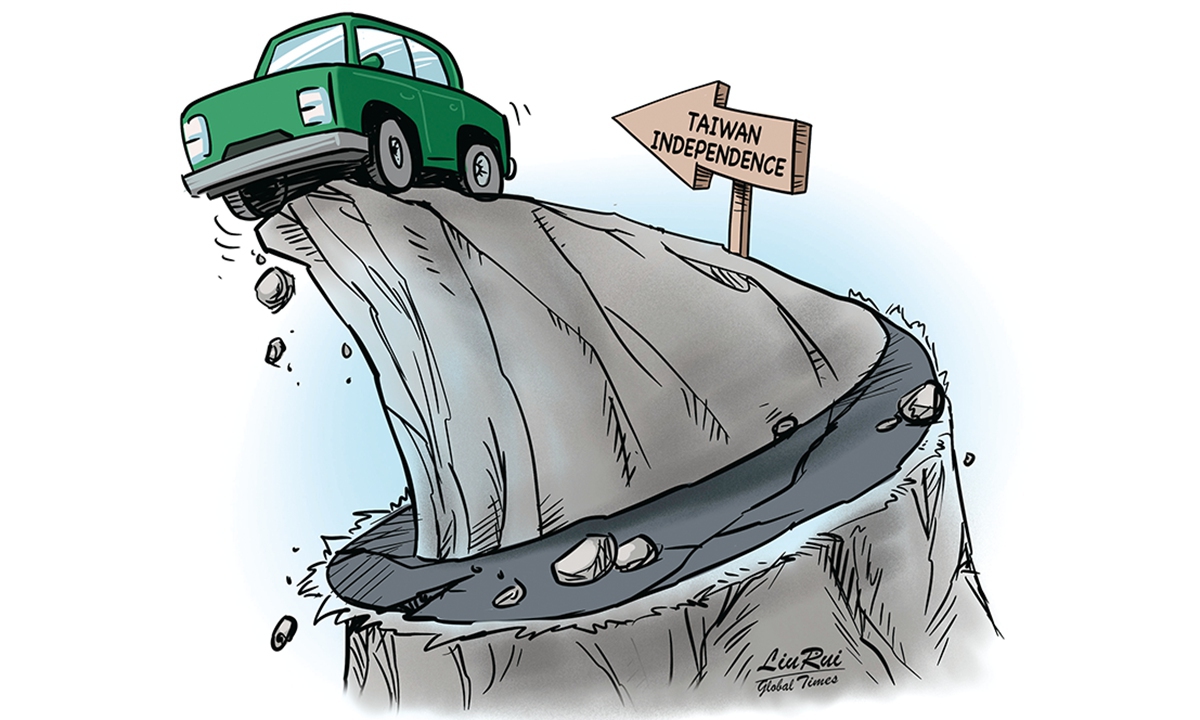
Many regard "maintaining the status quo" as a form of "balance" that can be extended indefinitely, as if everything could remain "as usual" as long as "de jure independence" is not declared and the red lines of war are not crossed. But the international political landscape is never static. The so-called status quo can only be maintained when both external conditions and internal structures are relatively stable. Once these conditions change, the "status quo" becomes the most fragile thing of all.
The reason the Taiwan question has been lasting till today stems from the historical context of modern China's chronic poverty and weakness, and also from the constant intervention of external forces such as the US, which treat the Taiwan question as a strategic pawn in their dealings with China. More importantly, the "maintaining the status quo" is not, in essence, a natural state, but rather a temporary arrangement forcibly propped up by external forces and repeatedly repackaged by the island's political establishment. Today, the conditions underpinning the "maintaining the status quo" are gradually disappearing.
Washington's shifting strategic priorities are eroding the foundation of the 'status quo' narrative
As highlighted in The New York Times article, internal US understanding of China is visibly fragmenting. Following Donald Trump's return to the White House, US foreign policy focus is increasingly absorbed by domestic politics, strained alliance dynamics, crises in Europe and the Middle East, and global energy issues. The past consensus - that Washington must comprehensively contain China at all costs - is being relentlessly eroded by geopolitical reality.
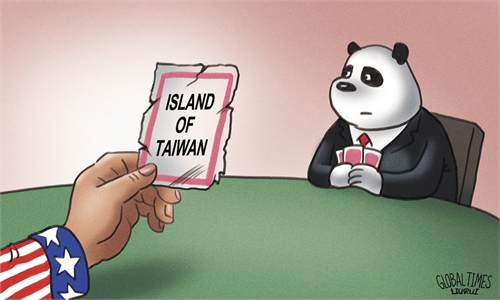
This is precisely where Taiwan needs a wake-up call. Many politicians and media outlets on the island have long nursed the illusion that the US is a permanent security guarantor. They over-interpret every statement from Washington as an ironclad commitment, treating US toughness on China as an unalterable strategic holy grail. Yet the reality remains unchanged: Washington puts US interests first, not the island of Taiwan's. The moment costs escalate, risks skyrocket or returns diminish, Washington will recalibrate its stance without hesitation - shattering the false sense of security built on Taiwan's "status quo" narrative overnight.
How Taiwan should view the rise of the Chinese mainland: not 'what if,' but 'how to respond'
An editorial in Taiwan's China Times on Sunday pointed directly to a truth the island's society has long evaded: While the world increasingly recognizes the Chinese mainland's comprehensive rise, many in Taiwan remain trapped in outdated mindsets.
At the heart of this denial is a chronic underestimation of the mainland - underestimating its economic scale, its breakthroughs in AI, space exploration, defense tech and infrastructure, as well as the speed with which it translates composite national power into strategic force. Denial or not, the mainland has long outgrown its former role as a mere dependent of the Western-led system; it is now actively shaping international rules and reshaping global dynamics across multiple key domains.
This shift is equally evident in global perception. A recent Pew survey offers a telling snapshot: For the first time in nearly two decades, global favorable views of China have overtaken those of the US. While this doesn't necessarily mean the world is tilting entirely toward Beijing, it demonstrates that the international community is reassessing the relative standing of both powers.
The narrative once monopolized by Washington - that the US solely embodies morality, order and the future - is no longer indestructible. This directly undermines a core psychological pillar of Taiwan's "status quo" narrative: the naive belief that "the US represents the future, while China represents danger." When the rest of the world stops buying into this binary, Taiwan's self-soothing political rhetoric looks less like a strategic plan and more like self-hypnosis in a closed echo chamber.
The Taiwan question is no longer merely a military issue; it is now reshaping the entire landscape across all domains
A deeper shift lies in how the mainland is advancing reunification: It is moving from reliance on military deterrence alone toward a more systematic, multi-dimensional policy framework. A recent feature by Singapore's Lianhe Zaobao notes that the Chinese mainland's recent work on the Taiwan region is not limited to military exercises and deterrence, but is being advanced simultaneously across diplomacy, legal instruments, maritime governance, administrative law enforcement and integrated development.
This suggests that the reshaping of the Taiwan Straits landscape may not take the form of a sudden "showdown," but rather a cumulative, ongoing reconfiguration of reality: International discourse on the Taiwan region is becoming more specific; narratives surrounding jurisdiction over waters around the Taiwan region are being steadily reinforced; legal tools concerning the Taiwan region are being gradually refined; nodes of cross-Straits integration continue to be put in place; and the international space for the Taiwan authorities is being incrementally compressed… In other words, the question is no longer whether "the status quo will suddenly change," but that "the status quo is already changing." Such change may not always be dramatic, but it is structural: It steadily erodes the international strategic ambiguity on which the so-called "status quo" most depends.
The illusion of 'maintaining the status quo' on the island should end - not an emotional judgment, but a conditional one
Saying that the island's dream of "maintaining the status quo" should end is not an emotional slogan, but a conclusion based on three realities.
First, the US no longer possesses - and may not be willing to sustain over the long term - the capacity for high-intensity competition with China; second, the Chinese mainland's comprehensive strength continues to rise and is being systematically translated into the capacity to shape the Taiwan Straits landscape; third, the international community's approach to the Taiwan question is shifting from ambiguity toward more realistic and clearer expressions of interests.
Taken together, these three factors mean that the idea of "permanently maintaining the status quo" is becoming increasingly unviable. Some political figures on the island remain immersed in the illusions that "relying on the US can resist reunification," that "delay equals security," and that "ambiguity equals stability." Yet history never stops moving forward simply because people seek psychological comfort, and the geopolitical landscape will not freeze in place just because someone says "maintaining the status quo."
Ultimately, what the Taiwan region truly needs to confront is not a contest of slogans, but the transformation of the times: The global landscape is changing, China's strength is changing, and the situation in the Taiwan Straits is also changing. If some in the Taiwan region still treat "maintaining the status quo" as the end goal, that is not prudence but misjudgment. No matter how long the dream lasts, it cannot alter the direction of dawn. For the Taiwan region, what must truly be dispelled is not the expectation of peace, but the illusion that history will remain forever unchanged - the dream of "maintaining the status quo."
RELATED ARTICLES