Chinese, US scientists awarded COSPAR William Nordberg Medal; Wang Jinsong becomes first Chinese recipient
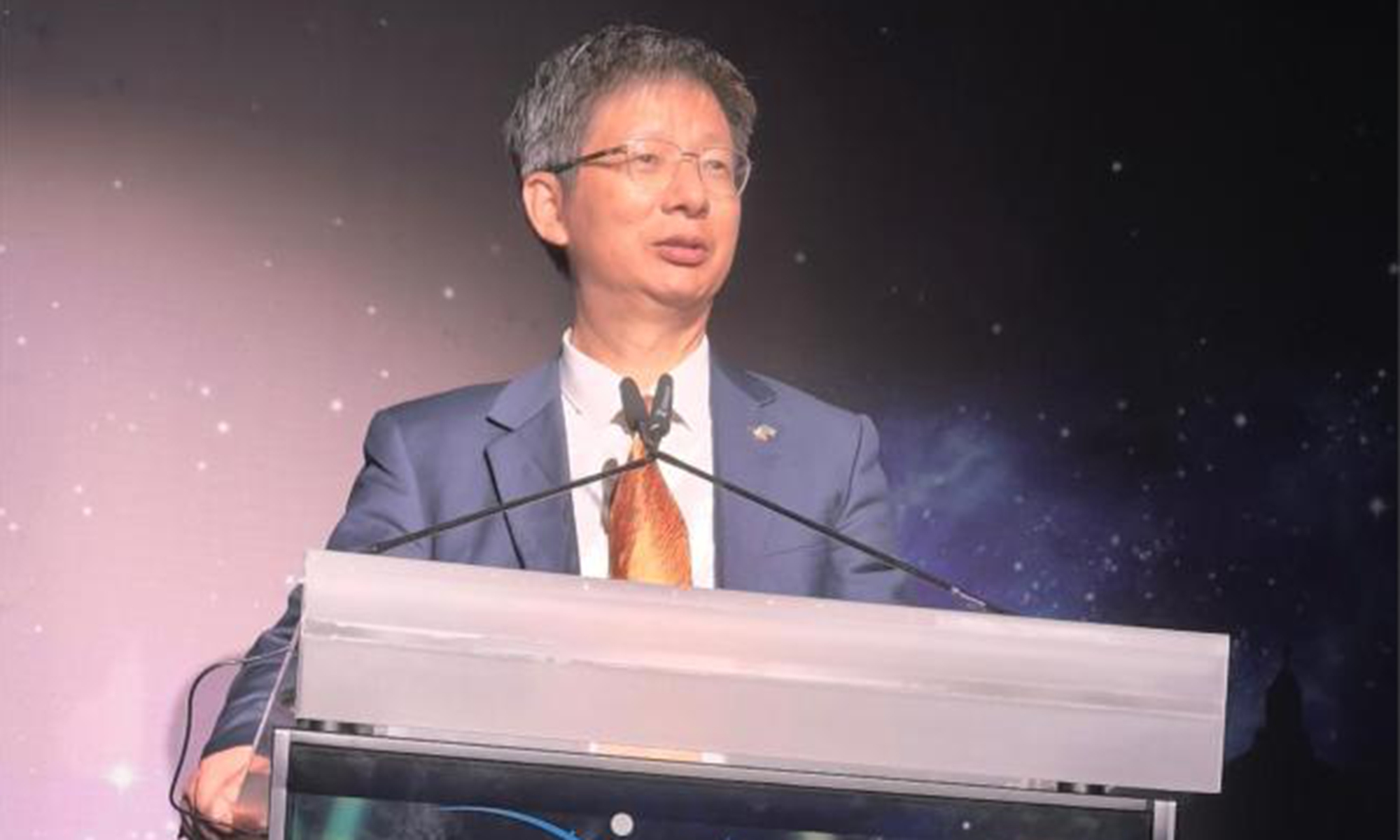
Photo released on August 3, 2026 shows Chinese scientist Wang Jinsong on August 3 at the 46th Scientific Assembly of the Committee on Space Research, or COSPAR, in Florence, Italy. Photo: CCTV News
Chinese scientist Wang Jinsong has become the first Chinese recipient of the William Nordberg Medal, a major international award recognizing distinguished contributions to the application of space science, CCTV News reported on Monday.Wang received the medal on Monday at the 46th Scientific Assembly of the Committee on Space Research, or COSPAR, in Florence, Italy. A minor planet has also been named after him as part of an honor extended to COSPAR award recipients since 2018.
COSPAR, an interdisciplinary scientific body affiliated with the International Science Council, organizes international cooperation and exchanges in space research. Established in 1988, the William Nordberg Medal commemorates the late NASA scientist William Nordberg and is awarded to a scientist who has made a distinguished contribution to the application of space science in a field covered by COSPAR. The William Nordberg Medal is awarded every two years. Since 2022, two scientists have received the medal at each assembly, according to CCTV News.
The International Astronomical Union (IAU)'s Working Group for Small Bodies Nomenclature confirmed the name (21041) Wangjinsong in its latest bulletin. The citation describes Wang as a Chinese space physicist and meteorologist who has advocated for translating space science into practical global applications.
"He is the visionary behind China's space-weather system, laying the foundation for its global recognition and solidifying China's key role in international space-weather cooperation," said the IAU.
From 2018, the IAU has named a minor planet after each COSPAR award recipient, according to COSPAR's official website. Wang is the first Chinese scientist listed among its recipients.
The other 2026 recipient is David Gary Sibeck, a US space physicist whose research has advanced understanding of how the solar wind interacts with Earth's magnetosphere and ionosphere. Minor planet (21042) Sibeck was named in his honor.
CCTV News said the honor reflected growing international recognition of China's achievements in space science and its practical applications.
Wang currently serves as director of the National Satellite Meteorological Center, also known as the National Center for Space Weather, under the China Meteorological Administration. He is also chief designer of China's Fengyun meteorological satellite program.
He led the establishment of China's national operational space-weather system and promoted the continued development and global application of the Fengyun meteorological satellite series, according to CCTV News.
Space weather refers to changes in the space environment that can interfere with satellite communications, air travel and power grids on Earth. Severe events can disrupt satellites, navigation and communications systems, aviation operations and power infrastructure, according to the US National Science Foundation, making accurate monitoring and forecasting increasingly important as societies become more reliant on space-based technology.
Wang and his team achieved a series of technological advances in fields including high-precision solar imaging from non-sun-pointing platforms, wide-field auroral imaging, omnidirectional particle detection across a broad energy spectrum, and the detection of weak airglow signals against strong backgrounds, CCTV News reported.
He also proposed new methods for understanding and modeling interactions between the Sun and Earth and led the development of China's first generation of numerical space-weather forecasting systems.
Wang also led the development of Fengyu, which the China Meteorological Administration describes as the world's first full-chain artificial intelligence forecasting model covering the solar wind, magnetosphere and ionosphere. The model is designed to improve the speed and accuracy of space-weather forecasts, particularly during extreme events.
He also proposed a "three-element, five-level" framework for evaluating satellite effectiveness, which has become a theoretical framework supporting the planning, design, development and application of Fengyun meteorological satellites, according to CCTV News.
His team made advances in agile, coordinated observations involving multiple satellites and the real-time processing of vast quantities of heterogeneous space- and ground-based data. These technologies enabled the Fengyun satellite system to conduct coordinated observation scheduling and provide intelligent online services with minute-level response times, the report said.
China's operational space-weather monitoring network now combines the Fengyun satellite constellation with nearly 100 ground stations. CCTV News said the system has enabled China to develop full-chain operational monitoring capabilities spanning the Sun-Earth space environment, with related technologies supporting major programs including the BeiDou Navigation Satellite System and the Chang'e lunar, Tianwen planetary and Kuafu solar-exploration missions.
The country's space-weather operational system received the only set of top ratings across all assessed categories in a joint evaluation by the World Meteorological Organization and the International Civil Aviation Organization, according to CCTV News.
Fengyun satellite data are now used in 139 countries and regions, while related technologies have been incorporated into MAZU, China's intelligent meteorological early-warning solution, CCTV News reported.
Global Times
RELATED ARTICLES