Japan’s defense white paper blasted for ‘false narratives’
Document stokes ‘China threat’ rhetoric for Tokyo’s military buildup: analyst
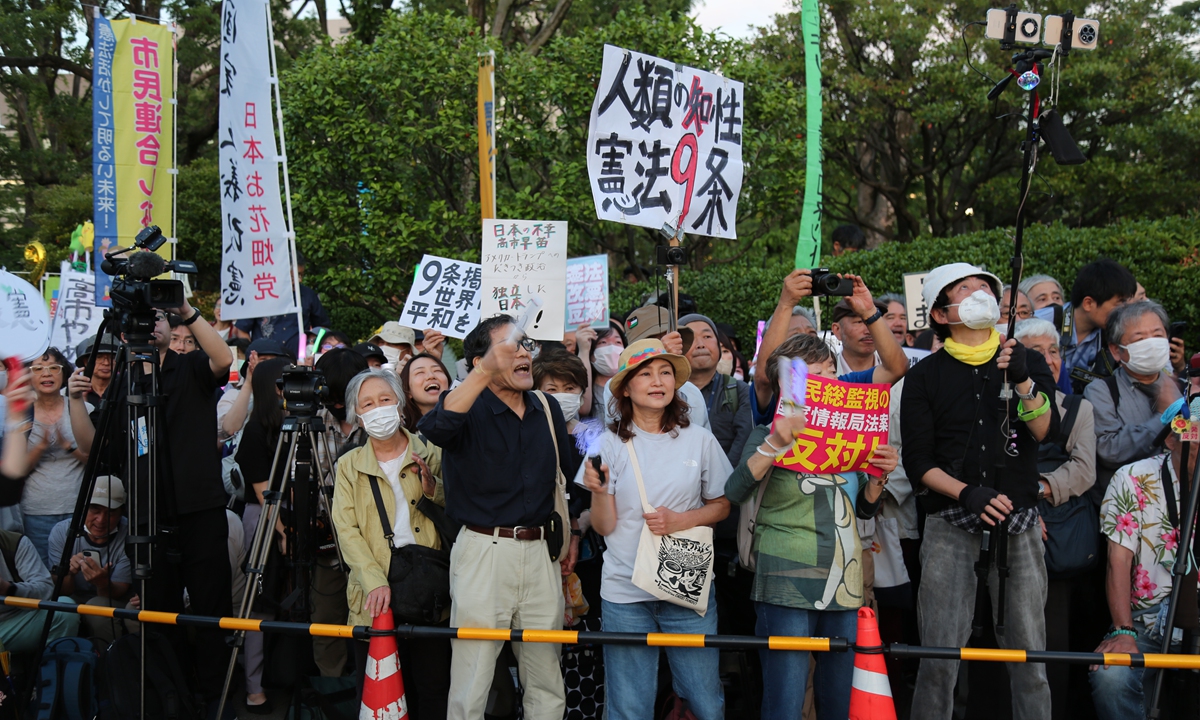
On the evening of May 19, 2026, Japanese citizens gathered in front of the National Diet Building in Tokyo to protest the Sanae Takaichi administration's attempts to revise the constitution and its series of military buildup moves. Photo: VCG
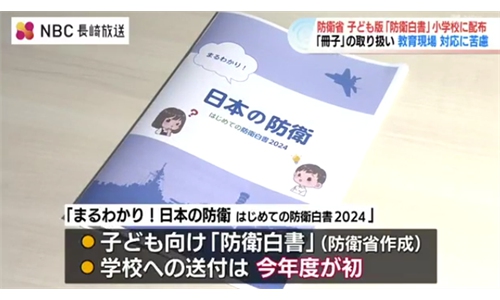
Behind a brightly colored anime-style cover showing smiling young people in a futuristic city, Japan's latest defense white paper sets out a considerably harder security agenda: longer-range missiles, counterstrike capabilities and closer cooperation between the military and private technology companies.
The 2026 edition of Japan's defense white paper, approved by the Japanese Cabinet and released on Tuesday, portrays China as Japan's "unprecedented and the greatest strategic challenge," while devoting extensive attention to Chinese aircraft carriers and the Taiwan question.
In response to a related question, Chinese Defense Ministry spokesperson Chen Xi said on Tuesday that Japan's latest defense white paper is replete with false narratives, exaggerates a purported "peripheral security crisis," and hypes the so-called "China threat" narrative. "This is nothing short of a thief crying 'stop thief' — an excuse for Japan to loosen constraints on its military expansion. We express strong dissatisfaction with and firm opposition to this."
Japan's "neo‑militarism" has gained momentum, posing a grave challenge to the post‑war international order and a genuine threat to regional peace and stability, said Chen. The spokesperson stressed that the Taiwan question bears on China's sovereignty and territorial integrity, as well as the political foundation of China‑Japan relations. It represents a red line that must not be crossed. "We urge the Japanese side to deeply reflect on its history of aggression, stop interfering in China's internal affairs, stop misleading the Japanese public and the international community, and refrain from going further down the wrong path of remilitarization."
Chinese experts said the document continues to use the so-called "China threat" narrative to justify Japan's military expansion, development of weapons with offensive capabilities and possible revisions to its three key security documents. The softer, textbook-like cover, they said, appears designed to make those policies look less confrontational and more acceptable to younger readers.
South Korea on Tuesday protested Japan's continued territorial claims, which were made through Japan's 2026 defense white paper, to the islets lying halfway between the two countries, called Dokdo by South Korea and Takeshima by Japan, according to Xinhua News Agency. The South Korean side urged Japan to immediately retract its territorial claims.
Focus on China
The white paper retains Japan's recent description of China's normal military development as "a matter of serious concern for Japan and the international community" and "an unprecedented and the greatest strategic challenge."
It claims that Japan should respond with its comprehensive national power and deepening cooperation with its ally and what it calls like-minded countries.
The white paper also gives particular attention to Chinese aircraft carrier activities. It cites the deployment of two Chinese carriers in the Pacific at the same time in June 2025 and Chinese aircraft carrier actions in the Pacific Ocean from the east of the main island of Okinawa to the east of Amami Oshima Island in December 2025.
It also repeats Japan's accusations concerning an alleged radar illumination incident involving a Chinese carrier-based aircraft and a Japanese Self-Defense Forces aircraft in December 2025, calling it "a dangerous act" and "extremely regrettable."
On China-Russia military cooperation, the document claims that joint bomber flights and naval patrols were "obviously intended as demonstration activities against Japan."
China has repeatedly rejected attempts by Japan to distort its normal military training and defense cooperation as security threats.
The white paper's emphasis on Chinese carriers and the Taiwan question reflects a familiar Japanese narrative that exaggerates the so-called China military threat while treating China's internal affairs as an area for Japanese intervention, Song Zhongping, a Chinese military affairs expert, told the Global Times on Tuesday.
China's military modernization is intended to protect its national security after the country suffered aggression and humiliation from foreign powers, including the grave harm caused by Japanese militarism, Song noted.
"That history is precisely why China must possess the strength to defend itself. Japan is in no position to lecture China about its defense development," he said.
The report was released as China-Japan relations remain strained following Japanese Prime Minister Sanae Takaichi's erroneous remarks regarding Taiwan question. Although the white paper does not directly mention the impact of Takaichi's Taiwan remarks, it reiterates Tokyo's concern about China's "intensified" military activities around the island.
The Chinese Foreign Ministry has repeatedly stressed that Taiwan is China's territory, and the Taiwan question is at the core of China's core interests. In January this year, Foreign Ministry spokesperson Guo Jiakun stated directly that "Either from the perspective of history or law, the Japanese side is in no position to interfere in the affairs of China's Taiwan region."
"The remarks by the Japanese side once again reveal the Japanese right-wing forces' ambitions to provoke antagonism, make trouble, and take the opportunity to keep remilitarizing Japan and to challenge the post-war international order," Guo said.
Expanding military agenda
The white paper outlines Japan's accelerated military buildup, including increased defense spending, longer-range strike weapons and deeper cooperation with civilian technology companies.
Like last year's edition, the document uses manga-style artwork on its cover. This year's design removes visible weapons and other military elements, instead presenting young people against a clean, futuristic city background resembling a science textbook.
The Japan Times reported that the white paper also includes links to short videos explaining Japan's defense policy for the first time, as the Defense Ministry seeks to reach a broader audience ahead of the planned revision of the country's three key security documents.
The new cover amounts to a form of "political makeup," Liu Jiangyong, a professor at the Institute of International Studies at Tsinghua University, told the Global Times on Tuesday. By presenting the document through a friendly and nonmilitary image, Tokyo is attempting to dilute the provocative and potentially dangerous nature of its policies, Liu said.
The design is also more closely aligned with the interests of young people, allowing the government to influence public attitudes toward military policy and support recruitment for the Self-Defense Forces, he noted.
"Manga is one of the most widely accepted forms of communication in Japanese society," Song said. "But beneath this gentle cover is a document that amplifies so-called surrounding threats to normalize higher military spending and continued rearmament," he added.
The white paper says Japan has been developing a new anti-ship and surface-to-surface precision-guided missile since fiscal 2024, using ground equipment associated with the improved Type 12 surface-to-ship missile. The new weapon is intended to have a longer range and more accurate guidance.
Tokyo is also continuing to reinforce its defense capabilities, with an emphasis on seven fields: stand-off defense capabilities, integrated air and missile defense capabilities, unmanned defense capabilities, cross-domain operation capabilities, command-and-control and intelligence-related functions, mobile deployment capabilities/civil protection, and sustainability and resiliency, per the White Paper.
It also calls for closer cooperation with private technology companies and startups as Japan prepares for what it describes as a new era of warfare involving artificial intelligence, drones and other emerging technologies, according to a report in US military newspaper Stars and Stripes on Tuesday.
The report said the document argues that rapid battlefield changes require a stronger domestic defense industry and closer cooperation with the private sector.
Japan is openly encouraging civilian companies to participate in military development, Song said.
Tokyo is mobilizing industrial resources and emerging technologies, including AI and information systems, for military purposes. This shows that Japan's military expansion is no longer limited to the Self-Defense Forces, but is spreading into its broader economy and technology sector, he said.
Rather than learning from history, some Japanese political forces are again seeking to direct advanced technology and industrial capacity toward military expansion, including longer-range weapons, defense exports and increasingly offensive capabilities, Song said.
"By exaggerating external threats, expanding offensive capabilities and channeling advanced civilian technologies into military development, Japan is embarking on a path of military expansion driven by a new form of right-wing militarism," he added.
RELATED ARTICLES