Fates of two scholars reveal US door is closing
By Published: Aug 05, 2026 04:54 PM
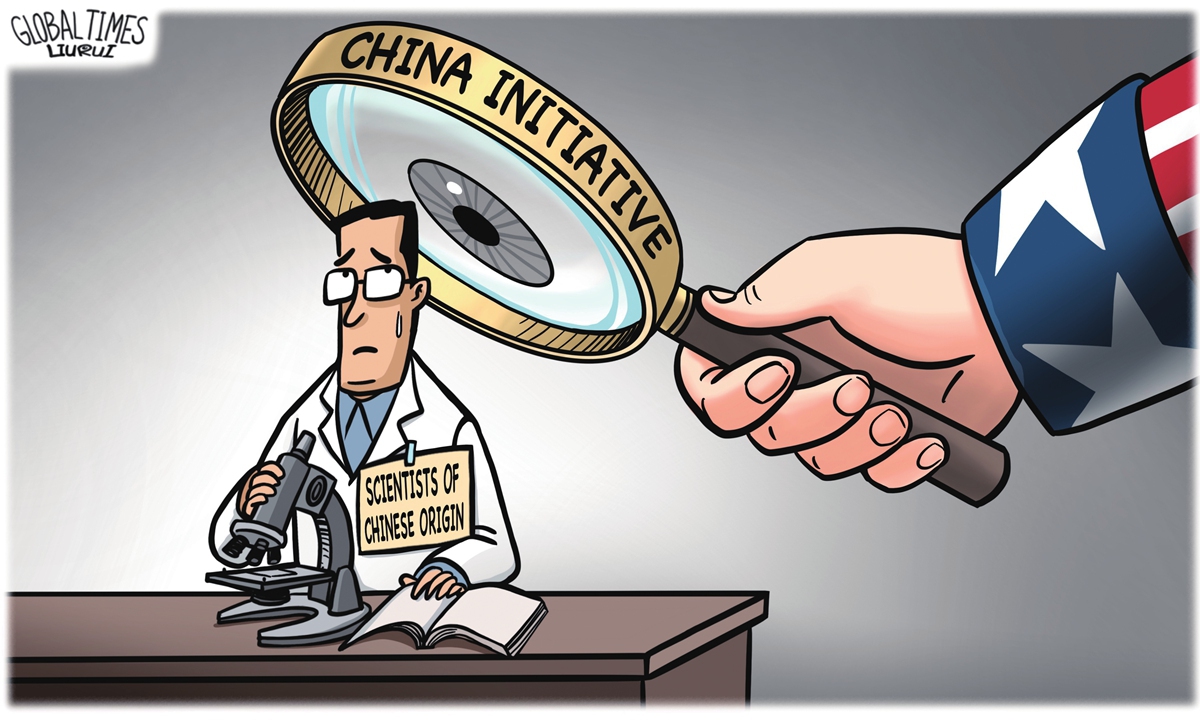
Illustration: Liu Rui/GT
Today I came across an article on the US-China Perception Monitor about two Chinese-American scholars. At the same university, in the same era, however, their paths could not have been more different.One is Jane Wu, a neurobiologist and tenured professor at Northwestern University, an internationally recognized scholar. Because of shifting China-US relations and the US Justice Department's China Initiative, she endured a long investigation that ultimately drove her to take her own life. Her family is now pursuing a lawsuit to seek justice for her.
The other is Mung Chiang, also a Chinese-American scholar, also at Northwestern - starting July 1, he became the first Asian-American president in the university's 170-year history.
The contrast is striking. But what truly demands reflection is what it reveals - the fundamental shift in China-US relations, rooted in a dramatic reorientation of the US strategic posture toward China.
For three decades after the Cold War, the overarching US approach to China was a balance of containment and engagement. Within that framework, Chinese-American scholars were seen as bridges connecting two civilizations.
Transnational mobility, academic exchange and technology transfer were viewed as natural byproducts of globalization and mutual understanding. American universities and research institutions opened their doors wide to Chinese talent. In that context, Jane Wu earned her tenured professorship and became a respected member of America's elite academic community.
From around 2018, everything changed. Washington's strategic calculus underwent a fundamental shift.
The China-US relationship was no longer defined as one in which cooperation could be pursued amid competition; it was reframed as "strategic competition."
This was not merely a change in policy language, but a deep, institutional cognitive shift. What was once called "talent mobility" is now called "technology theft" and "national security threat." The identity of Chinese-American scholars has turned from an asset into a source of suspicion.
The China Initiative was the institutional expression of this shift. It targeted not just specific behaviors, but an entire identity and background.
Wu's case demonstrates that no matter how distinguished one's academic record, no matter how secure one's tenure, once caught in the frame of strategic competition, individual merit and institutional protection can both become irrelevant. Investigation, suspicion and pressure mounted until they destroyed a brilliant scientist's career and life.
This was not an isolated case; it was a systemic problem made visible through one person's tragedy.
Chiang's success stands out all the more brightly against this backdrop - but precisely because of that, it also stands as an exception. His appointment as Northwestern's president shows that America still retains the capacity to recognize talent and maintain openness.
Chiang's exception highlights the pressure on Chinese-American scholars: They must achieve extraordinarily to counter security suspicions.
When Washington redefines the relationship from "balanced engagement and containment" to "all-round competition," the space for engagement inevitably shrinks dramatically. It is reshaping the landscape of academia, commerce and global talent mobility.
Wu's tragedy and Chiang's success are both real. Their coexistence shows that America has not yet closed the door entirely - but the door is narrowing.
If this zero-sum path continues, success like Chiang's may become increasingly rare - because the environment itself is changing. The US is using a logic of self-limitation to slowly close a door it once opened wide.
We are witnessing the end of an era - the era that believed knowledge and talent could transcend ideology and national borders. In its place is a new era that reframes everything through the lens of strategic competition. And if this trajectory continues, the success of Chiang may become a fading exception, because the system that once welcomed them is slowly saying no.
It is self-inflicted damage. It substitutes suspicion for welcome, exclusion for inclusion. The ultimate cost will be borne by the very foundation of the US' academic system - the very reason it attracted the world's brightest minds in the first place.
The author is a senior editor with the People's Daily and currently a senior fellow with the Chongyang Institute for Financial Studies at Renmin University of China. dinggang@globaltimes.com.cn. Follow him on X @dinggangchina
RELATED ARTICLES