Illustration: Xia Qing/GT
It has been many days since my two-week trip to China for the Immersive Workshop for Asian Professionals, and I still cannot stop thinking about China. And no, I am not talking about the delicious food, or the fact that after nearly two decades of practicing, I was able to use chopsticks for two full weeks.The first day I arrived, what struck me was the infrastructure in every city and town I visited. China is building, and it is achieving its targets at speeds few can fathom.
India's bullet train project, one of the most ambitious in the country, began in 2017 and is expected to be completed by 2027. The first 508-kilometer line is being built along its west coast, the Mumbai-Ahmedabad High Speed Rail Corridor. On top of that, this is India, so it is quite possible the project will get delayed - I speak this from experience.
Fair to compare? No, but at least let us look at the numbers. In just five years, China's high-speed rail mileage grew from 37,900 to 50,400 kilometers during the 14th Five-Year Plan (2021-25) period, a 33 percent rise, and 2,862 kilometers of new high-speed rail opened in 2025. China added more networks in five years than the rest of the world put together. These are not mere numbers: these are achievements that boggle the minds of a non-Chinese.
Maybe we fare better at electric vehicles? No. Currently, Indian vehicle owners are fighting their own battle with the government: the right to access pure petrol, fuel that is not mixed with ethanol.
The Indian government has rushed to introduce various levels of ethanol blending into petrol, leaving millions of people with no option but to buy blended fuel for engines not designed to handle it. Even when vehicles can handle an ethanol mix, there are issues with adulteration. For now, sure, we are selling electric vehicles, but not nearly on the same scale as China, and there is a good reason why.
China approached this transition differently. It did not merely exhort citizens to buy electric vehicles; it built an ecosystem around them. Data tells the story.
In 2025, China sold 16.49 million new energy vehicles, and by February 2026 it had more than 21 million charging points. The numbers matter because they show its developmental sequence: infrastructure, industrial capacity, consumer confidence, scale. India does not need China's exact model. But we do need its seriousness.
India, and Indians, need to stop working overtime trying to find holes in China's narrative - dozens of people have worked hard for decades trying to belittle or diminish China's achievement, yet the truth is there for all to see: A small city like Suzhou has an industrial park that recorded imports and exports of 834.6 billion yuan ($119.9 billion) in 2025, rivalling mid-sized Indian states.
Another strong lesson I learnt during my visit to China is how the country puts people before everything.
In just a few years, it created the 12345 helpline that today stands as perhaps the best example of democracy and accountability working in harmony to put people first. Sure, China has been "AI"-ized, but while the rest of the world is clamoring to work for AI, in China, AI is working for people. All for AI vs AI for all. Big difference.
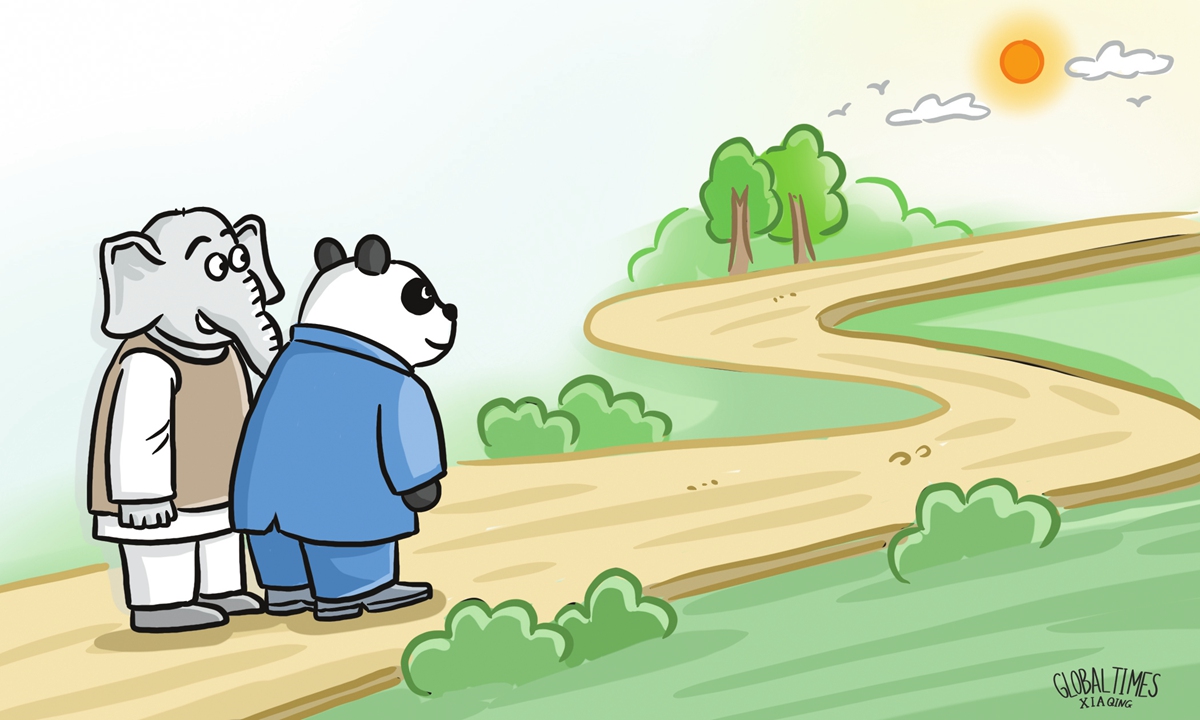
India and Indians don't need to spend hours trying to replicate China's model. That is neither possible nor advised. During one of the lectures I attended at the Renmin University of China, a professor said something that truly stuck with me: China does not give lessons; China shares its experiences. And it is high time we Indians learn from these experiences and make our own goals.
India and China are home to more than a third of humanity. Their futures are too consequential to be governed by insecurity, mockery or permanent rivalry. China's rise should not frighten India into defensiveness. It should challenge India into ambition.
The sooner we understand that, the better our future will be.
The author is the executive editor at EastMojo.com, a digital, independent multimedia news platform focusing on the Northeast of India. opinion@globaltimes.com.cn
RELATED ARTICLES