Exclusive: Naoero president, Chinese ambassador cycle island together passing China-supported projects, Chinese-run retail stores
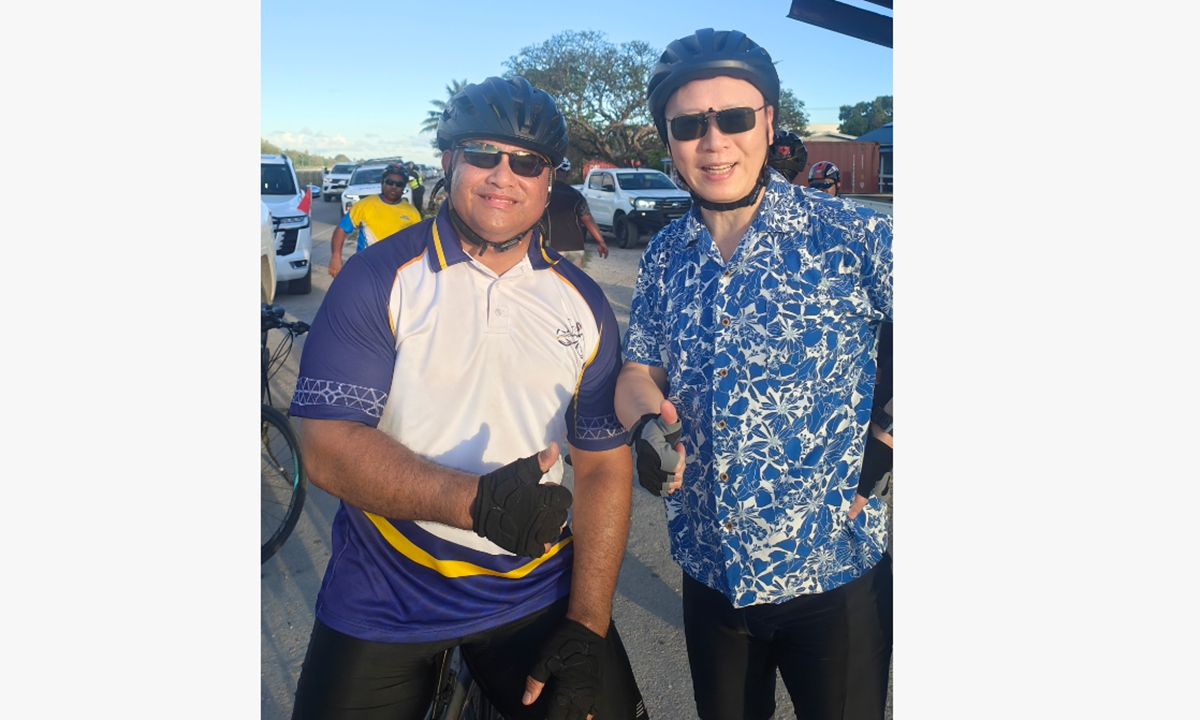
Naoero President David Adeang poses for a photo with Chinese Ambassador to Naoero Lü Jin. Photo: Courtesy of the Chinese Embassy in Naoero
The event offers an unusual glimpse into the close ties between China and the Pacific island country, the Chinese Embassy in Naoero told the Global Times in an exclusive interview, providing further details about the event and the broader cooperation between the two countries.
According to the embassy, Naoero's government has organized various public fitness activities in preparation for hosting the 2028 Micronesian Games, with the aim of improving public health. Whenever his schedule permits, Lü leads embassy diplomats in government-organized cycling events and fitness walks.
The embassy said the cycling route passed several China-supported projects, reflecting the expansion of practical cooperation since China and Naoero resumed diplomatic relations more than two years ago.
Solar-powered streetlights built with assistance from Jiangmen, South China's Guangdong Province, stand along both sides of the road. At Aiwo Port, where a terminal was constructed by China Harbour Engineering Co, a cargo ship provided by China to Naoero was unloading supplies critical to the island.
The Naoero Medical Centre has hosted free clinics provided by ophthalmologists from Sun Yat-sen University, doctors from Xi'an Hospital of Traditional Chinese Medicine and medical personnel from the Chinese PLA Navy hospital ship Silk Road Ark.
A China-aided sports center is also under construction in Naoero's inland highlands. Meanwhile, a hydroponic facility is supplying locally grown lettuce and Chinese cabbage to Naoero's households, helping diversify local dining tables.
As a partner in the Belt and Road Initiative (BRI), China supports Naoero in independently pursuing a development path suited to its national conditions, the embassy said. China has also expanded practical cooperation with Naoero in trade, investment and infrastructure, and provided assistance without political conditions to support the country's independent and sustainable development.
Over the past two years, policy coordination between the two countries has deepened, infrastructure connectivity has advanced, trade has gained momentum, financing channels have expanded and people-to-people exchanges have produced tangible results, according to the Chinese embassy.
The embassy also emphasized Naoero's firm adherence to the one-China principle. Naoero has repeatedly reaffirmed its support for the principle, while its Cabinet recently adopted a resolution requiring public officials to uphold and implement it, with strict rules governing their conduct related to the Taiwan region.
Chinese internet users also noted that Adeang and Lü visited a shop operated by overseas Chinese to buy cold drinks after completing the cycling event.
The embassy said shops operated by overseas Chinese account for more than 90 percent of Naoero's retail market and can be found across the island.
Overseas Chinese began arriving in Naoero more than a century ago and have since developed close ties with local communities. Adeang's maternal family traces its roots to migrants from Guangdong who moved to the South Seas in the 19th century.
In July 2025, Adeang traveled with his family to Jiangmen to trace his roots and pay respects to his ancestors, an event that further strengthened the historical and people-to-people connections between China and Naoero.
RELATED ARTICLES