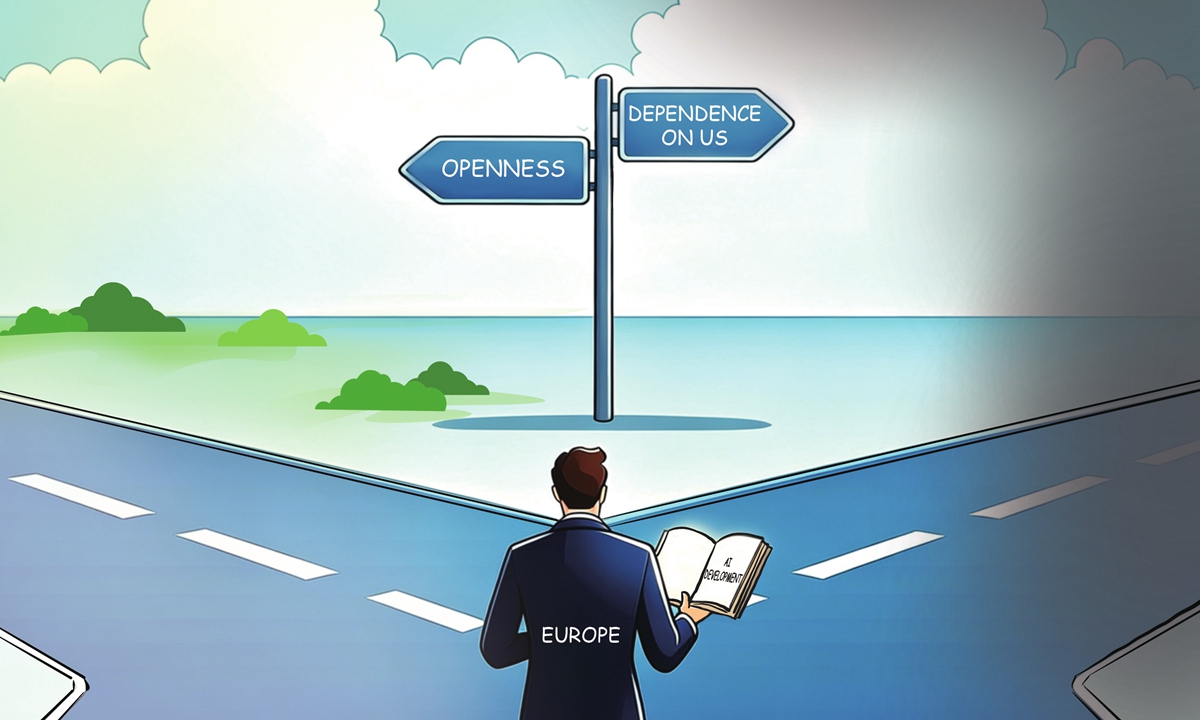
Illustration: Xia Qing/GT
In late July, the European Commission put money behind a phrase Brussels has used for years. It opened bidding for up to seven AI gigafactories, offering 10 billion euros ($11.5 billion) in public funding, hoping to mobilize 20 billion euros more, and specifying at least 100,000 advanced AI processors per site. This is the clearest evidence yet that Europe's AI "awakening moment" has arrived. But waking up and catching up are not the same thing.Europe is not starting from zero. The continent already has substantial strengths: leading universities, a vast single market, ASML at the center of the global semiconductor supply chain, and Mistral as a credible home-grown frontier AI lab. What Europe does not have is a stack it controls.
The ecosystem remains American-centered at almost every critical layer. The Commission's own accounting shows European providers' share of Europe's cloud market falling from 29 percent in 2017 to 15 percent by 2022, where it has stagnated; a report sent to the European Parliament in June listed the bloc's five largest cloud providers as all American.
That dependence is changing Europe's attitude toward American AI. European firms still want the scale and performance of US platforms, yet Brussels no longer treats them as politically neutral utilities. Across Europe, political and business leaders are increasingly alert to the risks created by excessive technological concentration, including supply-chain vulnerabilities, limited control over critical digital infrastructure and dependence on a small group of non-European providers for computing power and AI models.
In the face of the rise of American AI, Europe is asking whether access today could become leverage tomorrow. Technological and AI sovereignty should mean reducing single-source vulnerabilities and expanding Europe's choices, not pursuing isolation or complete self-sufficiency.
Can Europe escape the US-centered system? Not fully, and not soon. It can reduce excessive dependencies and raise its bargaining power. The objective should not be digital autarky but strategic optionality: the ability to operate and change suppliers without one foreign government or company being able to turn off the tap.
A significant part of optionality is openness rather than enclosure, and it is the part Brussels finds hardest. Open weights are the cheapest sovereignty instrument now on offer, and most of them come from China. Moonshot's Kimi K3, released in July at 2.8 trillion parameters, is the largest open-weight model anyone has shipped, and a sign that the frontier is no longer a closed American preserve. Its size drew attention; the fact that anyone can download it is what changes the argument. A model you have downloaded is not a service someone else operates. It runs on European hardware, under European law, inspected by European engineers, and no one abroad can revoke it. Set against renting an American application programming interface (API) on someone else's terms, that is the more sovereign arrangement, not the less.
Europe can enforce strict standards on data protection, cybersecurity and accountability while distinguishing between remotely operated services and model weights deployed in Europe. Yet the Cloud and AI Development Act proposed in June reaches into ownership and even staff nationality at its higher assurance levels, and adds a "Union added value" test to public tenders. Rules that turn on jurisdiction, contract and audit manage risk. Nationality-based exclusion merely replaces technological dependence with political isolation.
China remains sidelined in Europe's AI choices. Its experience in applying AI to electric vehicles, factory automation and logistics aligns more closely with Europe's industrial strengths than Silicon Valley's consumer-oriented model does. Joint pilots in non-sensitive sectors would expand Europe's options without weakening its autonomy. Leaving China off Europe's list of partners over the next decade would not make that list safer, only shorter.
Much of the sweeping "security risk" narrative around Chinese technology rests on assumptions with little bearing on the technical characteristics of particular products. Risks should be evaluated through evidence, testing and application-specific rules, not political labels.
If Europe excludes one major source of models, capital and industrial expertise while remaining structurally dependent on the other, it will have chosen a camp rather than achieved autonomy. Sovereignty is not isolation. It is the power to choose.
Yao Xu is an associate professor and Huang Kaiyue is a research assistant of the Center for Global AI Innovative Governance, Fudan University. opinion@globaltimes.com.cn
RELATED ARTICLES