Taiwan’s real crisis lies in living amid political theater and emotional mobilization: Hai Feng
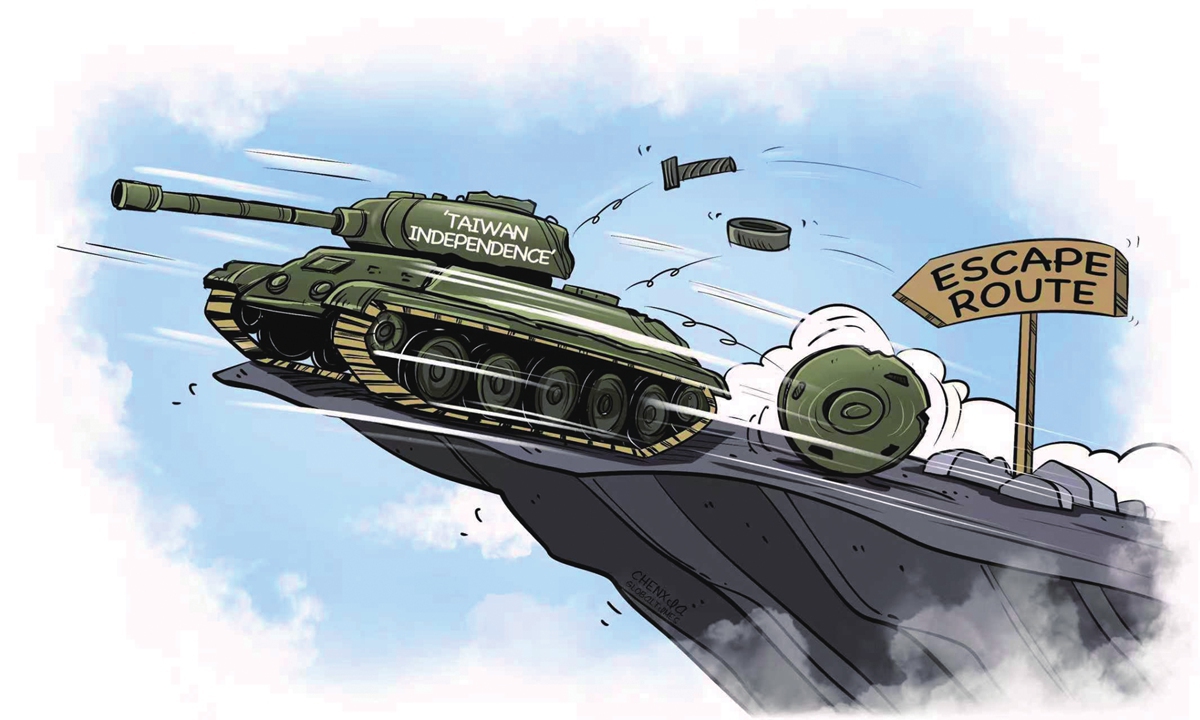
Illustration: Chen Xia/GT
Two news stories published on August 9 by Singapore's Lianhe Zaobao and the Taiwan island's China Times offer a glimpse into Taiwan region's current predicament.
One was about the Taiwan authorities' first-ever inclusion of a so-called "internet shutdown" drill in their Urban Resilience Exercises. 14 cities and counties on the island will be included to conduct a simulation of slowdown in mobile internet speeds on August 10 and 13 to test "how civilians would communicate if bandwidth became scarce." The other concerned the refusal of Taiwan's so-called "representative" in Japan to attend the Nagasaki Peace Memorial Ceremony after being seated outside the area designated for diplomatic delegations, claiming that Taiwan's status had been "downgraded," and using the incident to attack the mainland.
At first glance, one is an internal drill while the other is an external dispute, and they appear unrelated. But viewed together, they reveal an increasingly deep dilemma facing Taiwan region today. The Democratic Progressive Party (DPP) authorities have become increasingly accustomed to turning cross-Straits issues into political shows and transforming governance challenges into emotional mobilization.
Take the "internet shutdown" drill first. Many Taiwan residents interviewed appeared to be rather indifferent. Some did not even know the drill; some did not understand why network speeds needed to be restricted; others felt that half an hour "isn't a long time" and would have little impact. Some admitted they were unaware of the drill and said a louder alarm is needed.
This precisely shows the problem: The DPP authorities have issued too many alarms and repeated too many slogans. "Resilience," "preparedness" and "defense" have become constant talking points. Faced with repeated political messaging and media amplification, many residents have been left with only fatigue and numbness. Over time, drills have long since become mere formalities, alarms become background noise, and the so-called "whole-of-society defense resilience" remains confined to documents and political rhetoric.
For years, the DPP authorities have fueled cross-Straits confrontation and exaggerated tensions across the Taiwan Straits in an attempt to mobilize public sentiment around "resisting China and protecting Taiwan." Yet the reality is that calls for exchanges, peace and opposition to "Taiwan independence" separatist forces have continued to grow on the island. More and more people are recognizing who is creating confrontation, fueling tensions and increasing risks. Such drills have become little more than political performances — costly, socially unconcerned and unnecessary.
The seating dispute reveals an even deeper problem. The Taiwan authorities sensationalized the seating arrangements at the Nagasaki Peace Memorial Ceremony, framing them as an act that "downgraded its status" and "insulted its dignity," and subsequently escalated the matter into an unfounded accusation that the mainland was "suppressing Taiwan."
This exposes a deeply ingrained political reflex among Taiwan authorities: Whenever issues involving titles, seating arrangements or ceremonial treatment arise, especially those related to symbolic "dignity," they immediately enter a state of heightened emotional response. Whenever a sense of being "humiliated" can be created, it is quickly transformed into a resource for domestic political mobilization. This posture appears tough but is actually weak. The more vociferously the DPP authorities proclaim their "subjectivity," the more they expose their underlying anxiety.
Put these two stories together, and the logic becomes clear.
On one side is "security anxiety" — constantly trumpeting that risks are approaching and that preparation is urgently needed. On the other is "identity anxiety" — constantly propagating that dignity has been harmed and anger must be expressed. These two anxieties are becoming intertwined, shaping an increasingly distorted attention structure on the island: Issues involving communication vulnerabilities, infrastructure damage and society's capacity to withstand shocks receive growing public indifference, while issues such as seating arrangements, titles and symbolic treatment can instantly generate political outrage.
This is not the state of a mature society. If the DPP authorities remain trapped in "war imagination" and "dignity narratives," immersed in political performances and emotional mobilization while ignoring governance and development, the result will not be greater security or higher status. Instead, it will bring deeper internal friction, heavier anxiety and greater passivity.
True "social resilience" does not come from frequent alarms, symbolic drills or mobilization slogans. True "subjectivity" does not come from excessive sensitivity to seating arrangements, titles or ceremonial treatment.
At its core, the challenge facing Taiwan region today is not merely external pressure, but a distortion of internal perceptions and governance logic. What is a real problem and what is a political posture? What is a governance challenge and what is emotional mobilization? What is genuine preparation and what is merely superficial tension? These distinctions are becoming increasingly blurred.
A weakened signal is a technical problem caused by network interference. But if a society's ability to judge reality continues to weaken, the consequences will extend far beyond a mere perfunctory drill or a single seating dispute. They will gradually seep into its politics, governance, public discourse and collective psychology.
Therefore, what is more dangerous for the Taiwan region than an "internet shutdown" is losing sight of its governance challenges and cross-Straits realities amid repeated cycles of political theater and emotional mobilization.
RELATED ARTICLES