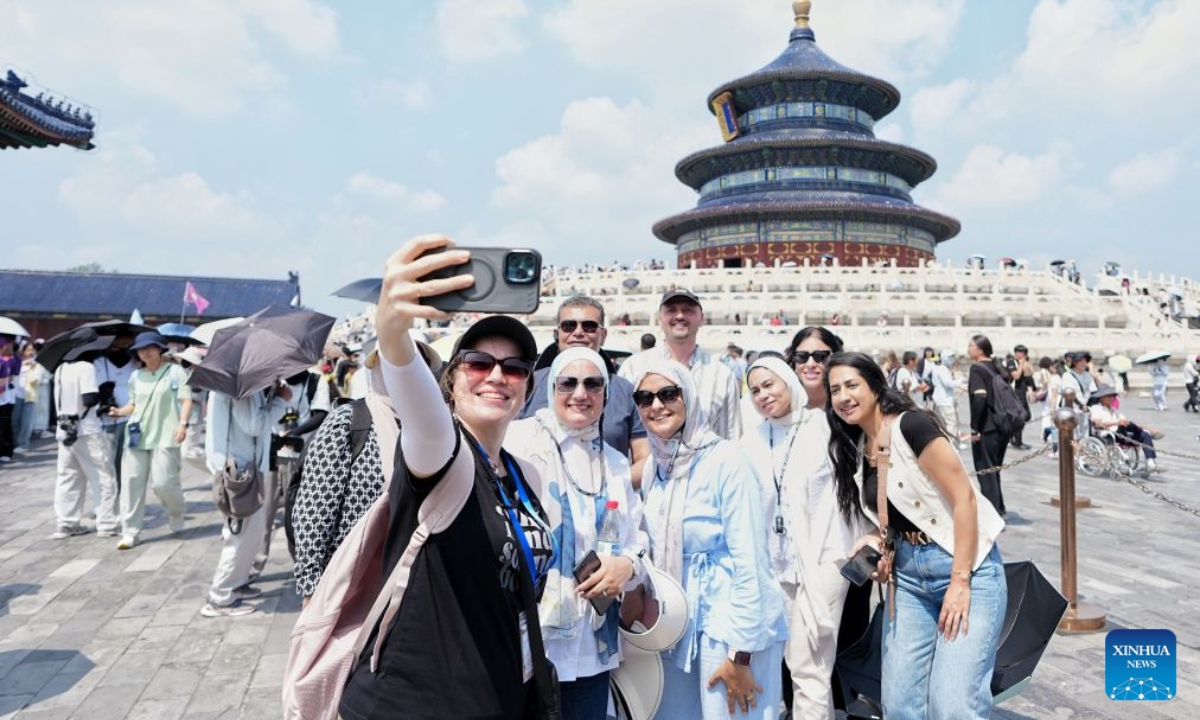
Tourists from Egypt take selfies in front of the Hall of Prayer for Good Harvests at the Temple of Heaven Park in Beijing, capital of China, July 28, 2026. Photo: Xinhua
In 18th-century Europe, China was in vogue. Aristocrats drank tea from Chinese porcelain, decorated their salons with lacquerware, filled their gardens with imagined pagodas and covered their walls with hand-painted Chinese wallpapers. This phenomenon, later known as chinoiserie, was not simply an artistic style; it was a cultural mirror. Europe looked at China and projected onto it luxury, refinement, order, mystery and distance. Today, a new online term - "Chinamaxxing" - suggests that the West is once again entering what social media users jokingly call a "very Chinese time," though under very different historical conditions.Both chinoiserie and Chinamaxxing reveal a Western fascination with China, characterized by a combination of admiration and fantasy. They also reflect the West's own anxieties as much as they do about China itself. Yet the differences are even more important.
Chinoiserie belonged to the age of empire, maritime trade and elite consumption. Chinese porcelain, silk and lacquerware entered Europe through long-distance trade from the early modern period, and by the 18th century, the Chinese aesthetics had become fashionable in Europe. However, this China was often not the real China. It was a decorative China, filtered through merchants, missionaries, imported objects, travel writing and European imagination.
Chinamaxxing, by contrast, belongs to the age of algorithms, short videos and direct digital encounters. Its carriers are not mainly aristocrats, merchants or court designers, but Gen Z users scrolling through TikTok, Instagram, YouTube and RedNote. The object of fascination is not only porcelain or wallpaper, but the living reality of contemporary China.
This marks a major shift. In the 18th century, Europe desired Chinese objects while remaining largely distant from Chinese people. In the age of Chinamaxxing, young Western users can interact directly with Chinese users, watch ordinary Chinese daily life in real time, and compare media narratives with personal digital experience. The distance has narrowed. China is no longer merely an exotic image placed on a cabinet or a teacup; it is a society whose speed, infrastructure and cultural confidence are visible on a smartphone screen.
Chinamaxxing did not appear in a vacuum; it reflects a generational search for alternatives. Many young people in the West face rising living costs, social fragmentation, urban insecurity, political fatigue and declining faith in their own institutions. When they see Chinese cities with fast trains, convenient payment systems, vibrant streets and visible technological progress, they are not merely romanticizing China; they are also questioning the failures of their own societies.
This is where Chinamaxxing differs from old chinoiserie. Chinoiserie admired China as a distant civilization of elegance, while Chinamaxxing often admires China as a functioning modern society. The former was about decorative fantasy; the latter is partly about developmental comparison. The former asked, "How can China beautify our rooms?" The latter asks, "Why does China seem to be building the future faster?"
This does not mean Chinamaxxing provides a complete or accurate understanding of China. However, it can break the monopoly of negative narratives that have long dominated Western coverage. For years, many Western audiences were encouraged to view China almost exclusively through the lens of threat. Chinamaxxing disrupts that frame by presenting China as interesting, attractive, and, in some ways, enviable.
In this sense, both chinoiserie and Chinamaxxing reveal a paradox in Western attitudes toward China. The West has often feared China while simultaneously desiring it. It has portrayed China as alien yet borrowed from it; criticized it as backward or threatening, yet admired its products, discipline, aesthetics and state capacity. The "Chinese dream" in Western imagination has repeatedly resurfaced because China offers something the West feels it lacks. However, China today is not a silent object of Western interpretation. It has its own voice, platforms, industries, cultural producers and global audiences.
From chinoiserie to Chinamaxxing, the West has rediscovered China more than once. The first rediscovery turned China into an ornament. The second may yet become something more meaningful: a recognition that modernity does not have only one author, one path or one center. If Chinamaxxing encourages even a small number of young people to see China directly rather than through ideological fog, it will be more than an internet joke. It will signify that the global cultural conversation is becoming more plural, more curious and, perhaps, more of an equal exchange between civilizations.
The author is a professor in the School of Journalism and Communication at Chongqing University. opinion@globaltimes.com.cn
RELATED ARTICLES