Illustration: Liu Rui/GT
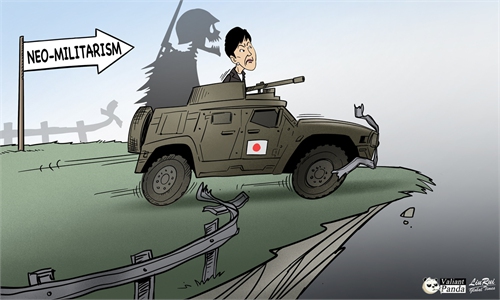
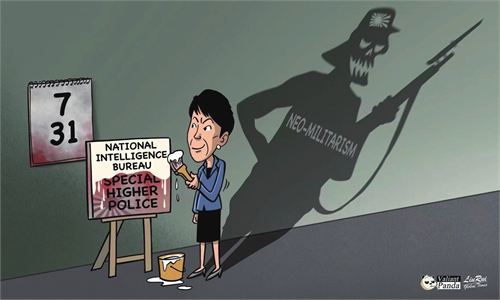
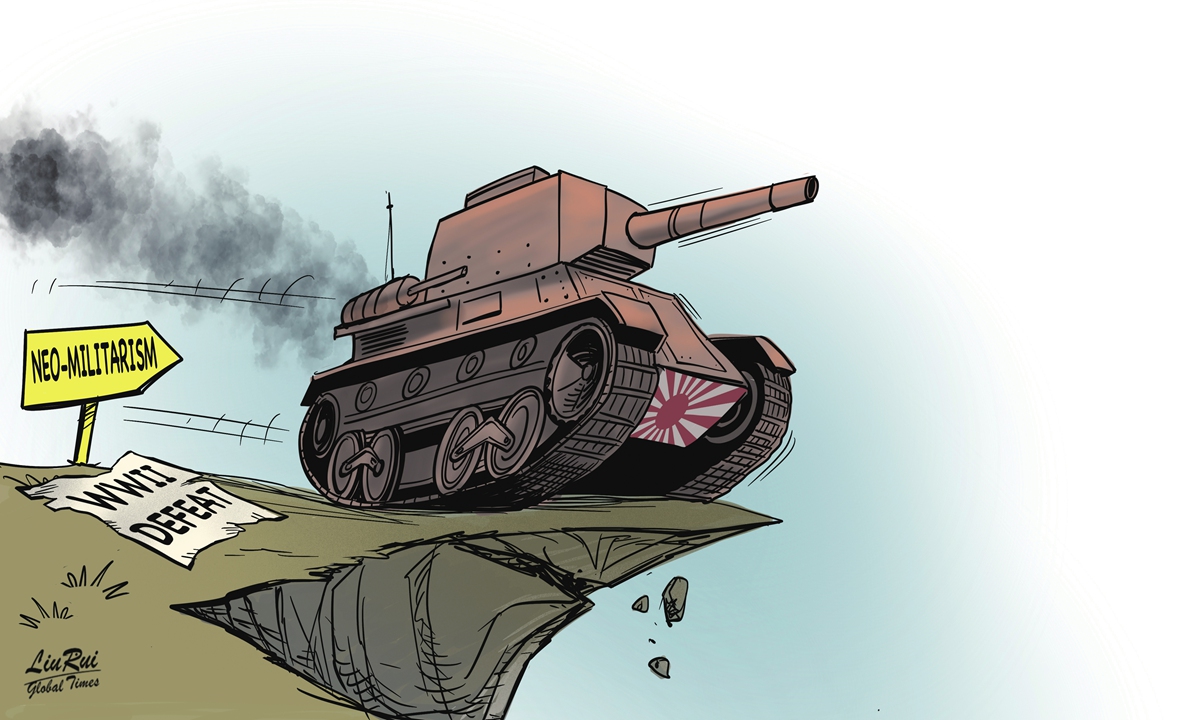
Editor's Note:On Saturday, the 81st anniversary of Japan's unconditional surrender in WWII, several key cabinet members in the Japanese government, including Defense Minister Shinjiro Koizumi, and a group of the ruling Liberal Democratic Party's senior officials visited the notorious Yasukuni Shrine, while Prime Minister Sanae Takaichi sent a ritual offering. These moves offer a stark manifestation of the accelerating neo-militarism driving Tokyo's current security shift under the Takaichi administration. Against this backdrop, Atsushi Kouketsu (Kouketsu), a professor emeritus at Yamaguchi University in Japan, dissects in an interview with Global Times (GT) reporter Zhang Ao how this dangerous trajectory, under the revival of the Yasukuni ideology, is eroding Japan's pacifist architecture and stoking security risks across East Asia.
GT: August 15 is a vital reminder to uphold the post-WWII peace order. As Japan's history education and security policies shift, how does failing to transmit factual accounts of WWII erode the country's domestic foundations for peace? What irreversible security costs could this impose on East Asia?
Kouketsu: German writer Ralph Giordano argued in his book The Second Guilt: On the Burden of Being German that acts of historical denial, distortion, falsification and fabrication are inexcusable. He emphasized that even generations born after the war bear grave moral responsibility for such historical wrongdoing. In Japan, politically driven efforts to block the transmission of facts about its wars of aggression have repeatedly occurred throughout history. This leads to the rampant prevalence of political actions that fail to learn from history.
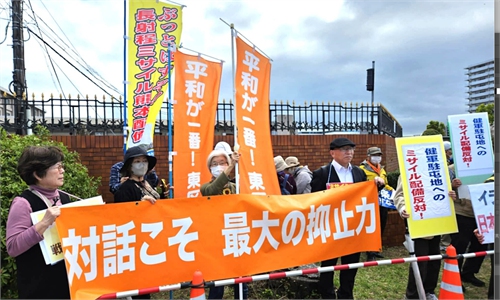
Japanese society retains vivid memories of its victimhood from the Hiroshima and Nagasaki bombings, yet many refuse to squarely confront our history as an aggressor. This very attitude constitutes a major factor behind the current resurgence of militarist undercurrents. The political sphere is marked by lofty rhetorical commitments to peace alongside a host of practical moves widely seen as wartime preparations.
In my view, a Japan behaving in this manner cannot win trust and respect as a peace‑loving country from Asian nations and the wider international community. Should this trajectory continue, irreversible consequences may ensue. There is no doubt that Japan's security policy is sailing into dangerous waters.
GT: You have observed that "the Yasukuni ideology, which is at the core of today's new militaristic ideology," is undergoing a revival in Japan. In your view, how does this ideological shift reshape public understanding of Japan's wartime aggression?
Kouketsu: The Yasukuni Shrine is an institution that promotes a fallacious historical narrative framing Japan's war of aggression as just "holy wars." It instills among Japanese and colonial subjects who perished in those aggressive conflicts that sacrificing one's life for the Japanese emperor is an honor. Many Japanese people once considered this something to be grateful for, and even today, some still hold this view.
Japanese politicians are employing a strategy to mobilize people who hold this Yasukuni ideology into the political arena, and thereby rally them to participate in war. That explains why they deliberately pay visits to the Yasukuni Shrine as a political gesture.
GT: Amid Japan's sluggish economy and falling approval ratings for the Takaichi administration, how do you interpret the government's policy choice to channel massive resources into armaments rather than people-centered livelihood priorities?
Kouketsu: The Takaichi administration is pushing hard to ramp up defense spending. It has yet to identify stable funding sources for such increases. It may intend to cover the outlays by issuing government bonds, yet this will only further swell Japan's central government debt, which already stands at more than 1,340 trillion yen ($8.5 trillion).
The current temporary consumption‑tax measures will likely compound the shortfall in fiscal resources. Living standards are set to deteriorate further. Even with joint Japan‑US currency intervention, the trend of a weak yen paired with a rising stock market is unlikely to be reversed.
Even so, the Takaichi administration is pressing ahead with military expansion. One primary driver may be its attempt to lift Japan's economy out of stagnation by building arms production into a leading sector of the national economy. Prewar Japanese militarism gathered strength against the backdrop of the "military-financial collusion," meaning the fusion between the military establishment and the zaibatsu conglomerates. A comparable dynamic may be unfolding today.
GT: How do you view Japan's current slide toward neo-militarism and its fundamental departure from the "peace-loving nation" identity it embraced after the war?
Kouketsu: The primary reason why present-day Japan finds itself accused of sliding toward neo‑militarism is its total failure to draw a full reckoning with its wartime defeat. At the time of Japan's defeat, the emperor - the supreme commander of the military that waged wars of aggression - together with the imperial system, came to be preserved. This was determined within the framework of the US initial post-surrender policy for Japan.
Washington sought to exploit the imperial system to uphold its hegemony in Asia. The crux is that Japan's prewar power‑holders seized the opportunity to align themselves with this US policy calculus, enabling prewar power structures to persist into the postwar era. After the war, the symbol‑status imperial system merged with entrenched anti‑communist legacies carried over from prewar times to become the foundation of Japan's postwar conservative forces.
In that sense, the seeds of Japan's neo‑militarism have been inherited from its prewar past. Though it drapes itself in the trappings of pacifism on the surface, scratch beneath that veneer, and one finds that militarist ideas and institutional mechanisms have remained operational in Japan throughout the postwar era. It was Japan's postwar peace movements that kept Japanese militarism from coming to the fore, while the US served as its restraining force.
As the peace movement wanes, the US is seeking to resurrect Japan as a military power, projecting it squarely against China, and exploiting it as America's surrogate power in Asia. Politicians, mainstream media and public opinion that seek to leverage this US strategy to maintain their power have coalesced into a major force that underpins neo-militarism.
These elite‑fueled narratives are preying on social frustrations to erode Japan's postwar peace‑oriented consensus. Many Japanese, worried about the declining economy, low birthrate, aging population, scarce natural resources, and vanishing rural areas, are gradually losing their identity as citizens of a "peace-loving nation." Japan was once proud to be Asia's economic powerhouse. Now, it no longer holds that status. Therefore, some Japanese are desperately turning to militarism and Yasukuni‑centered narratives in an attempt to reclaim a sense of Japanese "pride."
GT: Japan's 2026 Defense White Paper released earlier this month stokes perceptions of "threats," openly pursues "counterstrike capabilities," prioritizes defense industry expansion, and paves the way for the Takaichi administration to revise its three key security documents before the end of this year. In your opinion, has Japan's "exclusively defense-oriented policy" been substantially hollowed out?
Kouketsu: Japan's 2026 Defense White Paper is replete with military jargon such as "new ways of warfare" and "sustained operational capability." Its overarching tone is set by a wartime mindset that could be summed up as "normalization of wartime" or the notion of a "perpetual battlefield." Ironically, it might well be called an "Offense White Paper" instead of a "Defense White Paper."
Tokyo aims to elevate its defense industry into a core domestic industry, and seeks to strengthen ties with its allies and quasi-allies via arms exports. These moves are intended to build a framework enabling joint combat operations should Japan embark on a war. Even so, the Japanese government and Ministry of Defense continue to assert that they adhere to the "exclusively defense‑oriented policy." In practice, however, Tokyo's new "counterstrike capabilities" are operationally indistinguishable from a preemptive strike strategy in all but name. Accordingly, the "exclusively defense-oriented policy" is not simply hollowed out in form; its core spirit has been effectively discarded amid Japan's security transformation.
RELATED ARTICLES