Illustration: Liu Rui/GT
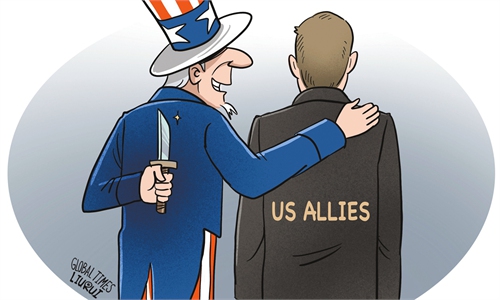
The US Under Secretary of War for Policy Elbridge Colby has just concluded his week-long tour of Southeast Asia, marking his first visit to the region with stops in the Philippines, Indonesia, Thailand and Cambodia. Colby's visit is intended to convey two main messages. First, he seeks to address concerns about a possible US strategic retrenchment from Asia, stressing that the US interests are "more engaged" in the region. Second, he is calling on regional partners to shoulder their share of the burden. Yet when viewed in light of the US own circumstances and interests, this "commitment" looks more like an illusory promise driven by self-interest - one that offers little to Southeast Asian countries while exposing them to greater risks.Washington's "commitment" looks less like a security guarantee and more like a strategic declaration - with a bill attached for regional countries to pay. The US is not seeking to leave Asia, but rather to maintain its regional influence at a lower cost - reducing the security costs it directly bears while asking allies to shoulder more responsibility and commit more resources.
This demand comes at a time when the US itself is facing growing strategic constraints. The US remains deeply involved in conflicts in the Middle East, with reports suggesting that Pentagon munitions stocks have fallen to "dangerously low" levels. To sustain its military strikes against Iran, Washington has repeatedly shifted military assets from the Pacific to the region, reportedly without consulting relevant Asia-Pacific allies. Against this backdrop, Colby's call for Asian allies to "do more" looks less like a confident power extending protection than a stretched power asking others to fill the gaps it can no longer cover.
Washington's security commitments are also increasingly inseparable from its own economic and strategic interests. Under an indiscriminate trade war, even traditional allies cannot secure exemptions simply by virtue of being allies; instead, they face tariffs and demands for greater investment in the US. America's security commitments and economic interests are no longer governed by two separate sets of logic.
Nor is Washington's call for regional countries to "do more" simply about helping them become more secure. Expanding US influence in the Asia-Pacific primarily serves Washington's own strategic objectives. The core objective of maintaining a US military presence in the region has not changed: containing China. As ideological offensives have produced limited results, trade wars backfired on the US itself, and its technological advantages have come under challenge, military means have become even more important. This is the broader context behind Washington's repeated emphasis on the "First Island Chain," its strengthening of regional military deployments, and even discussions of possible use of tactical nuclear weapons options.
The question is: Does this agenda serve the security interests of Southeast Asian countries? It is important to recognize that most Southeast Asian countries do not face an imminent external military threat. For most of them, economic growth, employment, inflation, energy security and people's livelihoods remain far more pressing priorities. At the same time, increased military spending often means more weapons purchases, with US defense contractors potentially becoming the biggest beneficiaries.
In this way, Washington's "security commitment" could become a formula in which Southeast Asian countries shoulder more costs while the US reaps greater strategic and commercial benefits. More importantly, turning the region into another arena for intensified great-power competition risks making Southeast Asia less secure, increasing the likelihood that regional countries will be drawn into confrontations that do not serve their own interests.
That is the real meaning behind Colby's "gift" to Southeast Asia: US attention comes and goes with its own interests and strategic priorities. Ultimately, Washington's supposedly steadfast "commitment" to the Asia-Pacific serves US interests first. When it needs allies, it speaks of "shared security"; when it wants others to share the costs, it asks them to "do more." So how will Southeast Asian countries respond to such a gift? A recent Politico report noted that Colby's Southeast Asia pitch "falls flat" and does not "land well" in the region. That should come as little surprise. It is little wonder that Southeast Asian countries, many of which have long pursued strategic autonomy, may be less than enthusiastic about buying into it.
The author is vice president of Shanghai Institute for International Studies. opinion@globaltimes.com.cn
RELATED ARTICLES