Who is deliberately narrowing the window of opportunity for peace across the Taiwan Straits?: Hai Feng
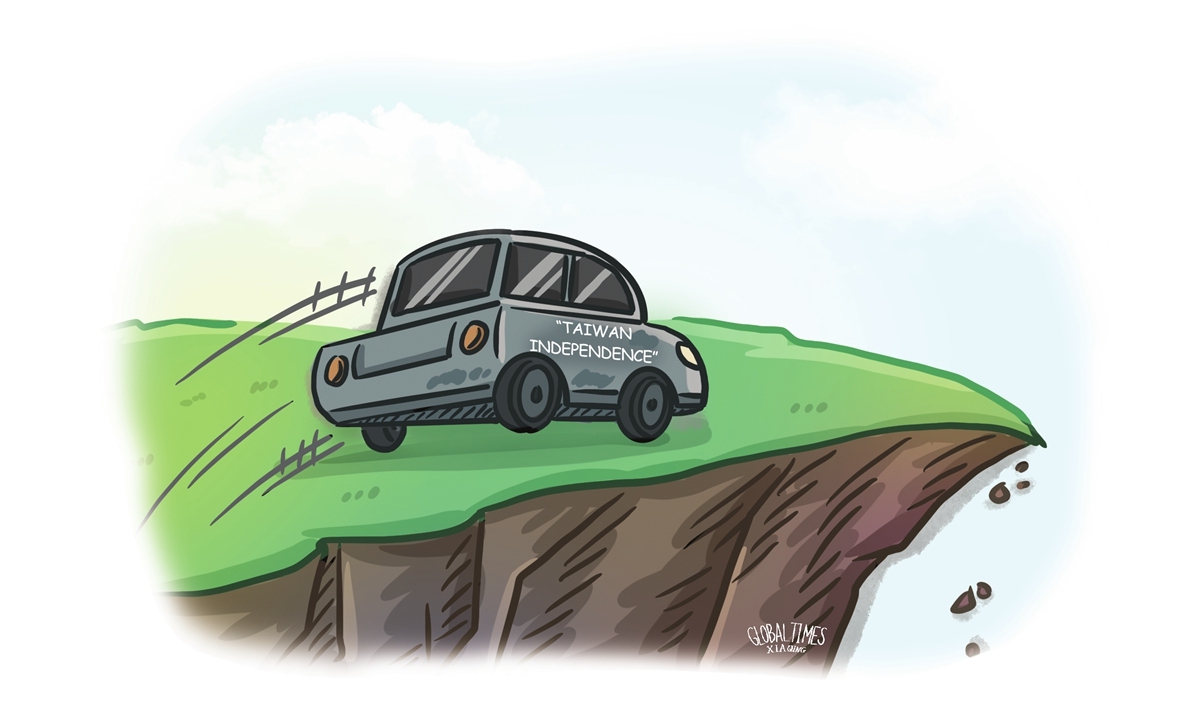
Illustration: Xia Qing/GT
The Taiwan question is the most complex in the world. It is inextricably linked to the historical destiny and the great cause of rejuvenation of the Chinese nation, China's national reunification, peace and stability in the Asia-Pacific region, and the broader context of the strategic rivalry between China and the US. If this question is not handled properly, it could push China and the US to the brink of conflict, triggering geopolitical upheavals with incalculable consequences. For this reason, it is time for Taiwan society to come to its senses.
For a long time, some people on the island were accustomed to treating "maintaining the status quo" as a "talisman" they can rely on indefinitely - as if, as long as they do not formally declare "de jure Taiwan independence," continue to navigate the gray zone, and align with external forces without completely "tipping over the table," they could drag things out endlessly, wear down the cross‑Straits situation, and maintain a prolonged stalemate. In the past, such an assessment may have created a certain illusion, but today's reality is that reunification is an integral part of the overall process of national rejuvenation - a practical question that cannot be evaded, delayed, or left unanswered.
General Secretary of the Communist Party of China Central Committee Xi Jinping's important speech at the ceremony commemorating the centenary of the birth of late Chinese leader Jiang Zemin attracted widespread attention because it conveyed a clear and solemn strategic signal: The reunification of the motherland is a historical task that must be accomplished as the Chinese nation marches toward great rejuvenation. Without reunification, rejuvenation will not be complete.
The old logic of "indefinite delay" no longer applies to the Taiwan question today. Many outside observers have keenly sensed this shift, yet some political forces on the island have yet to truly come to their senses.
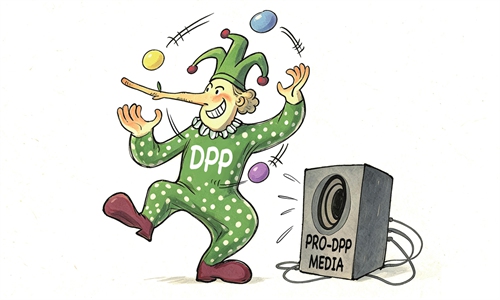
The Democratic Progressive Party's (DPP) political course in recent years, to put it bluntly, has been one of "pursuing independence without formally declaring it" and "advancing under a false guise." While claiming there is no "Taiwan independence" agenda, its pro‑independence party charter remains intact; while professing to "maintain the status quo," it is in fact constantly advancing "de-Sinicization" through cultural severance, historical revisionism, educational indoctrination, and identity reshaping; while claiming to cherish peace, it actually continues to incite "resisting the mainland and protecting Taiwan," thereby escalating cross-Straits tensions.
It is not that the DPP has taken no action; rather, its actions are more covert, gradual, and institutionalized. Through a "salami-slicing" approach, it creeps bit by bit toward the red line in an attempt to achieve its goal of gradual "Taiwan independence."
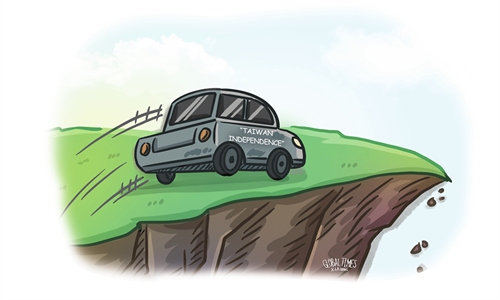
The DPP authorities' "Taiwan independence" agenda is leading Taiwan society into a dangerous situation. On the one hand, it deliberately severs the emotional and cognitive ties between Taiwan and the Chinese mainland's history, Chinese culture, and the Chinese national community; on the other hand, it constantly exaggerates external support and instills a narrative of confrontation, leading the public in Taiwan to mistakenly believe that "as long as they side with the US, they can rest easy." This dual misdirection is a major source of the current escalation of risks across the Taiwan Straits.
As the DPP authorities continue to stir up confrontation, create a tense atmosphere, and undermine mutual trust, the window of opportunity for peace across the Taiwan Straits is being deliberately narrowed. Behind this, four political forces are colluding and fanning the flames.
The first category consists of forces that feed their governance on "anti‑China" rhetoric. They excel at stoking anxiety, amplifying fear, and fostering hostility. Whenever election season arrives, they recycle narratives of "peril to the nation," "infiltration theories," and "election interference theories" to play out their political scripts for electoral mobilization.
The cause of the DPP's recent fabrication of the "CPC election interference" rumor lies in the fact that some people are accustomed to grasping at straws and fabricating stories. By relying on "mysterious intelligence," they package issues in the Taiwan Straits as weapons for electoral games, frantically hyping them up, manipulating public opinion, and boosting their electoral prospects. Such tactics may stimulate voter sentiment in the short term, but in the long run, they will only erode rationality, amplify divisions, and exacerbate risks, narrowing the space for easing tensions across the Taiwan Straits.
The second category consists of forces treating "de-Sinicization" as a long-term project. They attempt to sever the cultural ties between the two sides of the Straits, weaken Chinese identity, and reinforce the so-called "Taiwan subjectivity" by altering textbooks, rewriting history, and distorting perceptions - thereby reshaping the fundamental spiritual structure of Taiwan society.
On the surface, this approach appears to be about "education" and "culture," but in essence, it is dismantling the social foundation for peaceful development across the Straits at the level of identity. The reason peaceful reunification remains a possibility is due to the enduring connections of bloodlines, culture, history, and emotions. Once these connections are maliciously severed, the social foundation for a peaceful resolution of the Taiwan question will be eroded.
The third category consists of forces that deliberately obstruct normal cross-Straits exchanges. They stigmatize and penalize all normal contacts related to the Chinese mainland, attempting to create a "chilling effect" to completely sever cross-Straits ties. For instance, Tsang You-hsia, a "retired major general" from the Taiwan region, was severely punished - including a significant suspension of his monthly pension and the revocation of his medals and honors - simply for standing up for the national anthem of the People's Republic of China while attending an event in Hong Kong.
Under the ever-intensifying "green terror," cross-Straits exchanges and interactions have been politicized and manipulated, with issues blown out of proportion to serve as a pretext for "uniting the like and attacking the different." Once cross-Straits exchanges, cultural interactions, expressions of sentiment, and historical identity can all be turned into "evidence of guilt," the bridge for peaceful cross-Straits exchanges will be dismantled, inevitably narrowing the window for peaceful reunification.
The fourth factor is external forces that blatantly interfere in the Taiwan question. Represented by certain US politicians, some external forces treat Taiwan as a pawn in their strategy of "using Taiwan to contain China." Consequently, they sometimes issue vague "promises," sometimes push for arms sales or introduce legislation, and sometimes engage in high-level contacts - all with the intent of eroding the political foundation of the one-China principle, while also misleading certain people on the island to believe that "relying on the US to pursue independence" is a viable path.
The problem, however, is that the starting point of the US' policy toward the Taiwan region has never been the well-being of the people in Taiwan, but rather its own interests. The US is unwilling to foot the bill for "Taiwan independence" and will absolutely never allow the Taiwan question to truly affect America's national destiny. If those on the island fail to see through this, they will ultimately become pawns that can be traded, sacrificed, or exploited at any time.
The reason the window of opportunity for peace across the Taiwan Straits is narrowing today is that "Taiwan independence" separatist forces on the island and external interfering forces are deliberately working toward this outcome. The Chinese mainland has consistently exercised the utmost sincerity and made the greatest efforts to pursue the prospect of peaceful reunification. However, "Taiwan independence" separatist forces and external interfering forces are joining forces to push cross-Straits relations from a state where "there is still room for dialogue" to one where "dialogue is becoming increasingly difficult"; from a state where "there is still a buffer zone" to one where "there is little room for maneuver"; and from a state where "conditions for peace are still being built up" to one where "conditions for peace are being continuously eroded." What is most absurd - and most alarming - is that those who create these risks are, in turn, portraying themselves as "guardians of peace" and "defenders of democracy."
Today, Taiwan society as a whole must recognize a fundamental fact: No single political party in Taiwan can monopolize the right to interpret the Taiwan question, and no electoral rhetoric can forever obscure the inevitable trend toward the reunification of the motherland. Reunification must be achieved, and peace is the optimal path. But peace is by no means a hollow slogan devoid of bottom lines, deadlines, or conditions. Those who truly cherish peace should strive to rebuild mutual trust, oppose the incremental "Taiwan independence" agenda, oppose the use of fear to mobilize votes, and above all, oppose tying Taiwan to the chariot of external forces.
Amid the shifting global landscape, the most important thing is to recognize the prevailing trend. The prevailing trend today is that the process of reunification is becoming increasingly clearly embedded in the broader context of national rejuvenation. Any attempt to stall for time, resist reunification through external forces, or hijack the course of history with electoral logic and narratives will ultimately prove futile.
The past has not yet passed, and the future is already here. Political figures on the island must wake up once and for all: Face the inevitable trend of reunification head-on, cherish the opportunity for peace, abandon their erroneous course, and work together to bring cross-Straits relations back on track and advance peaceful reunification.
RELATED ARTICLES