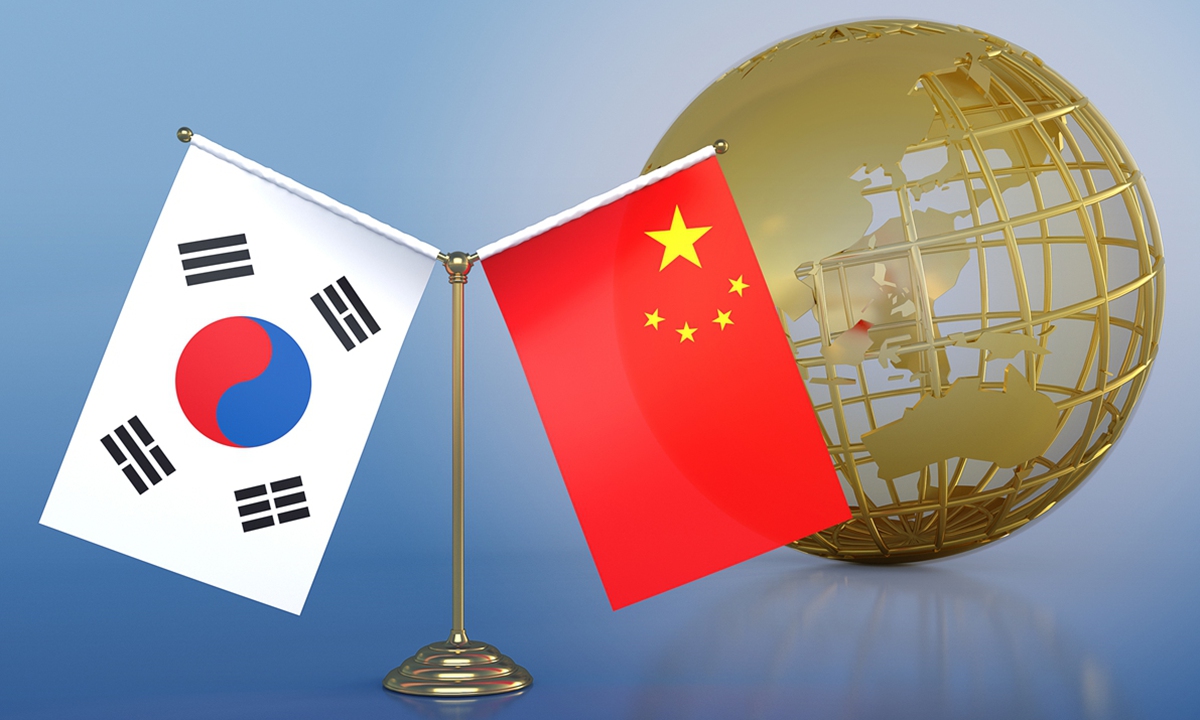
China South Korea Photo:VCG
Chinese Foreign Minister Wang Yi is on a visit to South Korea from Wednesday to Thursday. This is Wang's first visit to the country in around five years as well as a significant high-level overseas visit by a senior Chinese diplomat since South Korean President Lee Jae-myung's visit to China in January.Various indications suggest that, under the strategic guidance of the two heads of state, China-South Korea relations are gradually emerging from the trough experienced during the Yoon Suk-yeol administration. The relationship is beginning to recover and is about to return to the right track.
Lee's approval rating has recently seen a trend of falling, posing a serious challenge to his room to maneuver in governing for the remainder of his term. Taking effective steps to further improve China-South Korea relations is undoubtedly one of the best options for helping the administration overcome its difficulties.
In the political and security spheres, stable and developing China-South Korea relations would help South Korea pursue a more effective, pragmatic and proactive foreign policy as a middle power. Seeking greater strategic alignment with China would enable South Korea to play a more important role in international and regional affairs. At the same time, it would help reduce the risk of confrontation among Northeast Asian countries and contribute to building a stable security cooperation framework in Northeast Asia.
In the economic sphere, China is one of South Korea's most important trading partners. Stable demand in the Chinese market, which accounts for around 22 percent of South Korea's exports, is one of the key factors sustaining this strength.
At present, the two countries are actively advancing the second phase of negotiations on their Free Trade Agreement, with a focus on expanding cooperation in services, investment and finance. There remains considerable room for new areas of cooperation and growth in China-South Korea economic and trade relations.
During Wang's visit, the two sides are expected to further implement the consensus reached by the two heads of state and establish a regular mechanism for high-level exchanges. They may also reach agreements on regular high-level communication, management of crises on the Korean Peninsula, and economic, trade and people-to-people exchanges. The two sides are likely to reaffirm respect for each other's core interests, manage sensitive issues and disputes, and prevent differences from escalating or spilling over into other areas.
Looking ahead, the two sides are also expected to establish more platforms for economic, trade and industrial dialogue, facilitate people-to-people exchanges, and expand tourism and cultural exchanges.
Of course, difficulties remain in the development of bilateral relations.
There is a gap in the two countries' security perceptions. At present, although the Lee administration attaches importance to relations with China, it is difficult for it to make major adjustments to its existing policy toward the US. The Lee administration has proposed a "pragmatic, national-interest-centered diplomacy," seeking to strengthen the US-South Korea alliance while expanding cooperation with China. Whether South Korea can achieve this goal will test the political wisdom of its government.
Furthermore, there are both real and potential economic frictions between China and South Korea. As China's technological capabilities have advanced, industrial competition between the two countries has intensified in recent years. In particular, China and South Korea have shifted from complementarity toward competition in areas such as new energy, semiconductors and electric vehicles. The two sides are also engaged in strategic competition over supply-chain issues. As the US continues to pressure South Korea in the name of "de-risking" industrial supply chains and establish a "small yard, high fence" to keep China out, China-South Korea cooperation has been affected by the impact of security concerns.
In addition, people-to-people exchanges between China and South Korea currently lag behind official diplomatic relations, which also need to be gradually improved.
Overall, the trend toward easing tensions in China-South Korea relations is increasingly evident. Both sides need to move toward each other and avoid allowing geopolitical factors to interfere with the broader interests of bilateral relations.
A stable and robust bilateral relationship serves the interests of both countries. At the same time, its significance extends beyond bilateral ties, providing a sustained driving force for security, stability and development in Northeast Asia.
The author is an assistant research fellow of the National Institute of International Strategy, Chinese Academy of Social Sciences. opinion@globaltimes.com.cn
RELATED ARTICLES