With their clumsy fabrications, the DPP and its green media are less credible than a 3-year-old: Hai Feng
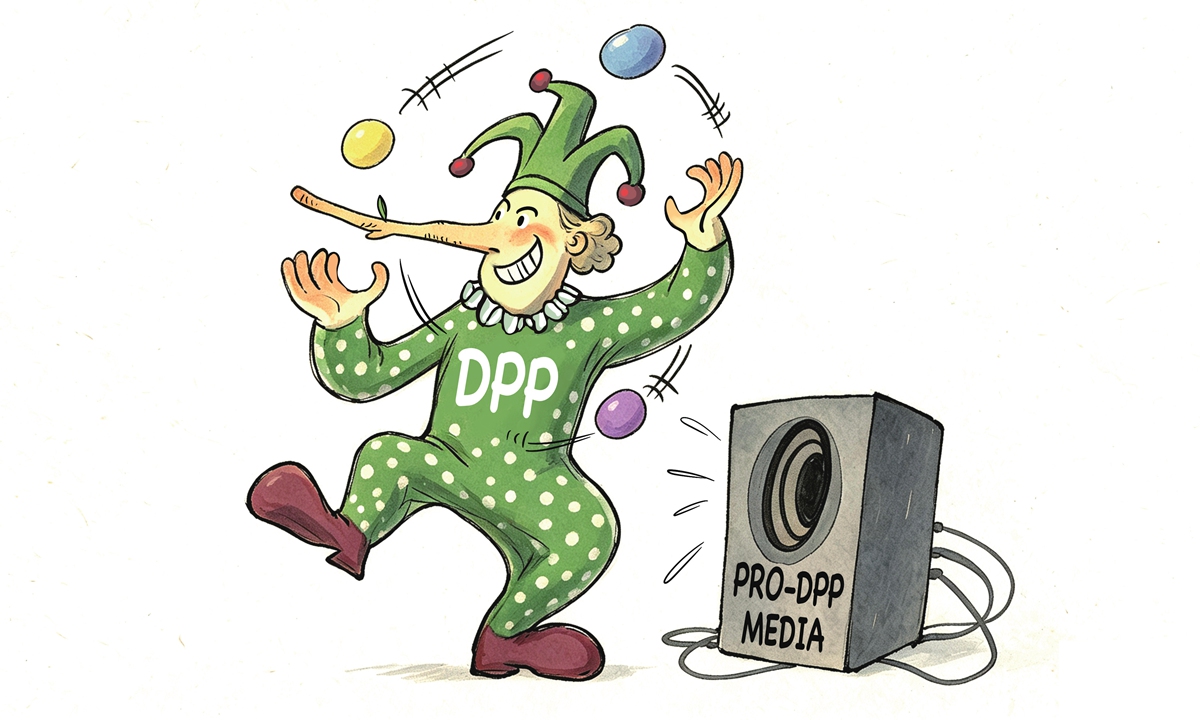
Clumsy fabrications of DPP Illustration: Liu Rui/GT
After Lai Ching-te floated the so-called claim of "CPC interference in the election," a highly ironic scene unfolded in Taiwan's public discourse: On one hand, the Democratic Progressive Party (DPP) authorities and pro-green media packaged so-called "anonymous sources" as major "national security warnings"; on the other hand, when faced with external inquiries, they could neither produce evidence nor provide an explanation, but instead lashed out at the media outlets that raised questions. The DPP authorities' furious reaction reveals their intent to exploit the "national security" issue to cover up their own election-related anxieties.Regarding the upcoming "nine-in-one" local elections in the Taiwan region at the end of the year, Lai Ching-te theatrically fabricated a supposedly "well‑detailed" set of "four secret directives from the CPC": opposing Taiwan's passage of a defense budget, strengthening so-called "substantive governance" over the Taiwan region, bolstering a "fifth column," and demanding support for the election of so-called "patriotic Chinese forces." He even went so far as to claim that the DPP's electoral success or failure would serve as "an indicator of whether Beijing's strategy toward Taiwan has succeeded."
Since the claims are so specific, surely some evidence should be presented? Yet none exists. The source of Lai Ching-te's claims is rumors leaked by so-called anonymous "national security officials," while the various narratives subsequently amplified by the DPP continue to originate from so-called "officials familiar with cross-Straits affairs." Pro-DPP media outlets are responsible for leaking the rumors, politicians take up the baton, and ultimately, an unverified claim is elevated to the level of a "major national security threat."
Anyone who raises doubts is labeled; anyone who asks follow-up questions is accused of "whitewashing"; and anyone who refuses to join in spreading panic may be branded an accomplice in "cognitive warfare." Anonymous leaks, media hype, politicians passing the baton, and public pressure - a "political rumor-mongering" assembly line is laid bare for all to see.
The DPP has actually gone so far as to suspect that China Times and United Daily News received the same "directives" or "script" simply because both newspapers simultaneously refuted the lie about "secret directives from the CPC." This line of reasoning is absurd, almost laughable. Faced with the two major media outlets reaching similar conclusions over the same far‑fetched episode, the DPP authorities, instead of reflecting on whether their own claims are riddled with holes, have resorted to suspecting everyone else of being "moles." This is not debate - it is bad‑faith posturing; not confidence, but sheer insecurity.
What is even more noteworthy is that Taiwan island's "Mainland Affairs Council" spokesperson Liang Wen-chieh stated that "even a 3-year-old knows" which side the Chinese mainland will support and which it will target in Taiwan's local elections. If that is the case, why did Lai Ching-te go to such great lengths to dredge up these so-called "secret directives"? The reason is simple: because the common sense that "even a 3-year-old knows" can no longer deliver electoral shock value; only by twisting ordinary cross-Straits political risks into mysterious and inscrutable "secret directives" can they rapidly stoke anxiety among their supporters.
This demonstrates once again that what the DPP truly intends to peddle is not facts, but fear. General claims of "Chinese mainland interference in elections" can no longer explain why the DPP faces tightening electoral prospects in Kaohsiung; why its candidate Lai Jui‑lung holds virtually no advantage in polling; nor can they cover up the DPP authorities' failures on food safety, people's livelihoods, and governance.
Kaohsiung has long been regarded as a "solid stronghold" for the green camp, yet reports now indicate a dead heat between the blue and green camps and a narrowing of the green camp's lead. Instead of addressing why voters are dissatisfied or answering what exactly is wrong with local governance, Lai Ching-te is rushing to elevate a local election to the front lines of cross-Straits confrontation. At its core, this maneuver boils down to ideological blackmail: reframing its own governing pressures as "Taiwan's security" rhetoric.
At the same time, the issues that truly concern the people of Taiwan - and the real problems that Taiwan's society should be addressing - have instead been pushed to the sidelines by the authorities, whether intentionally or unintentionally.
The "toxic oil" incident involved edible oil containing carcinogens above the legal limit, affecting downstream businesses, the food service industry, and even school meal programs. The public is concerned about whether the distribution channels of the tainted products were disclosed on time, whether the regulatory authorities were derelict in their duties, and why food safety safeguards failed.
Faced with these concrete and pressing questions regarding people's livelihoods, the DPP has failed to provide a convincing explanation; instead, it has been particularly eager to fabricate so-called "secret directives from the CPC."
Take the "Cash for Everyone" initiative of the universal cash handout of 10,000 New Taiwan dollars. This is yet another classic case of "the DPP can do it, but others can't." When the KMT‑TPP camp floated similar proposals in the past, the DPP slammed them as "unnecessary" and questioned their "constitutionality"; now that they are proposing it themselves, they frame it as a "people-friendly measure" representing an "AI dividend shared by all."
Yesterday they said it was unnecessary; today they say it's imperative. Shouldn't they first explain why their stance has changed? If they don't even have to address such contradictions - and can simply get away with it by shouting a few more slogans about "resisting China and defending Taiwan" -is there any sense of responsibility left in Taiwan under DPP rule?
When the election campaign isn't going well, they blame the CPC; when polls are unfavorable, they call them fake; when the media criticizes them, they claim it's a "cognitive war"; when the people demand accountability for governance, they deflect by citing external threats. This is precisely the election playbook the DPP knows best.
However, truly responsible policymakers do not rely on anonymous officials leaking information, pro-DPP media hyping the narrative, or labeling dissenters to suppress dissent. Instead, they should present the evidence openly and let the public judge for themselves - rather than, when the public raises questions, slapping them with the baseless label of "whitewashing for Beijing."
The more the DPP and green media evade the issue of evidence regarding "secret directives from the CPC," and the more eagerly they attack those who raise questions, the more they prove they lack confidence. Continuing to spread rumors will not turn lies into facts; continuing to level baseless accusations will not make the loopholes disappear on their own. Even a 3-year-old understands: Hearsay is not evidence, suspicion is not fact, and making up stories cannot replace governance. Yet the DPP and green media fail to grasp this - they are truly less credible than a 3-year-old.
RELATED ARTICLES