Illustration: Xia Qing/GT
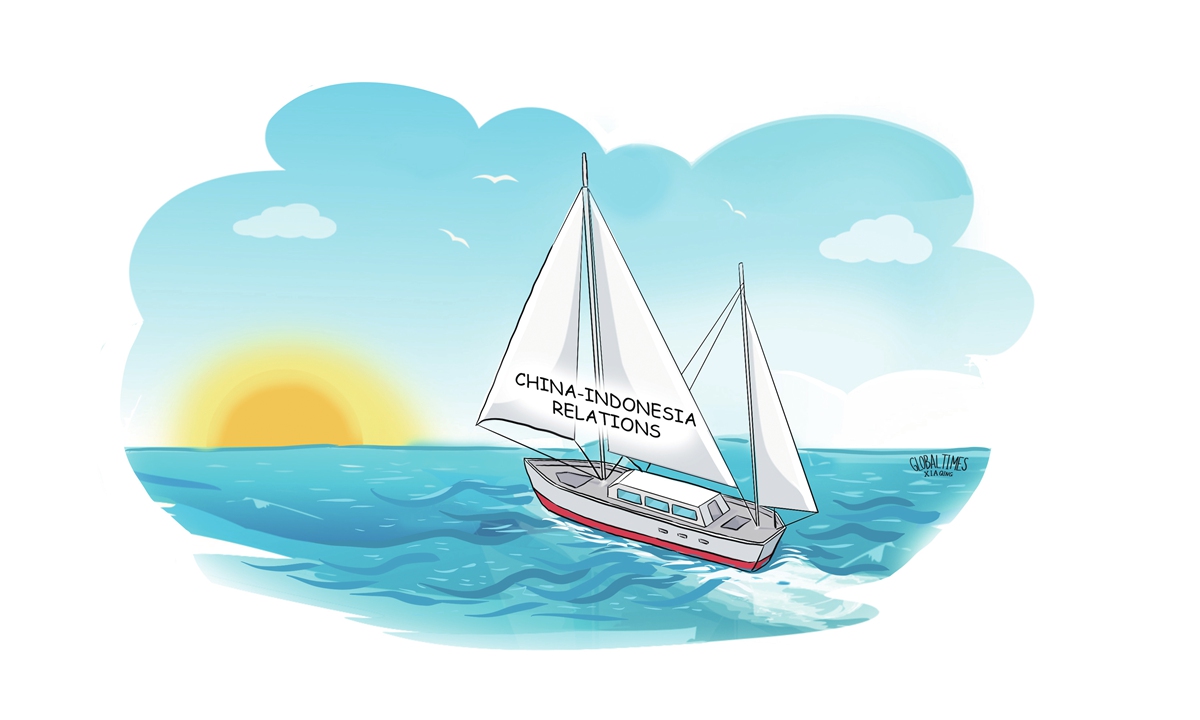
The Second Ministerial Meeting of China-Indonesia Joint Foreign and Defense Ministerial Dialogue was held in Jakarta on Friday. Chinese Foreign Minister Wang Yi and Defense Minister Dong Jun co-chaired the meeting with Indonesian Foreign Minister Sugiono and Defense Minister Sjafrie Sjamsoeddin.The visit of Wang and Dong marked a major step forward in institutionalizing and strategically deepening the comprehensive strategic partnership between China and Indonesia, injecting strong momentum into the future development of bilateral relations.
During the visit, the two sides agreed to launch the formulation of the China-Indonesia Five-Year Action Plan (2027-31), advance cooperation across the "five pillars," namely politics, economy, people-to-people and cultural exchanges, maritime affairs and security, and jointly build a comprehensive, open and green partnership in energy and mineral resources.
Taken together, the visit marked an unprecedented increase in the level of institutionalization in China-Indonesia relations, establishing an all-round framework for strategic communication spanning politics, economy, security and defense, while further deepening political and security mutual trust. At the same time, the focus of bilateral cooperation is expanding beyond infrastructure, trade and investment into emerging and frontier areas such as artificial intelligence, cybersecurity and green energy.
During the visit, both sides repeatedly emphasized their shared identities as major developing countries and important members of the Global South, clearly demonstrating the global outlook and strategic vision underpinning China-Indonesia relations. Through concrete actions, China and Indonesia are turning the strategic consensus reached by their heads of state into tangible outcomes and making positive contributions to regional peace, stability and prosperity, with the aim of setting an example of solidarity, self-reliance and mutually beneficial cooperation among the countries of the Global South.
The positive momentum in China-Indonesia relations has inevitably raised the sensitivities of certain powers outside the region, triggering strategic anxiety and deliberate smears in the US and the West. Recently, some Western media outlets have seized on the recent naval navigation exercise conducted by Chinese and Indonesian navies in waters east of the Taiwan island, hyping it up, and commenting that it had "raised neutrality concerns" and questioned if Indonesia has strayed away from its non-aligned foreign policy.
The Indonesian Navy has publicly stated that the exercise was a "universal naval tradition," noting that Indonesian naval vessels have conducted similar exercises with the US and Japanese navies. Nevertheless, Western commentators have continued to take issue with Indonesia's decision. The Australian Strategic Policy Institute, a think tank, even published an article claiming that Indonesia's participation in the exercise was a "judgement failure."
However, on the Taiwan question, the Prabowo Subianto administration's position is unequivocal. Indonesia fully recognizes the importance of safeguarding national unity and territorial integrity, and is fully aware of the political significance of the waters where the China-Indonesia naval exercise was held. Through its participation in the joint exercise with China, Indonesia sent an unambiguous message: Separatist activities advocating "Taiwan independence" seriously undermine regional peace and stability and run counter to Indonesia's national interests and foreign policy.
Indonesia's participation was therefore not a departure from its non-aligned diplomatic tradition, nor was it a case of being "dragged into geopolitical conflict." Guided by the historical wisdom of non-alignment, Indonesia was actively choosing to shape an external environment more conducive to its own interests.
Shortly after the exercise, at the Second Ministerial Meeting of China-Indonesia Joint Foreign and Defense Ministerial Dialogue, Indonesia once again reaffirmed its "firm commitment to the one-China policy" and "opposition to external interference," while reaching new agreements with China on deepening defense cooperation. This shows that Indonesia's recent moves stem from deeper strategic planning. The joint naval exercise conducted by China and Indonesia in mid-August was a concrete manifestation of this strategic planning and a prominent indication that China-Indonesia relations continue to move forward at a higher level. It was by no means an isolated or accidental event.
During his meeting with Wang Yi, Indonesian President Prabowo said that Indonesia "looks forward to deepening all-round strategic cooperation with China" and "opposes any ill-intentioned instigation and hype." His remarks were, in effect, an implicit rebuttal to the smears and sensationalism coming from Western media, while clearly expressing Indonesia's position.
It can be expected that, with this visit as a new starting point, China-Indonesia relations will move forward by filtering out external interference and noise, translating the strategic consensus reached by the two heads of state into more tangible outcomes, and steadfastly building a higher-level China-Indonesia community with a shared future.
The author is an associate research fellow at the Department for Asia-Pacific Studies of China Institute of International Studies. opinion@globaltimes.com.cn
RELATED ARTICLES