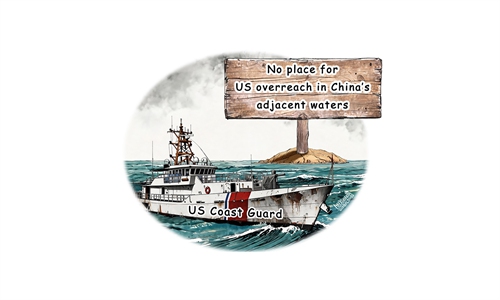
Illustration: Xia Qing/GT
Recently, the Asia Maritime Transparency Initiative (AMTI) published a report entitled "As Tokyo and Manila Talk Boundaries, Beijing Breaks Them." The report is not merely a straightforward assessment of the developments surrounding the maritime delimitation process launched by Japan and the Philippines in late May 2026. Rather, it seeks to establish a deeper narrative framework in global maritime discourse. At its core, that framework portrays Japan-Philippines bilateral delimitation as a "normal practice" consistent with international practice, while characterizing China's responsive measures to safeguard its rights and interests as "unlawful disruption" of the rights of other states. AMTI thereby seeks to furnish a legal rationale for Japan and the Philippines to bypass third party unilaterally and alter the status quo in the waters east of Taiwan region.
The most conspicuous problem with the AMTI report is not its policy preference for Japan and the Philippines or its criticism of China. It is that the report presents three propositions that lack sufficient legal and evidentiary grounding as established facts: Because the relevant Japanese and Philippine land territories lie less than 400 nautical miles apart, there is a bilateral overlap that the two countries are free to delimit between themselves; because a bilateral agreement does not bind third party, it cannot legally affect third-party claims; and because Chinese government vessels increased their activities after the Japan-Philippines negotiations were announced, at least some of those activities were "unlawful" and may have constituted a rehearsal for blockade.
Each inference skips a necessary intermediate step. An overlap in distance does not necessarily entail an overlap of legal entitlements; the absence of binding force is not the absence of spatial consequences; and temporal sequence is not proof of causation or intent. Through its title, AMTI combines these three leaps into a stigmatizing narrative directed at Beijing: Tokyo and Manila are "lawfully" negotiating a boundary, while Beijing is cast as the "disruptor."
A closer examination reveals at least three problems: an oversimplification of geographic distance, a conflation of standing to negotiate with legal authority to delimit and a one-sided interpretation of the relative effect of legal instruments.
AMTI's proposition that the third party possesses no general veto is legally shortsighted. In the complex setting of overlapping maritime entitlements, the legal effect of a bilateral agreement vis-à-vis third party is constrained by the need to respect maritime areas in which third-party rights may subsist.
The report's credibility is further weakened by errors in its treatment of basic sources of international law and by its characterization of the factual record surrounding leading judicial precedents.
In international legal scholarship, accurate citation is not a matter of ornament. It is part of the evidentiary foundation on which legal argument rests. Errors concerning basic legal sources and important cases therefore matter, particularly when those sources are being invoked to support a broader claim about the rights of third party.
AMTI conflates distinct rules into a general assurance that third party will remain "unaffected," treating that assurance as a shield for an unrestricted Japanese-Philippine "freedom to negotiate." This appeal to the absence of binding force conceals serious externalities.
At the same time, the delimitation talks were announced alongside negotiations on an agreement to protect classified military information. Then, the Japanese and Philippine defense ministers agreed to continue discussions with a view to transferring Abukuma-class destroyers promptly after their decommissioning.
AMTI mentions these accompanying defense initiatives, yet does not ask what their simultaneous announcement implies for the strategic character of the delimitation process. If AMTI's own practice of drawing strategic inferences from temporal and operational context is applied consistently, Japan and the Philippines should face the same inquiry: Does this convergence warrant scrutiny through the lens of securitization? More specifically, is maritime delimitation being transformed into a form of strategic deployment that prefigures a spatial boundary for subsequent exclusionary maritime-security cooperation, intervention in the Taiwan question and interference in China's internal affairs?
Against this background, the Japan-Philippines decision to commence formal negotiations on the delimitation of their "exclusive economic zones" and "continental shelves" cannot be understood merely as a technical legal matter between neighboring states. It forms part of a deeper reconfiguration of spatial order in the critical waters of the First Island Chain.
By invoking the United Nations Convention on the Law of the Sea and relevant international jurisprudence as the legal basis for the negotiations, the joint statement seeks to reinforce their legitimacy. Read together with the simultaneously announced security initiatives, however, the delimitation project and its underlying strategic purpose exhibit pronounced features of securitization.
This contrast exposes the central asymmetry in AMTI's analysis: It accords Japan and the Philippines a presumption of legality while subjecting China to the most adverse strategic interpretation. Yet the choice to launch delimitation negotiations at this particular juncture is itself strategically provocative and demands equivalent scrutiny. Its provocative character cannot be displaced by describing the initiative simply as "normal negotiations." In the multi-party undelimited waters of the western Pacific, using legal characterization as an instrument of political manipulation will only further damage the region's already fragile maritime order.
The author is associate research fellow of Center for Japanese Studies, Shanghai Jiao Tong University. opinion@globaltimes.com.cn
RELATED ARTICLES