A quite shift behind the China-India border talks: How US influence is fading in China-India relations
By Published: Aug 26, 2026 08:59 PM

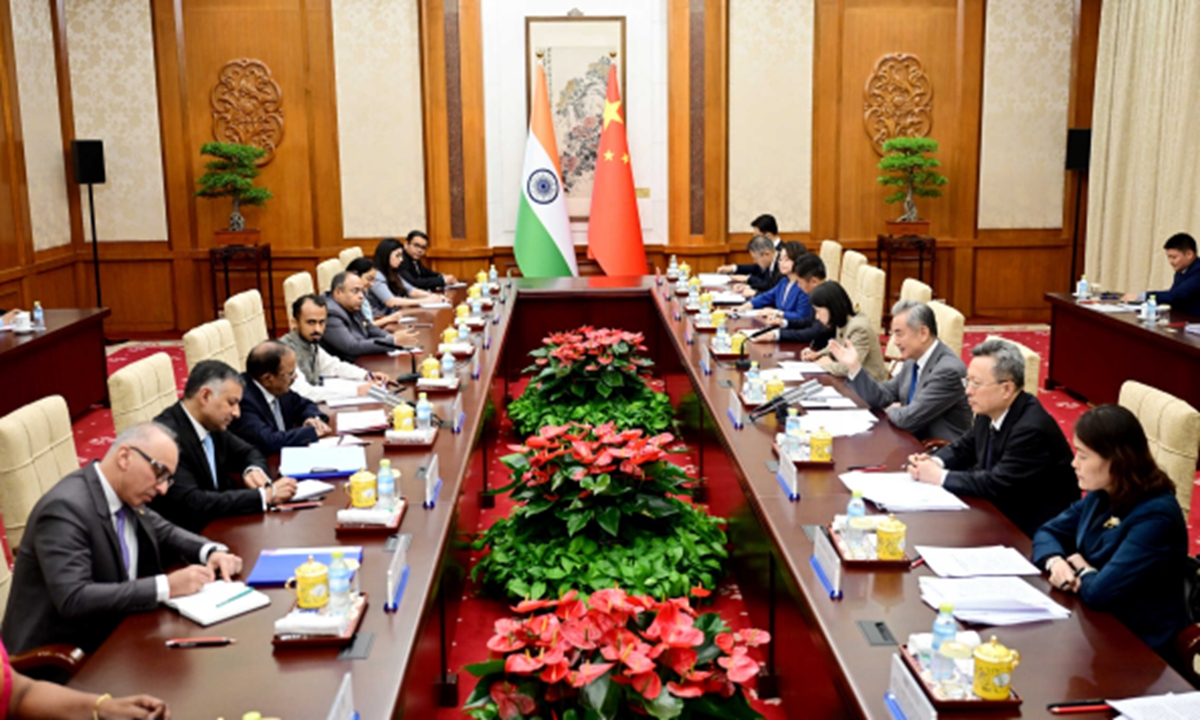
China and India held the 25th round of talks between the two countries' special representatives on the boundary question in Beijing on August 25, 2026. Photo: Chinese Foreign Ministry
A few years ago, I took part in a dialogue between Chinese and Indian media figures. The atmosphere in the room was cordial, with both sides speaking politely about "good neighborliness" and "the shared interests of major developing countries." However, deeper talks always hinted at the US, a silent third party. The Chinese side mentioned the "Indo-Pacific Strategy," while the Indian side spoke of "strategic autonomy." Both sides recognized that US influence shaped their relationship, a constant, unspoken presence.
This latest round of talks in Beijing - the 25th round between the two countries' special representatives on the boundary question - brought that dialogue to my my mind.
On the surface, the latest talks appeared to be routine business: Wang Yi, a member of the Political Bureau of the Communist Party of China Central Committee, director of the Office of the Central Commission for Foreign Affairs and China's Special Representative on the Boundary Question between China and India, and India's Special Representative and National Security Advisor Ajit Doval sat down to discuss the border and manage differences.
But when I place it on a longer timeline, I find that what is genuinely different this time is not what was said at the table - but the world outside that table, which has quietly taken on a new face.
The US-led order has subtly shaped China-India ties for a decade. India weighed US opinions on China's actions, while China assessed whether India's moves were influenced by its relations with the US.
The bilateral relationship, in other words, never truly existed on its own terms - it was always a function of that larger triangular structure.
However, in recent years, that once-solid reference point has begun to loosen. This shift is not the preference of any single US government; rather, it is a deeper, structural change: the transactional turn in American foreign strategy, the rise of protectionism, and an increasingly instrumental approach to allies and partners are altering global expectations about what the US can actually deliver.
India, in particular, has genuinely felt this shift over the past few years across various concrete issues - tariffs, energy procurement, and technology cooperation. The "special partnership" it once placed such hope in has not always translated into substantive consideration when real interests were at stake.
Once such an experience occurs, it cannot simply be erased; it becomes internalized as a longer-term strategic caution - one that means India, even as its relationship with Washington warms again, is unlikely to revert to the old posture of dependence.
This is precisely what I find most noteworthy about this round of special representatives' talks. What was actually discussed differs little from the past - still the same unresolved border questions, still the same disputes requiring deeper communication. But the overall atmosphere sustaining this dialogue, the political will both sides are now willing to invest and the parallel progress unfolding alongside it - such as the resumption of direct flights, the easing of visa restrictions, and the reopening of border trade - all reflect not some breakthrough in the China-India relationship itself, but a change in the underlying reference system by which both sides judge each other.
The "American factor" of years past still exists, but its weight and capacity to shape the bilateral relationship are no longer as pervasive or all-encompassing as they once were.
Of course, the genuinely thorny structural contradictions between the two countries - territorial disputes, geopolitical competition, and mutual strategic suspicion - will not dissolve simply because the external environment has changed. They will persist for the long term and will continue, from time to time, to generate friction.
But my point is this: The significance of this round of talks should not be measured only by "what was discussed." It should be judged by "what kind of world it took place in." The shadow of the US that lingered so palpably in that dialogue years ago is now growing fainter - not because of diplomatic efforts on either side, but because of a deeper adjustment now underway in the international order itself.
From here on, every dialogue and every round of talks between China and India will be redefined within a new, more enduring strategic environment. This, to me, is the most lasting impression left by this meeting, and it is what I, as a long-time observer, believe is truly worth recording.
The author is a senior editor with the People's Daily and currently a senior fellow with the Chongyang Institute for Financial Studies at Renmin University of China. dinggang@globaltimes.com.cn. Follow him on X @dinggangchina
RELATED ARTICLES