Illustration: Liu Rui/GT
Signed on August 30, 1951, the US-Philippines Mutual Defense Treaty will mark its 75th anniversary later this month. In recent years, the administration of Philippine President Ferdinand Marcos Jr has, under the banner of "military modernization," continuously expanded military cooperation with the US through a series of bilateral defense agreements centered on the treaty.
The frequency and scale of joint military exercises, the number and use of bases available to US forces, maritime patrols, and intelligence cooperation have all increased significantly. At the same time, the Marcos administration has treated the treaty as a "protective shield" for its hardline policy toward China and its efforts to stir tensions in the South China Sea. It has repeatedly sought explicit commitments from the US, attempting to use "joint defense" with Washington to safeguard Philippine national security and give itself the "confidence" to continue challenging China in the South China Sea. In reality, seeking "joint defense" with the US cannot deliver genuine national security resilience for the Philippines.
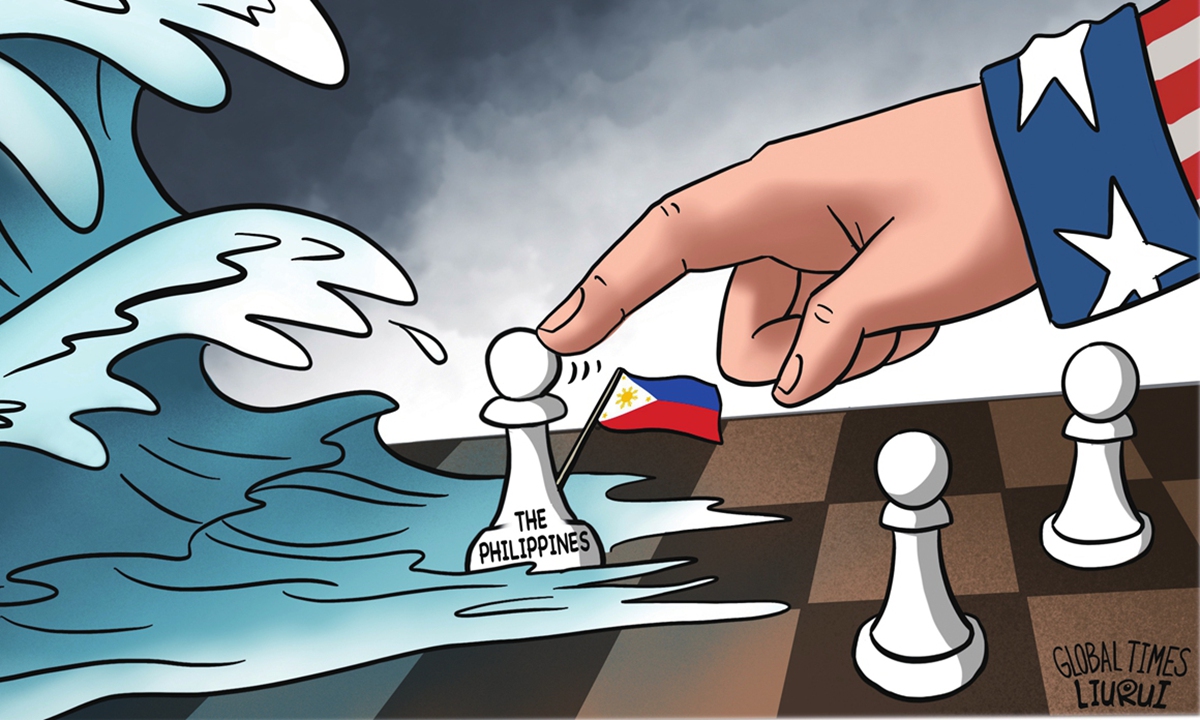
First, a "pawn" does not get real security. In its "joint defense" relationship with the US, the Philippines' asymmetric position reduces it to a "pawn" in Washington's regional strategy. The Philippines has traded territorial access for US security assurances on paper, while also facing US constraints in economic and diplomatic affairs and lacking meaningful strategic autonomy. The US is simply exploiting the Philippines' geographic position to strengthen its military presence in the South China Sea and around the Bashi Channel, while remaining behind the scenes and shifting as much of the strategic cost as possible onto others.
On August 10, US Under Secretary of War for Policy Elbridge Colby attended a think-tank meeting in Manila, the Philippines, saying "We are looking for partners, not protectorates." Under the new US National Defense Strategy, Washington is also calling on allies, including the Philippines, to take on a "greater share of the burden" of their collective defense. In other words, reduced to a "pawn," the Philippines is seeing its strategic autonomy eroding. Rather than building resilience for its own national security, it may ultimately pay the price of being a US "ally."
Second, the US "joint defense" commitment has amounted to little more than a "bad check" - a promise that looks good on paper but cannot be cashed when it counts. At present, Washington and Manila appear to be moving "in the same direction" in the South China Sea, with joint military exercises and patrols taking place with increasing frequency. Yet this alignment does not mean that the US is acting simply to support the Philippines on the South China Sea issue or to provide full backing for its provocations and risky actions. Fundamentally, it is driven by US regional strategy and interests. The South China Sea issue is no longer merely a dispute over territory and maritime rights and interests. It has become a highly strategic issue, a key platform for US efforts to counterbalance China and a focal point of China-US strategic competition. If Washington concludes that all-out confrontation with China in the South China Sea does not serve its regional strategy or national interests, or that the Philippines' excessive provocations and risky actions are damaging US strategic interests in the region, Manila will find that the "joint defense" pledge will not be honored - it may instead face criticism from the US ally.
Third, by deepening and upgrading its "joint defense" relationship with the US, the Philippines remains trapped in a strategic mindset and conception of national security of Cold War. That is why the Philippines still cannot find a viable path to safeguarding its national security in the 21st century. Today, the trend of globalization remains unstoppable, while deepening regional cooperation has become a priority for China and the overwhelming majority of ASEAN countries. The Philippines should actively participate in this process. Yet, constrained by its alliance with the US in its economic and external relations, the Philippines has developed a deep dependence on the US economy even as it maintains trade and economic ties with countries in the region, becoming a forward platform for the US to compete with China economically and expand its regional influence.
At the same time, the Philippines should be a common guardian of regional security. But constrained by US regional strategy in the strategic, security and diplomatic spheres, the Philippines has, in essence, become increasingly unable to fulfill its role as a member of the ASEAN Political-Security Community, while its commitment to jointly safeguarding regional security with other regional countries has become largely superficial.
As this year's ASEAN rotating chair, the Philippines has chosen "Navigating Our Future, Together" as its theme for the year. However, until the Philippines determines which matters more - its role as a US ally or its role as a member of ASEAN - this annual theme is little more than an empty slogan. Nor can it enable the Philippines to work with regional countries to build resilience in regional security.
The South China Sea issue should never become a tool for the Philippines to seek security commitments from the US. Stability in the South China Sea concerns the common well-being of the countries in the region. Managing differences and resolving disputes in the region require equal dialogue, not bloc confrontation. The Philippines' national security should rest on an independent foreign policy and strategic autonomy, rather than "joint defense" with the US.
The author is Director of the China-ASEAN Maritime Security Research Center at Guangxi Minzu University. opinion@globaltimes.com.cn
RELATED ARTICLES