The disaster on China-Nepal border is a stark warning that Earth’s cryosphere is coming loose: Hai Feng
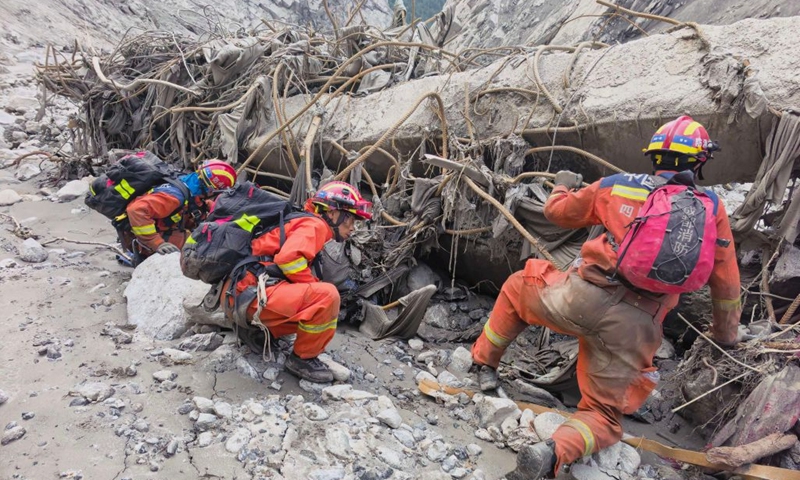
Rescuers carry out search and rescue operations at the mudslide-hit area in Gyirong County, southwest China's Xizang Autonomous Region, Aug. 29, 2026.
Almost overnight, the China-Nepal border became the heaviest place in Asia.
As of Sunday morning, the mudslide at the China-Nepal border on August 26 had killed 734 people, with 2,498 still missing. In Gyirong, Southwest China's Xizang Autonomous Region, the death toll stood at 16, with 546 missing.
In a disaster, numbers are never abstract. Behind every death is a family broken apart. Behind every missing person are people still waiting for news. Human fragility before nature has been laid bare.
But if this is read only as an ordinary mountain flood or mudslide, the real point would have been missed. What should alarm us is not only the scale of the damage, but where it began.
According to findings released by authorities in Xizang, on August 26, a glacier on the slope of Mount Langtang Lirung in Nepal fractured at an altitude of about 5,200 meters, triggering an ice-rock avalanche. After plunging from a high altitude, it scoured the mountainside, formed a massive debris flow and raced some 22 kilometers down the valley toward Gyirong Port. Over two-thirds of a square kilometer of the area was flattened, including 27 buildings and related facilities.
This was not a surface disaster set off by rain alone. It was a chain: glacier failure, ice-rock collapse, mountainside scouring, then a mudslide that grew as it ran. The disaster did not start at the foot of the mountain. It started when high ice came loose.
On August 29, Taiwan's China Times published a commentary, "Nepal's flash floods warn that Earth's cryosphere is collapsing," and made a sobering claim: The catastrophe on the China-Nepal border may not be a local freak event, but a warning that the planet's ice sphere is slipping into instability.
What does a 'loosening cryosphere' mean?
In the long sweep of Earth's climate change history, disasters on this scale from melting ice have happened before - over the past 18,000 years or so. Most came after the last ice age, in the thaw that carried the planet from cold into warmth. By about 6,000 years ago, glaciers in the high mountains and at high latitudes had, on the whole, steadied. That is why humans came to assume mountain ice might shrink, but slowly, and in ways we could see coming.
That assumption is breaking now. What happened on the southern rim of the Qinghai-Xizang Plateau was not an ordinary melt event. It was fracture, ice-rock avalanche and catastrophic runoff. Under continued global warming, some high-mountain frozen systems once considered as relatively stable may be nearing a new tipping point.
History has already left this lesson.
The Great Lakes of North America are themselves a vast leftover of the ice age. About 14,000 years ago, as the climate warmed and ice wasted away, meltwater poured south and reworked the continent's river systems. About 12,000 years ago the northern ice lakes lurched again. An ice dam failed, a huge pulse of freshwater entered the North Atlantic, changed the density of seawater, disrupted deep-ocean circulation and helped bring on the Younger Dryas cold reversal.
The American West's Dry Falls and "channeled scabland" record an even more violent kind of disaster. About 15,000 years ago, ice dams on Glacial Lake Missoula failed again and again - 40 to 80 outburst floods in some 2,000 years. Peak discharges ran several times the combined flow of all the world's rivers today. The land was gouged; boulders were carried far onto the plains. They still lie there, like a prehistoric alarm left on the surface.
These stories sound distant, but they point to the same fact: When the planet enters a warming path, the cryosphere does not retreat gently or evenly. At certain nodes it can fail suddenly, and set off chain disasters humanity cannot survive.
The China-Nepal border disaster shows a harsh reality. The thin balance between natural activities such as high glaciers, frozen ground, slope stability, extreme weather and human activity is giving way.
We used to think disaster still stood a little apart from modern life; that roads, buildings and warning systems would take the blow; that "climate change" meant heat, drought, rain and typhoons. This time the disaster started deep in the ice, fell from the high peaks, tore down the valleys and left a port in ruins. Warming is not only a rising number on a thermometer. The planet's frozen systems are loosening, and with them the structure of mountains and rivers is being rewritten.
What should humans do?
First, admit that this is not one country's issue. It is a shared human risk. The Earth is not a pile of separate pieces; it is one linked whole. When high glaciers fail, the shock doesn't only affect nearby villages and travelers. It hits cross-border transport, regional water systems, ecological security and, more broadly, the order in which humans live.
Second, speed up a shared, cross-border system to watch and warn for high-mountain disasters. Glacier fracture, glacial-lake outburst and slope collapse are high-intensity chain events. One country, one agency, one discipline is no longer enough. Better remote sensing, linked data and joint rescue are what buy time.
More important still, humans have to look again at their relationship with the Earth. We cannot enjoy the spread of industrial civilization and pretend that glaciers, oceans, permafrost and forests are someone else's business. "The world shares the same cold and heat" is already a reality.
The mudslide on the China-Nepal border is not only the name of a disaster. It is a blow from nature against the chest of this age. When the cryosphere starts to loosen, mountains and rivers do not stay silent. When they speak, humanity has to learn to listen.
If this is treated only as a stroke of bad luck, and the planetary alarm behind it is ignored, then what is buried in the mud may not only be lives and homes. It may also be humanity's last remaining luck.
RELATED ARTICLES