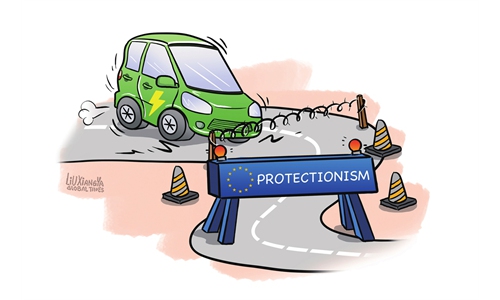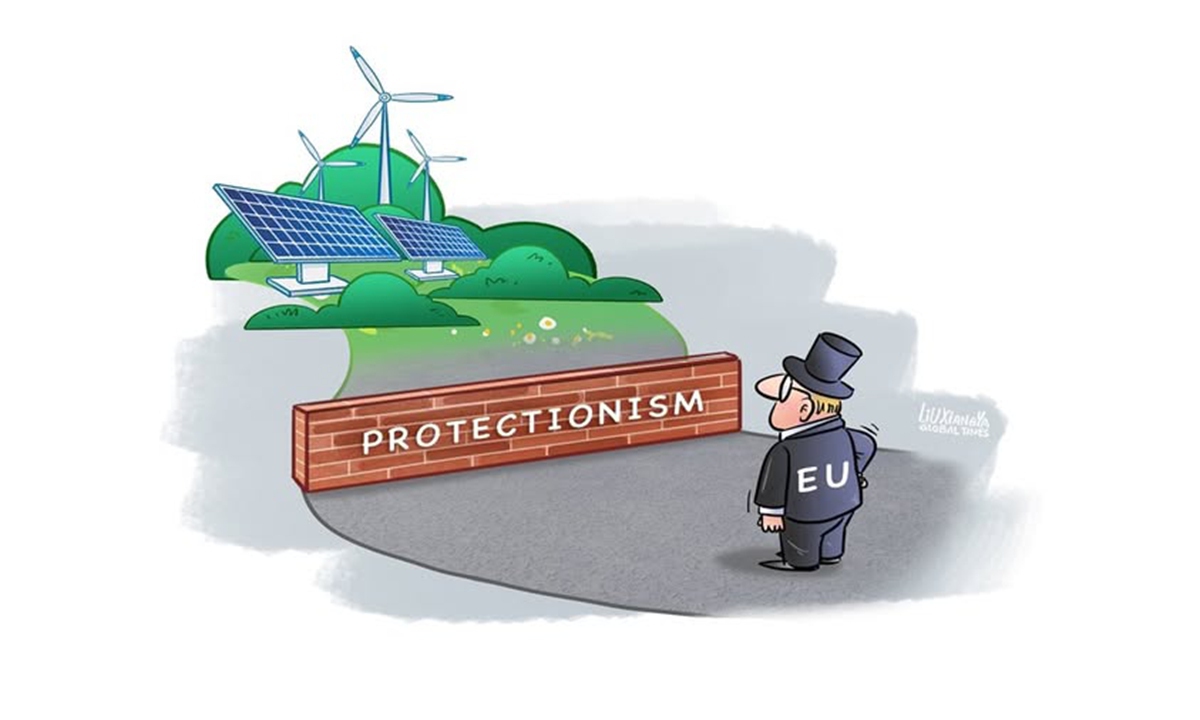
EU protectionism. Illustration: Liu Xiangya/GT
At a critical juncture when the EU is considering a new round of trade policy toward China, with the possibility of further tariff escalation, voices from within Europe are beginning to challenge Brussels' increasingly hardline narrative. Siemens CEO Roland Busch recently told European media that he opposes blanket EU tariffs against China. Earlier, Slovakian Prime Minister Robert Fico, during a meeting with European Council President António Costa, also expressed a "different view" on China-EU relations, saying that "we should not oppose China by creating barriers or treating it as an 'enemy.'"
These are not isolated personal remarks, but rather reflect a broader, more rational sentiment from Europe's industrial sector and some pragmatic member states. Faced with such growing dissent, Brussels should not bury its head in the sand like an ostrich; instead, it should set aside ideological rigidity and listen to the genuine concerns of public opinion and the industries.
For a long time, some EU policymakers have habitually attributed weak manufacturing performance and trade deficits to Chinese "overcapacity," treating tariff barriers as a universal remedy for structural industrial challenges. In reality, this is nothing more than a form of evasive political rhetoric that avoids addressing the underlying problems. As Busch noted, China's competitive advantage lies in "having excellent engineers and dedicated teams that develop innovative products and bring them quickly into application." China's rapid breakthroughs in fields such as AI and advanced manufacturing are the natural outcome of embracing and sustaining market-based competition. In contrast, Europe faces structural challenges including manufacturing relocation, slower innovation cycles, high production costs and delayed industrial transformation. These are the real root causes of its declining competitiveness. Relying on tariffs to build trade barriers may appear to shield domestic industries, but in fact it masks structural weaknesses.
Such measures, which essentially serve political optics, cannot resolve Europe's underlying industrial problems. Instead, they risk raising production costs, weakening innovation and ultimately eroding the real foundations of European economic growth, forcing both businesses and consumers to bear the cost of protectionism.
Today's China-EU economic relationship can be described as one of "deep interdependence," which makes the construction of trade barriers inherently a lose-lose proposition. The data is telling: Trade between China and the EU reached a record $828.1 billion in 2025, up 5.4 percent year-on-year, with cumulative two-way investment exceeding $280 billion. China's high-quality, affordable industrial and new energy products have continuously helped stabilize prices in Europe, ensured supply chain security and supported the green transition, tangibly improving the well-being of ordinary European citizens. A sudden escalation of tariffs on China would disrupt stable supply chains, increase costs for both industry and households, and undermine years of accumulated cooperation.
The essence of trade is mutual benefit, not a competition over who can build higher or thicker barriers. Brussels should take seriously the rational voices within Europe and move beyond a confrontational trade mind-set. Only by doing so can Europe find the right path toward economic recovery and industrial revitalization.
RELATED ARTICLES