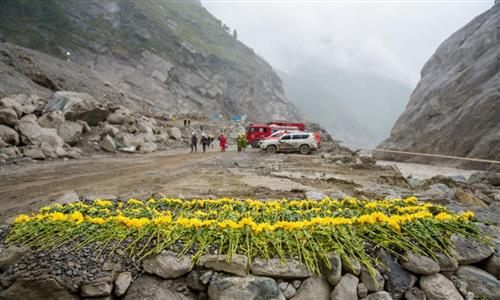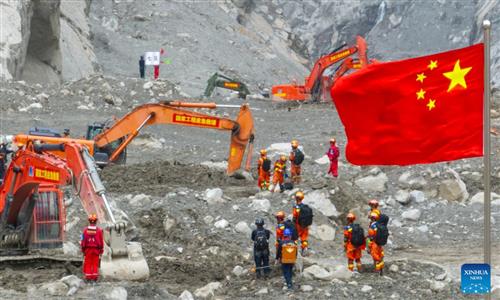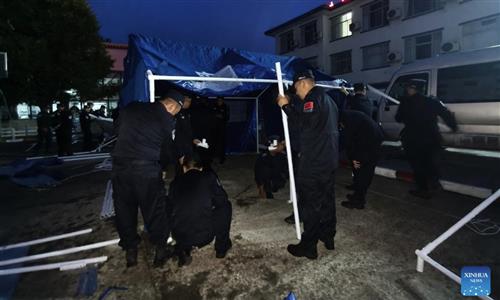
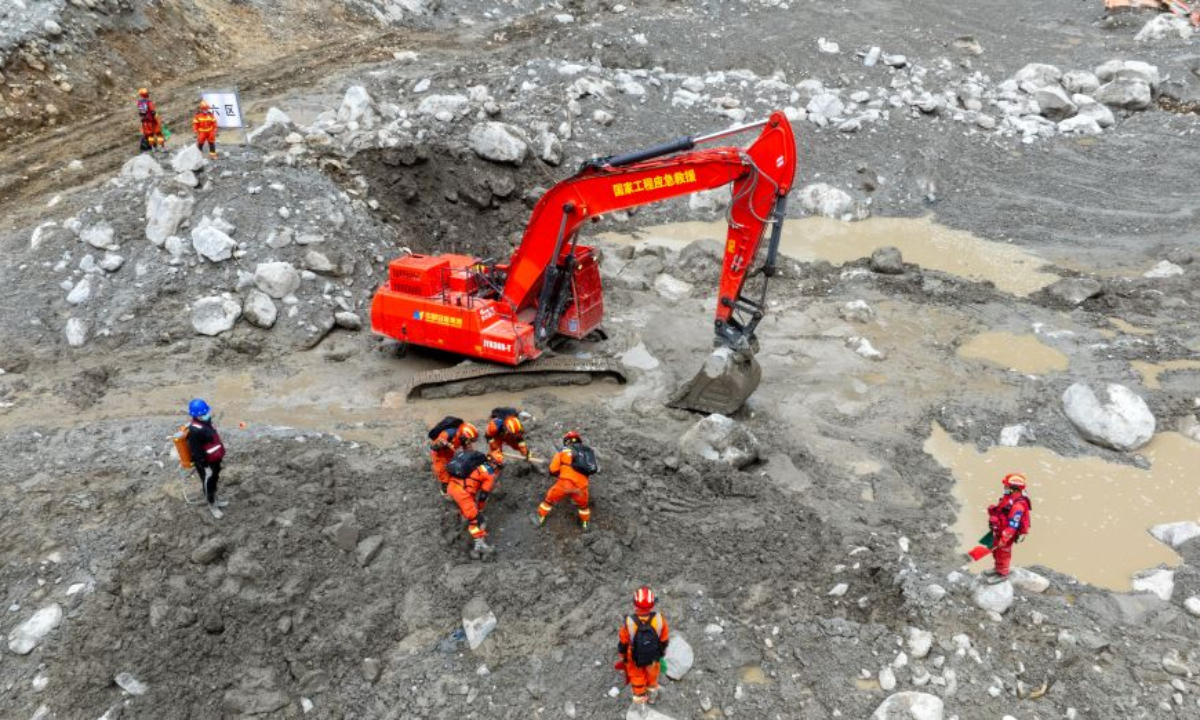
A drone photo taken on Sept. 6, 2026 shows rescuers working at the core affected zone of the mudslide-hit Gyirong Port in southwest China's Xizang Autonomous Region. China has deployed more than 2,500 rescue personnel after a mudslide struck Gyirong Port on the China-Nepal border in southwest China's Xizang Autonomous Region on Aug. 26, the emergency response and rescue headquarters said on Sunday. The mudslide, triggered by a high-altitude glacier collapse in Nepal, had left 43 people dead and 519 others missing at the border port as of 6 p.m. Saturday, officials told a press conference. As of 6 p.m. Saturday, more than 2,500 people and over 500 vehicles had been deployed to join rescue operations, and more than 1,000 flights of drones had air-dropped 5.43 tonnes of supplies, officials said. (Xinhua/Tenzin Nyida)
"Yesterday, journalists from the US, UK, Russia, Brazil, India, Pakistan and other countries were at the disaster site, which is self-explanatory," Muhammad Asghar of the Associated Press of Pakistan, who was invited to on-site report of mudslide-hit Gyirong Port in Southwest China's Xizang Autonomous Region over the weekend, told the Global Times on Monday.
On August 26, an ice-rock avalanche tore down a high-altitude slope in Nepal, unleashing a devastating debris flow that left people dead or missing on both sides of the China-Nepal border. The Pakistani reporter made the comments addressing claims by some Western media outlets, including the BBC, that Chinese authorities had provided the public with little access to information from the site.
The mudslide in Gyirong has drawn close attention from international media, who hope to enter the area for reporting and interviews. With roads having just been cleared after non-stop repair work, China invited journalists from eight foreign media outlets, including NBC, CNN, Reuters, RT and PTI, to enter the core area to learn about the impact of the disaster and progress in rescue, recovery and reconstruction. They also attended a press conference for journalists held by the Xizang Autonomous Region. "I believe you have seen the media reports from these outlets," Chinese Foreign Ministry spokesperson Mao Ning said on Monday.
"China will continue its all-out search and rescue efforts to deal with the aftermath. We will provide timely updates on the situation on the ground and rescue operations," Mao said.
The remoteness and isolation of the port impressed Mauro Ramos Pintos, a journalist with Brazilian outlet Brasil de Fato.
"We left Beijing in the morning, arrived in regional capital city Lhasa at noon, left for Dinri County for a 7-hour van trip, rest. We left in the next morning and it took us five and a half hours to finally arrive at Gyirong, in winding roads between a very mountainous region. So I was just thinking about how difficult it is to send all the teams there," Pintos said.
Bruno Falci, a correspondent from Latin American outlet TeleSUR, told the Global Times on Monday, "I find it outrageous that some mainstream Western media outlets, instead of behaving like journalists, seem to be trying to do politics with a tragedy."
Falci said that during his visit to Gyirong, he saw a reality very different from the picture portrayed by some of these reports.
"Thousands of rescuers and thousands of pieces of equipment have been mobilized. Heavy machinery, drones and helicopters are being used in the search, and the G216 national highway was reopened to allow rescue teams and heavy equipment to reach the disaster zone. The operation is highly organized, with the affected area divided into sectors and teams working systematically," he said.
"There is also an important human dimension that should not be ignored. We are talking about families who have lost loved ones. Not every piece of information needs to be made public if doing so could unnecessarily expose victims and their families," Falci continued.
"Protecting their privacy and dignity should not automatically be presented as a lack of transparency. This is a moment of pain, and tragedies should not be turned into political instruments," the Latin American journalist said.
"International media visit mudslide-hit Gyirong Port," a Reuters headline said on Monday.
"China has this particular capacity to address this kind of crisis. You have thousands of workers trained for this and you have machines made for this kind of efforts. And of course, our heart goes to them for the kind of work they are putting," KJM Varma Mokanda, a reporter from Press Trust of India, was quoted in the Reuters' report.
Pintos from Brazil was in Xinjiang Uygur Autonomous Region when the disaster struck and was unable to closely follow the developments because of the intensity of his trip. He said the first report he came across was from the BBC, which claimed that Chinese authorities had restricted the release of images from the disaster, a claim he found somewhat unusual.
"I turned on the TV and watched Chinese television, with a reporter explaining the accident. The reporter was explaining what had happened, and they were showing images of the accident on a public channel. The first thing I thought was, 'They are lying again - the Western media, right?'" Pintos said.
"After I saw the report from the BBC, I could quickly see that it was a manipulation. Basically, it was a lie that there had been censorship of information about the accident," he said.
Pintos noted that while the disaster was tragic and highly destructive and had claimed many lives, some Western media outlets had politicized the tragedy and propagate their own agendas, which he said made the tragedy even more saddening.