Unlocking the potential: How SCO AI cooperation could shape a shared digital future
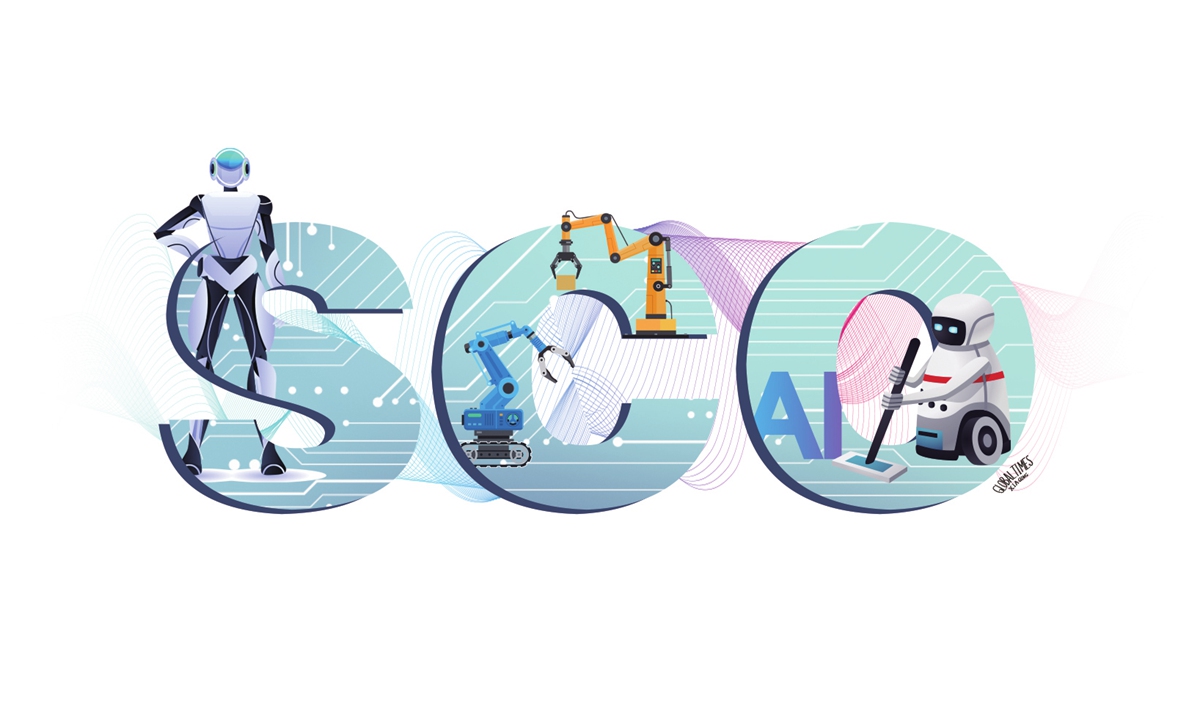
SCO Illustration:Xia Qing/GT
One passage in the newly issued Bishkek Declaration after the recent Shanghai Cooperation Organisation (SCO) summit deserves particular attention. It calls for the safe and responsible use of AI, stressing that AI must not be misused to endanger human life and health or undermine national sovereignty, security and territorial integrity.This consensus is rooted in an expanding range of real-world cooperation, especially in the region of Central Asia. In fact, in this historically rich region, the development of AI finds a rather fascinating echo in the past.
Not long ago, during the World Artificial Intelligence Conference in Shanghai, an official at Uzbekistan's IT Park offered one particular example. Asked why Uzbekistan is investing heavily in AI, he did not begin with government plans or investment figures. Instead, he talked about the history of the land itself - more than 1,000 years ago, on the land of Central Asia, the great mathematician Muhammad ibn Musa al-Khwarizmi was born. In recognition of his contributions to mathematics, his name was later Latinized as "Algoritmi," giving rise to today's well-known word in the tech world: "algorithm."
Al-Khwarizmi's intellectual legacy - breaking complex problems into a sequence of logical steps - has acquired new relevance in the age of AI. What began centuries ago as foundational rules of calculation is now shaping how the region builds its future. Today, in the SCO countries, AI is no longer simply a technology issue. It is becoming a major arena for practical multilateral cooperation.
As AI capabilities advance rapidly, the digital divide is widening in many parts of the world. The question now is not simply how to make AI more powerful, but how to make its benefits more widely accessible while ensuring that its development remains safe and responsible.
Against this backdrop, the China-SCO Countries AI Application Cooperation Center is designed to bridge this gap. Rather than acting as a traditional tech-transfer model where some are mere recipients, it builds partnerships around local needs, helping member states access technologies while fostering domestic capabilities.
This is where SCO AI cooperation differs from a conventional technology-transfer model. Rather than treating some countries as technology providers and others as recipients, it seeks to build partnerships around local needs and shared development. In doing so, it offers a potentially useful model for the digital transformation of the Global South.
Engagement with SCO member states points to two clear demands. The first is practical application: SCO countries want AI to drive productivity in areas such as agriculture, education, healthcare, manufacturing and cross-border logistics. The second is capacity building: SCO countries want more than ready-made AI tools. They need affordable computing resources, local talent and the ability to adapt and further develop technologies themselves.
Digital sovereignty, local languages and cultures, and a greater voice in shaping global AI governance are also increasingly important concerns.
In my view, this is where the SCO's AI cooperation has its greatest significance: It is beginning to move beyond the traditional logic of technology transfer toward a model of multilateral cooperation better suited to developing countries.
First, it emphasizes local adaptation rather than simple replication. Technologies must fit local languages, cultures and industrial needs. For example, a smart weather service in Tashkent adapts China's "MAZU" weather early-warning system into an AI frost-forecasting tool to help apple growers, while large language models are being localized for e-government and trade.
Second, it puts talent development alongside project delivery. The long-term foundation of AI cooperation is local talent. Through the SCO AI cooperation center, universities and research institutions are developing joint training programs for government officials, technology professionals and young people from member states. An SCO AI Summer School is also being prepared. The goal is not simply to deliver projects, but to help member states build lasting local capacity.
Third, it brings governance into the cooperation process from the outset. SCO AI cooperation is not about pursuing quick, high-profile results. It's about building foundations and strengthening coordination. Rather than following a "develop first, govern later" approach, the framework emphasizes openness, collaboration, inclusiveness and responsible development from the start.
The SCO's AI cooperation is still young. Over the next few years, the focus will remain on resource sharing and capacity building. In the digital age, technological barriers cannot secure shared prosperity. If developing countries can gain not only safe access to AI, but the capacity to write their own digital formulas, the SCO's vision - grounded in the Bishkek Declaration and translating a historic legacy of logic into a shared future - could offer a truly valuable path forward.
The author is executive dean of Gaoling School of Artificial Intelligence at Renmin University of China. opinion@globaltimes.com.cn
RELATED ARTICLES