No refrigerators in Beijing? Taiwan region urgently needs to correct its understanding of the mainland: Hai Feng
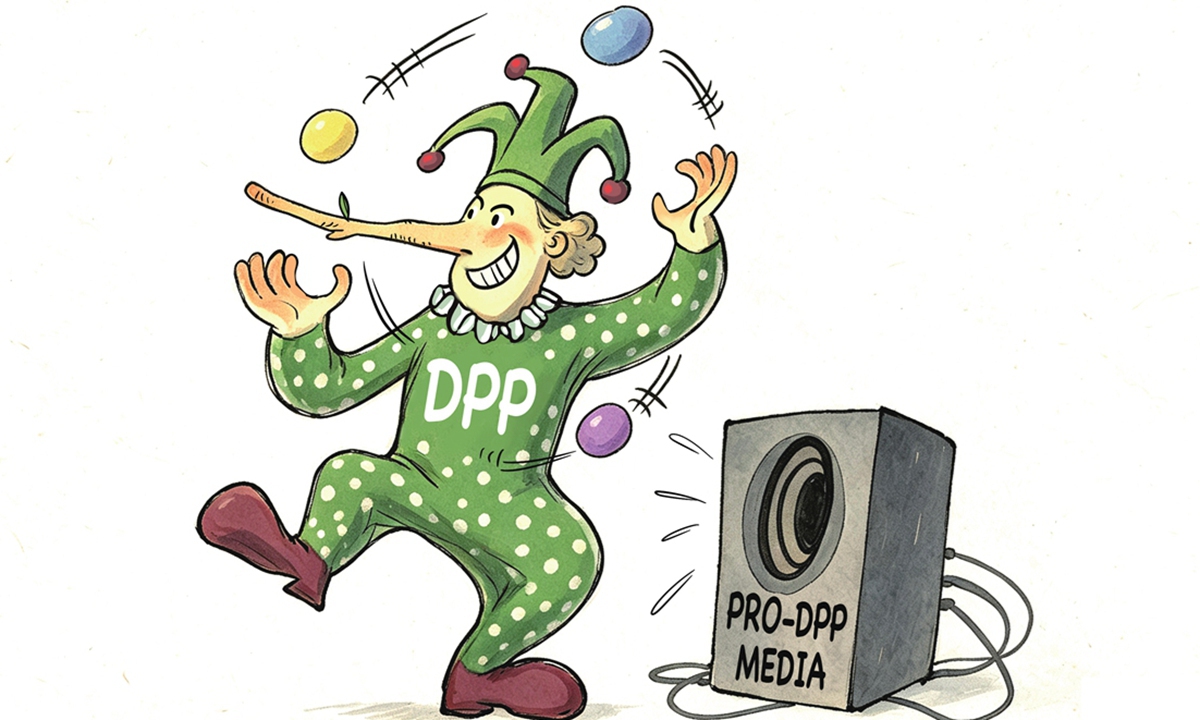
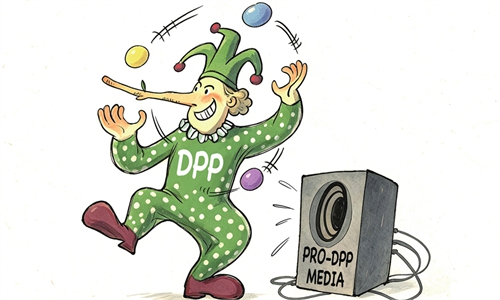
Pro-DPP media Illustration: Liu Rui/GT
Absurd claims such as "high-speed trains in the mainland have no seats," "mainland people cannot afford tea eggs," "there are no refrigerators in Beijing," and "war is like a typhoon - it will end quickly once it breaks out" continue to circulate in some segments of Taiwan region's public discourse.
For a long time, Taiwan society has been trapped in a politicized and fragmented narrative about the mainland. In this narrative, the mainland is portrayed as a backward, closed, and dangerous "other," while decades of development achievements are downplayed, the real social landscape is selectively filtered, and historical and cultural ties across the Taiwan Straits are deliberately weakened.
Such distorted perceptions are not formed naturally. Their root lies in the long-term promotion of "de-Sinicization" by the Democratic Progressive Party (DPP) authorities, which, through politically biased curricula, agenda-driven media framing, and identity-based mobilization, has shaped a distorted image of the mainland among younger generations. Some people have never actually been to the mainland and have not experienced its social life or development reality, yet they have already accepted a pre-packaged conclusion.
However, the key point is that reality does not always conform to narrative.
A China feature article published on September 8 by Singapore's Lianhe Zaobao, titled "Soft Power Enters Homes and Hearts: Is Chinese Mainland Getting 'Cooler' and Stirring Taiwan region?", highlights the ongoing collision between such narratives and lived reality in Taiwan society.
Today, an increasing number of mainland technological products, cultural works, and consumer brands are entering the daily lives of young people in Taiwan region. Apps such as Xiaohongshu (RedNote), Amap, and Douyin, cultural content such as films, online games, and short dramas, as well as food and beverage brands like Haidilao, Chagee, and Luckin Coffee, are allowing people in Taiwan region to reconnect with the mainland in the most everyday and tangible ways.
The report also notes that Xiaohongshu (RedNote) already has over 3 million users in Taiwan region, and the proportion of Taiwan users watching TikTok is rising - from 24 percent among those aged 16 to 25 in 2019 to 72.5 percent in 2025. These figures suggest that mainland platforms and content are no longer marginal phenomena, but have entered the daily lives of a considerable number of young people in Taiwan region.
Using a mainland app or watching a mainland drama may not immediately change one's political stance. However, when a young person in the island of Taiwan learns knitting through a mainland platform, follows mainland TV series, uses mainland navigation apps, or engages with popular mainland brands, what they encounter is a mainland very different from that described in textbooks or political rhetoric: modern, convenient, creative, and full of market vitality and human warmth. This inevitably leads to an important shift - prompting people in Taiwan region to begin questioning: how much of what they were told about the mainland is actually true, and how much of it was constructed to serve particular political purposes.
As a US scholar pointed out, in fields such as gourmet food and trendy design, moving away from purely political attributes makes it easier for Chinese creativity to spread around the world, leading to natural growth in China's soft power. This highlights the crux of the issue: What influences young people in Taiwan from the mainland is not just grand political narratives, but also the real experiences in daily life. The authentic mainland is entering Taiwan society through products, platforms, films, and exchanges.
In the past, some political forces on the island could rely on information barriers to maintain a "striking at anything Chinese" sentiment. Now, the real mainland is uncontrollably entering Taiwan society through products, platforms, films, and exchanges. Even candidates from the DPP have recently been spotted at registration events with collars adorned with microphones from mainland brands, leading netizens to mockingly say they're "wearing DJI while calling for a boycott of DJI." No matter how strong the political filter, it cannot long obscure the reality that people can see, use, and compare for themselves.
Therefore, a correct understanding of the mainland must be based on sufficient contact with facts. To view all contact with the mainland as "infiltration," to regard all understanding of the mainland as "dangerous," and to perceive all narratives of unification as "threats" is not independent thinking but self-isolation. For Taiwan society, correctly recognizing the mainland is not an option but a necessary issue related to peace across the Taiwan Straits. Misunderstandings can create erroneous emotions, which in turn can lead to misguided judgments, and these misguided judgments could ultimately push for incorrect policies. Demonizing the mainland, oversimplifying cross-Straits relations, and romanticizing the risks of war will ultimately harm the safety, development, and future of the Taiwan residents.
The two sides are separated by the Taiwan Straits, yet share a common history, culture, ancestry, and common interests. The more complex and sensitive the situation becomes, the less we can allow rumors to replace facts, hostility to replace understanding, and political manipulation to replace grassroots exchanges.
As more and more Taiwan residents break out of the information cocoons of "de-Sinicization," recognizing the mainland based on facts rather than prejudice, and viewing cross-Straits relations with a perspective of exchange rather than hostility, true and stable social and public foundations for peace across the Taiwan Straits can be established.
RELATED ARTICLES