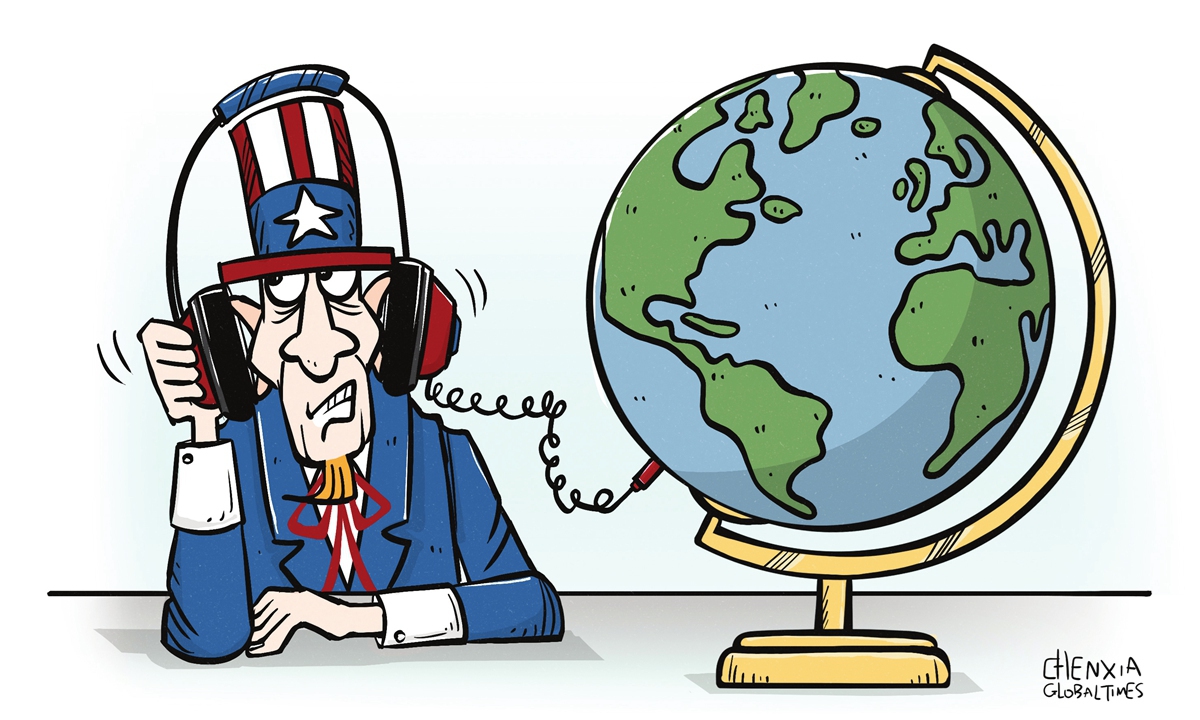
US spy Illustration: Chen Xia/Global Times
The Cold War ended decades ago, yet the CIA, an agency so closely associated with it, still seems determined to prove that it is not obsolete.
On Tuesday, CIA Deputy Director Michael Ellis publicly said the US is engaging in a broader range of espionage against China. In his view, since the competition between China and the US is economic, information held by Chinese companies in areas such as artificial intelligence, semiconductors and biotechnology can also be considered intelligence for the CIA.
The remarks drew attention not only because the CIA was explicitly putting companies in its sights, but because of how unusually blunt they were. The New York Times called the comments "rare," noting that US officials have "traditionally" not spoken so openly about such activities in public.
If we look deeper, this is more than a shift in CIA's intelligence-gathering priorities. It is also a more blunt and convenient expansion of what counts as a "threat." Under this logic, anything in which China becomes competitive can be easily included in the US "national security" discourse, and thus, worthy of surveillance.
For the CIA, an agency born in the old era of the Cold War, that is clearly a useful arrangement. As the boundaries of "national security" move further into the economic and technological spheres, which are seeing constant evolution and rapid expansion, the agency has more room to operate. If every new area can be defined as a "security concern," the CIA will never run short of new missions.
Everyone knows what kind of institution the CIA is. An intelligence agency that sits among the darkest corners of the US establishment, it has earned a notorious reputation for its sweeping surveillance of other countries in pursuit of US hegemony. Its "bluntness" is, rather than simply sending a "warning" to China and Chinese companies, a message to US policymakers: Faced with what it portrays as an ever-growing "threat" from the competition with China, the CIA is not becoming less relevant and has more work to do than ever.
As long as the "China competition" narrative continually generates new intelligence priorities, more resources will be distributed in that direction. In terms of China, the CIA established the China Mission Center, its only single-country mission center, in 2021, while its budget for China-related work has reportedly doubled in recent years. At this rate, the CIA seems increasingly preoccupied with "China intelligence" - so much so that it is closer and closer to becoming the "China Intelligence Agency."
But there is a problem: Wanting to expand intelligence operations against China does not mean the CIA can easily do so. While the CIA is trying to cast its intelligence net over an ever-wider range of targets, China's Ministry of State Security has said that in recent years, amid efforts by Chinese security authorities and support from the public, the CIA's intelligence networks in China have suffered what it described as a "fatal blow." The agency's repeated efforts to recruit people who speak Chinese have, time and again, become fodder for online ridicule. At least judging from these public accounts, US intelligence operations in China are not and will not be quite as freewheeling as they might imagine.
For decades, US intelligence agencies have used sweeping surveillance and infiltration tactics against some of their allies with little apparent resistance. They may simply have become used to getting away with it. But trying to apply the same logic wholesale to China would be overestimating their own capabilities - and choosing the wrong target.
RELATED ARTICLES