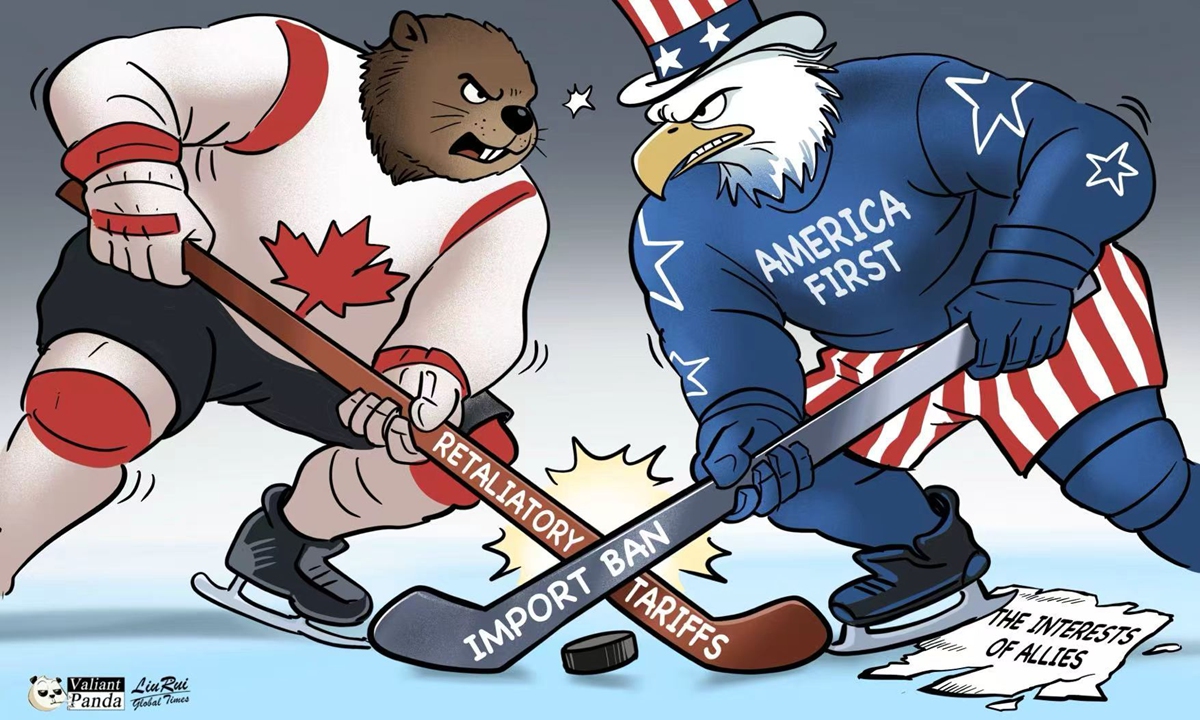
Canada-US trade feud Illustration: Liu Rui/GT
Canada's retaliatory tariffs on US goods of equal value officially took effect on September 8, affecting approximately $20 billion worth of US products across sectors such as steel, dairy products, and home appliances. In a nationwide video address, Canadian Prime Minister Mark Carney criticized the US for wanting dependency in too many areas. On the same day, the US announced a ban on imports of Canadian alcoholic beverages, certain dairy products, and large motorcycles. This economic friction on the North American continent is rapidly escalating.Judging by the current situation, the US-Canada trade war is unlikely to cool down in the short term, as both sides have become embroiled in a costly and protracted standoff. Canada has adopted a targeted countermeasure strategy, with its list of restricted goods strictly matching the scale of US tariffs while excluding categories closely tied to its own supply chains in an effort to minimize self-inflicted damage.
However, the US response has been even tougher, escalating from additional tariffs to direct restrictions on certain goods entering the US market. Import bans have a more immediate impact than tariffs; affected Canadian exporters will lose direct access to the US market, dealing a particularly severe blow to the manufacturing sectors in Ontario and Quebec.
As the two countries' economies are highly integrated, both are bearing the tangible costs of the trade war. In Canada, small and medium-sized enterprises are considered among the hardest-hit groups in this round of the trade war; businesses reliant on cross-border supply chains face the dual pressures of rising costs and lost orders. On the US side, retaliatory tariffs on Canadian goods will directly impact manufacturing and agriculture in swing states, creating political pressure on the ruling party. Both sides are testing each other's limits.
There is a possibility that Canada will ultimately reach a compromise with the US, but only on the condition that the US acknowledges that the sovereignty red lines set by Canada are nonnegotiable. The root cause of the breakdown in negotiations was the fact that the US proposed conditions that went beyond the scope of trade, such as restricting Canada's ability to sign trade agreements with other countries and encroaching on cultural protection policies. Canada will not compromise on its core interests.
With 75 percent of Canadians supporting the government's hardline stance toward the US, any agreement involving concessions on sovereignty issues would struggle to pass domestic political scrutiny. At the same time, the Canadian economy itself is under pressure: The Canadian dollar has been weakening since 2026, and inflationary pressures are rising. However, the Carney administration believes that enduring economic pain is a more acceptable option than making concessions on sovereignty.
From a political cycle perspective, with the US midterm elections approaching, pressure from manufacturing and agricultural constituencies in swing states may prompt Washington to reassess the marginal benefits of the trade war with Canada. It cannot be ruled out that, should the election race become tight, Washington might seek a phased de-escalation.
This dispute is no longer merely a tariff standoff; rather, it marks a shift in Canada-US relations from deep integration toward structural reconfiguration. Canadian policymakers and the public are irreversibly downgrading their assessment of the reliability of US commitments.
Canada has begun to accelerate the diversification of its foreign trade, economic, and defense relations. At the same time, several Canadian provinces are actively exploring direct economic and trade cooperation with the Asia-Pacific region in an effort to build a multi-tiered network of external economic relations.
This evolution in US-Canada relations sends a clear signal to other US allies and partners. When an alliance shifts from a security community that shares risks to a transactional relationship where every penny counts, strategic arrangements that rely heavily on a single superpower inherently pose systemic risks. Canada's current predicament demonstrates that even with decades of deep integration and shared values, alliance status does not automatically shield a country from unilateral pressure exerted by a hegemonic power.
For other nations within the US alliance system, this case serves as a reminder to reexamine the stability of their relations with the US, assess the vulnerabilities of overreliance on a single market, and, where possible, diversify their external dependencies. Canada is now paying the price for its strategic dependence. The fracture in the traditional US-Canada alliance will not be confined to North America; it will influence how other countries assess their own strategic positioning.
The author is a research fellow at the Center for Canadian Studies at Guangdong University of Foreign Studies. opinion@globaltimes.com.cn
RELATED ARTICLES