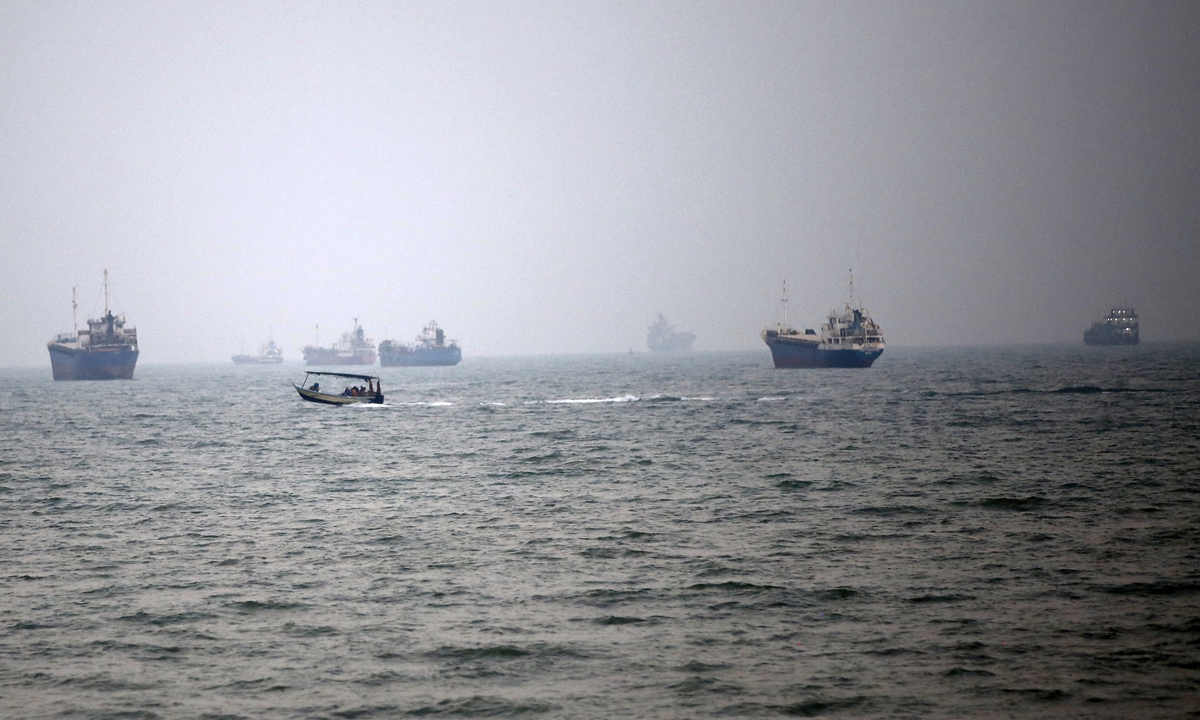
Numerous merchant ships from Iran and other countries remain at anchor near Bandar Abbas, Iran, in the Strait of Hormuz, on September 10, 2026. (Photo: VCG)
The Strait of Hormuz - barely 30 kilometers at its narrowest - is the world's most critical energy chokepoint. Before the US-Israel war with Iran, roughly 20 million barrels of crude and petroleum products passed through it daily, accounting for over a quarter of global seaborne oil trade.What happens when that artery is cut? Japan, which sources more than 90 percent of its crude from the Middle East, saw ethylene plant utilization plummet to 67 percent in April 2026, the lowest since 1996. South Korea's president confessed he "can't fall asleep." India urged its citizens to curb fuel use; and the UN warned that 45 million more people could face acute hunger.
Yet China, the world's largest oil importer, taking over one-third of Middle Eastern oil exports, has kept its gas stations stocked, supply chains humming and consumer prices steady. How? The answer lies not in luck, but in decades of systematic energy planning.
First, a substantial reserve cushion. China began building its strategic petroleum reserves in the early 2000s, creating a three-tier system: national strategic reserves, commercial stocks and mandatory corporate holdings. Although China has not disclosed official figures, a US Energy Information Administration (EIA) report released in April 2026 estimated that China's strategic stockpile reached nearly 1.4 billion barrels as of December 2025. That translates to 140-180 days of net import cover, well above the International Energy Agency's (IEA) 90-day benchmark.
When the Strait of Hormuz crisis hit, satellite-based estimates showed that China began drawing down commercial inventories in May, releasing nearly 25 million barrels within a month to offset short-term import losses. Crucially, its national strategic reserve remained largely intact.
Second, supply and transport route diversification. China imports oil from dozens of countries across the Middle East, Russia, Central Asia, Africa, the Americas and the Asia Pacific, reducing dependence on any single supplier. Overland pipelines from Myanmar, Kazakhstan and Russia complement maritime shipping, forming a resilient network. Even if tanker traffic is disrupted, this geographic spread insulates China from any single point of failure.
Third, domestic output and coal substitution. A seven-year program launched in 2019 to expand oil and gas reserves and output has kept China's annual crude production above 200 million metric tons. New sources of energy are playing an increasingly important role, with shale oil output surging eightfold since 2018 and offshore fields contributing the lion's share of production growth.
Yet China's oil self-sufficiency remains only slightly above 20 percent, which is why its coal advantage matters so much. The country's coal-chemical industry - the world's largest - can substitute roughly 140 million metric tons of imported oil equivalent per year, turning coal into aviation fuel, asphalt, plastics and synthetic fibers when necessary. That is not a marginal hedge; it is a strategic game-changer that gives China an option almost no other major economy has.
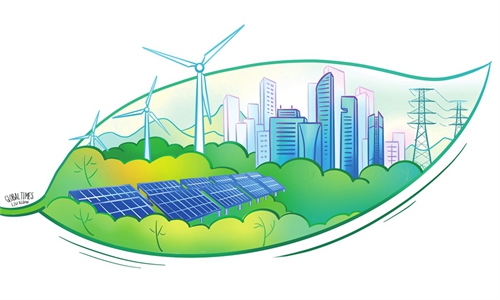
Fourth, a fast-forward energy transition. Since the Renewable Energy Law took effect in 2006, China has built the world's biggest clean-power system. By the end of 2025, renewables exceeded 60 percent of China's total installed power capacity; wind and solar alone reached 47.3 percent, overtaking thermal power for the first time. Renewables generated 38.3 percent of all electricity in 2025. That means one in every three kilowatt-hours came from wind, sun or water. Meanwhile, new-energy vehicle (NEV) sales hit 16.49 million in 2025, with a penetration rate approaching 50 percent. The IEA estimates that China's NEV fleet alone cut oil consumption by about 1 million barrels per day (b/d) last year. And that figure is set to grow as more renewables replace coal in power generation. Less oil burned in transport, more electricity from clean sources - this is a virtuous cycle that directly reduces import vulnerability.
When the Strait of Hormuz crisis roiled global markets, China had vastly more room to maneuver than most major economies. Rather than panic-buying on expensive spot markets, which would have driven prices even higher, it simply reduced imports. The EIA estimates that China's crude imports fell to about 8.1 million b/d in Q2 2026, nearly one-third lower than in the previous quarter. In May and June, imports dropped below 8 million b/d for the first time since 2016. That import cut - made possible by years of strategic preparation - has helped to stabilize global prices and prevent further spiraling.
Some online bloggers have argued that China quietly saved the world; many media outlets have echoed that view, contending that China's reduced oil imports were in themselves a major contribution to global stability. Western observers are increasingly recognizing that the strategies China pursued for decades have proven their worth - not just for China, but for everyone who depends on stable energy markets.
For China, protecting its own people and acting as a responsible major country have never been contradictory. Through long-term foresight in reserves, diversification, domestic production, and clean energy, China has secured its own baseline and, in doing so, given the world room to breathe when it needed it most. While others scrambled for every barrel, China let the global market exhale.
The author is a commentator on international affairs, writing regularly for Xinhua News, Global Times, China Daily, CGTN. He can be reached at shaoxia2019@163.com.
RELATED ARTICLES