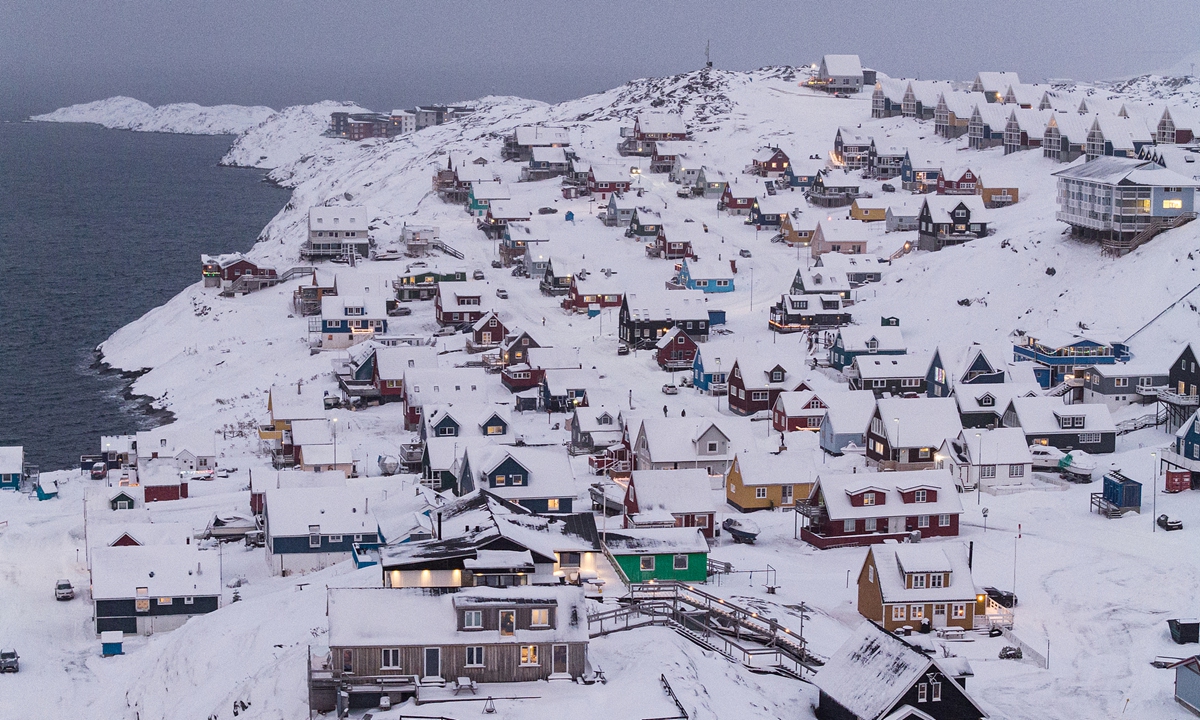
Nuuk, Greenland Photo: VCG
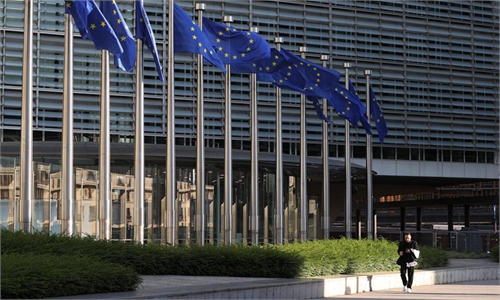
The EU has significantly increased its attention to and investment in the Arctic.On Sunday, leaders from several European countries gathered in Rovaniemi, a city in northern Finland on the edge of the Arctic, to discuss the region's geopolitical landscape, further building consensus ahead of the EU's forthcoming "new Arctic Strategy."
Just days earlier, during her visit to Nuuk, the capital of Greenland, an autonomous territory of Denmark, European Commission President Ursula von der Leyen announced that the EU would launch an investment package worth 200 million euros to strengthen cooperation with Greenland, signaling that Greenland will be one of the priorities of the EU's "new Arctic Strategy."
The EU's current Arctic strategy is the 2021 Joint Communication on a stronger EU engagement for a peaceful, sustainable and prosperous Arctic. Under this strategy, the European Commission established an office in Greenland in 2024 to strengthen communication and coordination with the island. Since 2021, major changes have taken place in Europe and around the world, including the EU working on a "new Arctic Strategy."
What exactly is new about the EU's "new Arctic Strategy"? Some preliminary observations can be made based on discussions within the EU. The issues of concern have not fundamentally changed, but the emphasis and priorities are likely to undergo significant changes.
First, the importance of security has risen. The 2021 version of the Arctic Strategy had already begun to emphasize geopolitical competition and security factors, and the new strategy is expected to place even greater emphasis on them. Since the outbreak of the Russia-Ukraine conflict, the EU has regarded Russia as its biggest threat. Finland and Sweden have joined NATO and called for stronger security to ensure that the EU has sufficient capabilities to respond to what it sees as "the Russian threat." The US government has stated that it would not rule out the use of force to seize Greenland and has continued to show an interest in the island. The EU's growing focus on Greenland is also aimed at creating a degree of counterweight to the US and deterring any rash moves by Washington.
Second, the development of raw materials and energy has grown in importance. Heavily reliant on external markets for energy, rare earths and other resources, the EU seeks to reduce such dependence and mitigate associated risks, viewing these efforts as key to strategic autonomy. The Arctic is rich in natural resources and boasts substantial mineral reserves. The European Parliament recently released a report calling on the EU to strengthen cooperation with Arctic countries and build secure mineral supply chains.
Third, addressing new challenges brought about by climate change. Europe is among the regions experiencing the fastest global warming. During the summer, multiple European countries suffered devastating losses from extreme heat, droughts and wildfires. The Arctic is warming at an even higher rate, meaning Europe will face deeper hardships ahead and has no choice but to channel more resources into climate governance in the Arctic region. Meanwhile, the continuous melting of Arctic sea ice is reshaping global shipping patterns, with new trade routes emerging. Europe, naturally, refuses to lag behind.
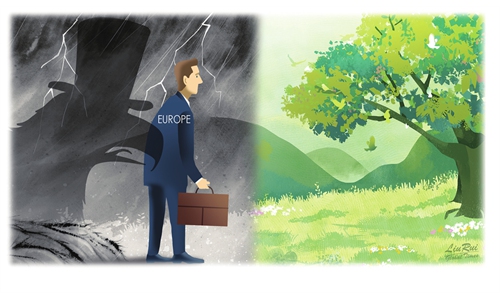
Overall, the EU's "new Arctic Strategy" will place greater emphasis on security issues, attach more weight to geopolitical games and involve increased investment. Yet it remains uncertain whether this strategy can deliver results. For one thing, the longstanding challenge of internal coordination within the EU persists. Nordic countries, Germany and other countries are the most vocal advocates for the EU's Arctic strategy, while Southern European countries have their own geopolitical priorities.
It is still unclear whether the EU's "new Arctic Strategy" can secure solid funding and sustained, stable investment at a relatively high level. For another, while the EU's "new Arctic Strategy" contains reasonable demands, over-securitization and excessive focus on geopolitical competition and zero-sum games may backfire.
The Arctic belongs to humanity, and its governance requires the participation and contributions of more countries. Therefore, in formulating its "new Arctic Strategy," the EU should adopt less exclusive thinking and embrace greater openness and cooperation.
The author is vice president of the China Institutes of Contemporary International Relations. opinion@globaltimes.com.cn
RELATED ARTICLES