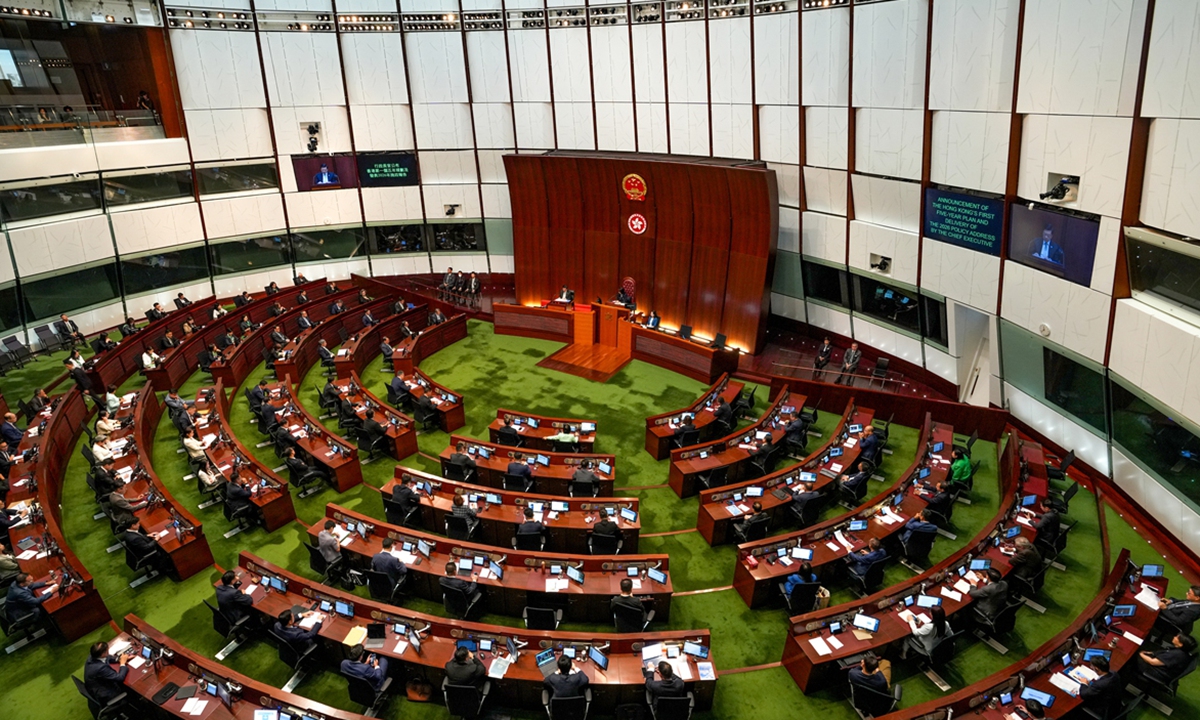
John Lee, chief executive of the Hong Kong Special Administrative Region, delivers his policy address and unveils inaugural five-year plan at the Legislative Council on September 16, 2026. Photo: VCG
Hong Kong has produced a Policy Address in every year of its modern history. On Wednesday, for the first time, it produced something different: The Hong Kong Special Administrative Region (HKSAR)'s first five-year plan for economic and social development (2026-30). The HKSAR Chief Executive John Lee presented it in a blue cover, chosen to signal openness, progress and stability, alongside his Policy Address in green. The colors are a small thing. The change of horizon is not.
Why does a five-year horizon matter to a city like ours? Because the things that determine Hong Kong's future cannot be built in 12 months. A court takes years to establish. A generation of professionals takes longer still. Legislation, institutions, campuses, treaties - these are the slow assets of a modern economy, and an annual cycle is not the natural unit in which to plan them. By setting out directions and indicators for 2026 to 2030, with each Policy Address rolling out the measures in sequence, the government has given itself, and everyone who invests here, a longer field of vision. The Chief Executive was careful to add that this is not a planned economy, and he is right. It is a blueprint, not a quota.
The deeper significance lies in what the plan connects to. In March, the country adopted its outline of the 15th Five-Year Plan (2026-30), and that document speaks about Hong Kong directly. It calls for giving full play to Hong Kong's unique advantage of maintaining close connections with both the Chinese mainland and the world. It calls for deepening Hong Kong's development as an international legal and dispute resolution services center. It supports the International Organization for Mediation, newly headquartered here, in furthering its role. It supports Hong Kong in building an international hub for high-calibre talent. It asks Hong Kong to put its professional services at the disposal of Chinese enterprises going global. And, in a phrase that deserves far more attention than it has received, it calls on the country to improve the system and capacity for the rule of law in foreign affairs.
Hong Kong's own plan is, in large part, the answer to that call. Where the national plan sets a direction, the local plan supplies the delivery: an International Commercial Court, with judges invited from other common law jurisdictions; reform of our arbitration law; a mediation regime built to international standards; the expansion of the Hong Kong International Legal Talents Training Academy into a hub for training and exchange serving the country and the wider world; and a purpose-built International Legal Service Building to house all of it. Read beside each other, the two documents are not two plans but one relay. That is what genuine coordination looks like - not the repetition of slogans, but a division of labor in which the nation names the objective and Hong Kong builds the capability.
For the legal fraternity, this is a moment of unusual clarity about our own worth. Hong Kong is the only jurisdiction in China that practises the common law, and the only place in the world that practises it bilingually in Chinese and English. That is not a colonial residue to be apologized for; it is a national asset, protected by "One Country, Two Systems" and now written into the country's own development strategy. It is why contracts across Asia choose Hong Kong law, why disputes across the region choose Hong Kong as their seat, and why our courts and our counsel are trusted by parties who share neither our language nor our politics.
The next five years should see that asset put to harder use. Chinese enterprises now own factories, mines, ports, power stations and networks across Latin America, Africa, Central Asia and Southeast Asia. Some of those investments will be treated unfairly by the states that host them - licenses withdrawn, assets taken, profits trapped, rules changed after the money has been spent. When that happens, the answer is not resentment but law. The government's decision to invest in legal talent, rather than merely in legal buildings, is the single most far-sighted commitment in the plan.
Does planning sit uneasily with a capitalist city? I do not think so. The plan allocates no market share and directs no private capital. It states public objectives - courts, statutes, training, standards - and leaves the professions to compete for the work. Certainty of law and certainty of purpose have never been enemies of enterprise.
Five years from now, the test will be simple. Are there more disputes resolved in Hong Kong, more Chinese enterprises defended by Hong Kong counsel abroad, more young lawyers from the region trained here? Our Hong Kong Legal Exchange Foundation intends to help make the answer yes.
The author is chairman of the Hong Kong Legal Exchange Foundation. opinion@globaltimes.com.cn
RELATED ARTICLES