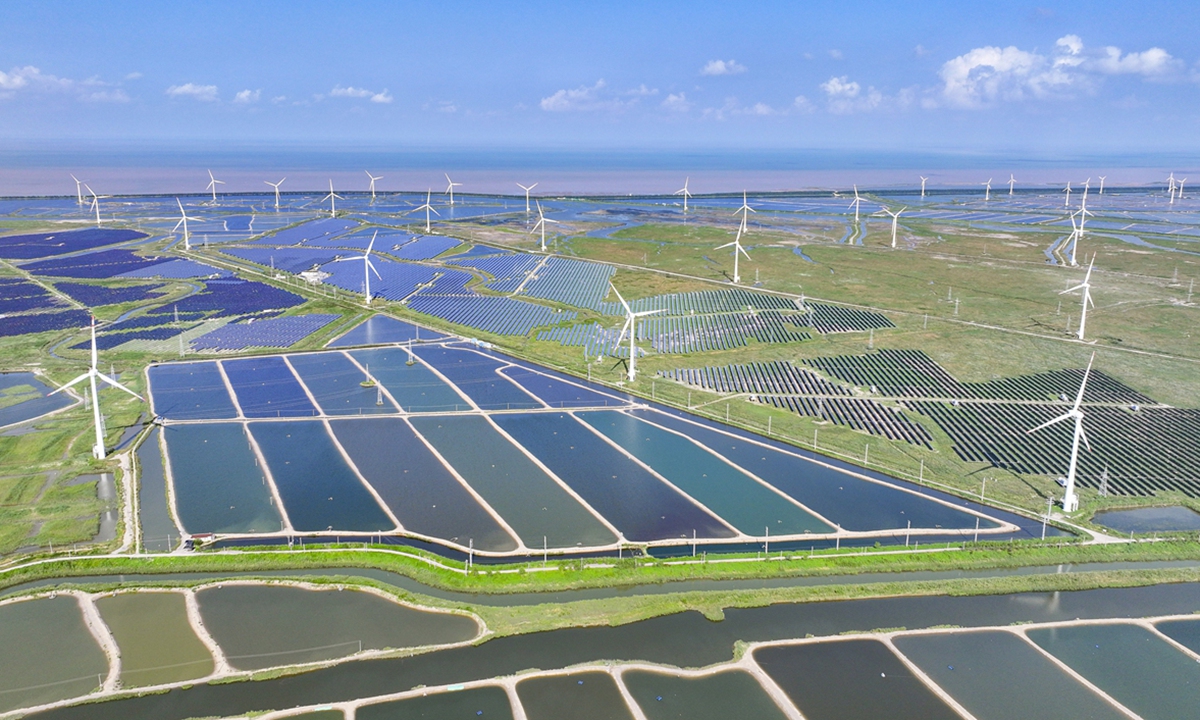
Wind turbines and photovoltaic panels in Yancheng, East China's Jiangsu Province deliver reliable green energy on August 15, 2024. According to data from the National Energy Administration, as of July, China's installed renewable energy power generation capacity reached 1.65 billion kilowatts, up 25 percent year-on-year. Photo: VCG
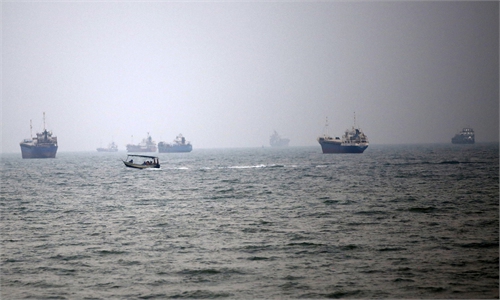
The world has China's "energy strategy to thank" for avoiding a "much worse" oil price shock. So wrote the Associated Press (AP) in a report on Saturday, saying that "we've been free-riding off Beijing in a weird way" and that the US should "thank" China. The lengthy report focused on the turmoil in global oil markets triggered by concerns over shipping through the Strait of Hormuz. It argued that China's forward-looking energy planning has enabled the country to withstand the pressure while easing global demand, thereby softening the upward price effects for the US, Europe and other regions.
At a time when much of the Western media is busy reviving the "China shock" narrative, this may be one of the more clear-eyed assessments of China to come from a mainstream US media outlet in quite some time. One of the two experts interviewed by the AP said China "deserves credit" because it "did in 10 years what took us 25 years after the 1973 oil crisis to do." The other saw it as a "vindication" of China's last five-year plan and focus on "self-reliance." Notably, neither expert has a pro-China background. One is retired US Navy Rear Admiral Mark Montgomery, an analyst at the hawkish Washington think tank Foundation for Defense of Democracies, while the other is Jonathan Czin, a former senior CIA analyst who now works at the Brookings Institution.
What makes the report worth noting is not that it has suddenly "said something nice about China," but that it brings a question that has long been politicized back to the realm of common sense. China's oil stockpiling and efforts to reduce imports were first and foremost intended to safeguard its own energy security. But global markets are interconnected. At a time of tight global oil supplies, China did not scramble for oil but instead left more supply available to others, easing pressure on the market and putting a lid, at least to some extent, on the price hiking. The portion of the bill that the US, Europe and other importers therefore did not have to pay is simply the most basic arithmetic of interdependence. It is not difficult to work out.
In fact, this is just one window into how China interacts with the world. Forward-looking planning serves China's own interests first, but in an interconnected world, it can also become a public good. China has helped move clean energy from the laboratory to mass production, turning solar panels, batteries and electric vehicles into scalable infrastructure. Developing countries can consequently electrify their grids, modernize transportation and reduce imported fuel bills at lower cost, while developed countries have faced less energy-driven inflationary pressure during periods of heightened price sensitivity. Advocates of the "China shock" narrative always like to portray China's capabilities as something that comes at the expense of others. But when crises hit, the world can clearly see that China has repeatedly helped make things "less bad."
That also offers a more honest lens through which to view China-US relations. The relationship between the world's two largest economies is not a simple equation in which "your gain is my loss" or "what you have, I cannot have." What the two countries should guard against and avoid is not each other's development, but turning an interconnected world into a distorted zero-sum story. Whether or not Washington "thanks China," the essence of China-US economic and trade relations remains one of mutual benefit and win-win cooperation. That will not change.
RELATED ARTICLES