Proposed US-Japan-ROK Arctic plan raises ‘geopolitical, security competition concerns’
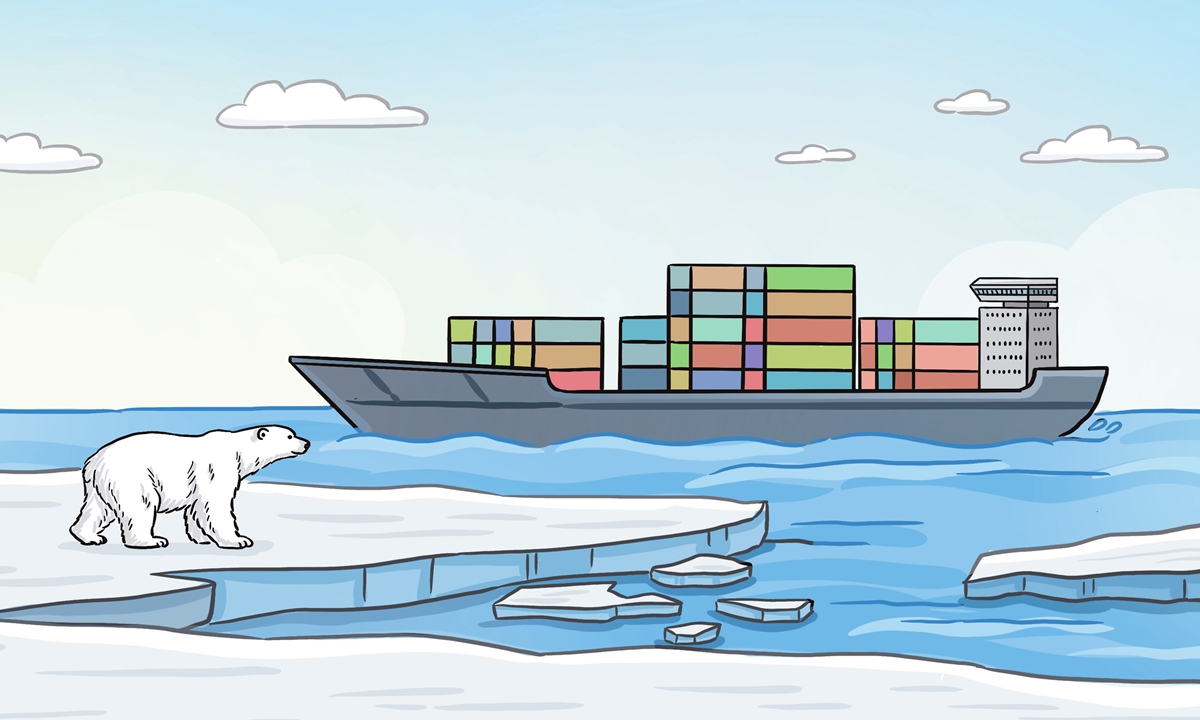
Illustration: Xia Qing/GT
Japan, the US and South Korea are preparing a memorandum on Arctic maritime cooperation and expanded energy supplies, Japan's Yomiuri Shimbun reported on Sunday. The Japanese newspaper framed the initiative as an effort to strengthen the three countries' economic security amid what it described as intensifying competition with China and Russia over Arctic shipping routes and resources.
A Chinese expert warned that the proposed arrangement could turn the Arctic into an arena for geopolitical and security competition, urging the countries to uphold peaceful use and international cooperation in the region.
Japanese Foreign Minister Toshimitsu Motegi, US Secretary of State Marco Rubio and South Korean Foreign Minister Cho Hyun are expected to meet and sign the memorandum in New York on the sidelines of the UN General Assembly, according to the Yomiuri Shimbun.
The draft describes Arctic cooperation as essential to the three countries' economic security and proposes a working group tentatively named the "Arctic-Pacific Trilateral Partnership" to discuss areas of cooperation. The countries would also explore coordination with the Arctic Council, whose eight members include Denmark and Norway, the newspaper reported.
The proposed cooperation would focus on maritime affairs and economic ties. Maritime cooperation could draw on Japan's icebreaker construction expertise, developed through vessels such as the Antarctic research ship Shirase, as well as ocean observation capabilities and responses to unexpected incidents. Economic discussions would focus on expanding the production and supply of Arctic oil, natural gas and other energy resources, according to Yomiuri.
For South Korea, the Arctic route means shortened logistics channel for shipping to Europe. The country's MBC reported that South Korea launched its first commercial container ship voyage along the Arctic Northern Sea Route from Busan on August 22.
Zhao Long, director of the Institute for International Strategic and Security Studies at the Shanghai Institutes for International Studies, told the Global Times that Japan-US-South Korea Arctic cooperation is confronted with multiple practical bottlenecks amid uncertain climate and ice conditions. Russia, a leading Arctic coastal state, holds sway over Arctic shipping and oil-gas exploitation, while Tokyo, Washington and Seoul's involvement is curbed by their sanctions on Russia.
Lü Chao, dean of the Institute of US and East Asian Studies at Liaoning University, told the Global Times on Sunday that the proposed cooperation appeared largely directed at competing with existing China-Russia cooperation and risked turning the Arctic into an arena for geopolitical and security competition.
Japan has previously participated in Arctic development, but its involvement has been relatively limited, and the subject is relatively unrelated to its domestic economy, Lü said. As an island country, Japan already enjoys convenient maritime transport links, he added.
"Japan's current push to participate in Arctic development may not be driven entirely by direct economic needs, but more by a desire to compete with China-Russia cooperation on Arctic shipping routes and development," Lü said.
Arctic development should adhere to peaceful use and international cooperation, whether it involves establishing research stations, conducting climate observations or surveying resources, Lü said.
"Japan's participation in Arctic affairs should follow this direction, rather than turn the development of Arctic shipping routes into a tool for competing against China-Russia cooperation," he said.
Beyond economic cooperation, the Yomiuri report highlighted Washington's security concerns. It said the US, which has Arctic territory in Alaska, is wary of Russian military activities and China's growing presence. The Pentagon's 2024 Arctic Strategy identified expanding China-Russia cooperation as a security challenge, and Washington aims to work with Japan and South Korea to improve surveillance and navigation capabilities, according to the report.
Shen Yi, director of the International Research Institute of Global Cyberspace Governance at Fudan University, told the Global Times on Sunday that the US was increasingly linking Arctic security, resources, infrastructure and its network of alliances.
The Pentagon's 2024 strategy had already identified increased China-Russia cooperation as an important factor shaping the Arctic security environment, Shen said. Cooperation with Japan and South Korea, alongside Washington's newly announced arrangement with Denmark and Greenland, reflects that broader approach, he said.
A prominent feature of recent US diplomacy is the attempt to secure strategic locations and key resources before competitors develop greater capabilities, Shen said. In the Arctic, Washington seeks to work through its alliances to constrain China-Russia cooperation and development, he added.
Washington instead seeks to prevent future changes in the Arctic balance of power that it considers unfavorable, Shen said. Japan, meanwhile, hopes to use the US security and alliance system to translate its limited Arctic capabilities into greater influence over regional rules by bringing Arctic issues into trilateral security cooperation, he added.
The reported initiative comes as Washington pursues other Arctic arrangements. Reuters reported that the US, Denmark and Greenland announced late on Friday an agreement allowing the US to develop a significant military presence in Greenland while prohibiting US adversaries from building their own bases there.
The deal "gives the United States permanent control over security, and all other needs, in Greenland," US President Donald Trump said, according to Reuters. He added that no adversary would ever be permitted to have a base or military presence in Greenland, or make sensitive investments there, without Washington's express written approval.
Reuters quoted Mikkel Vedby Rasmussen, a political science professor at the University of Copenhagen, as saying that transfer of formal authority from Copenhagen to Washington would raise the question in Greenland of whether "this is the beginning of replacing the colonial relationship with Denmark with a colonial relationship to the United States."
RELATED ARTICLES