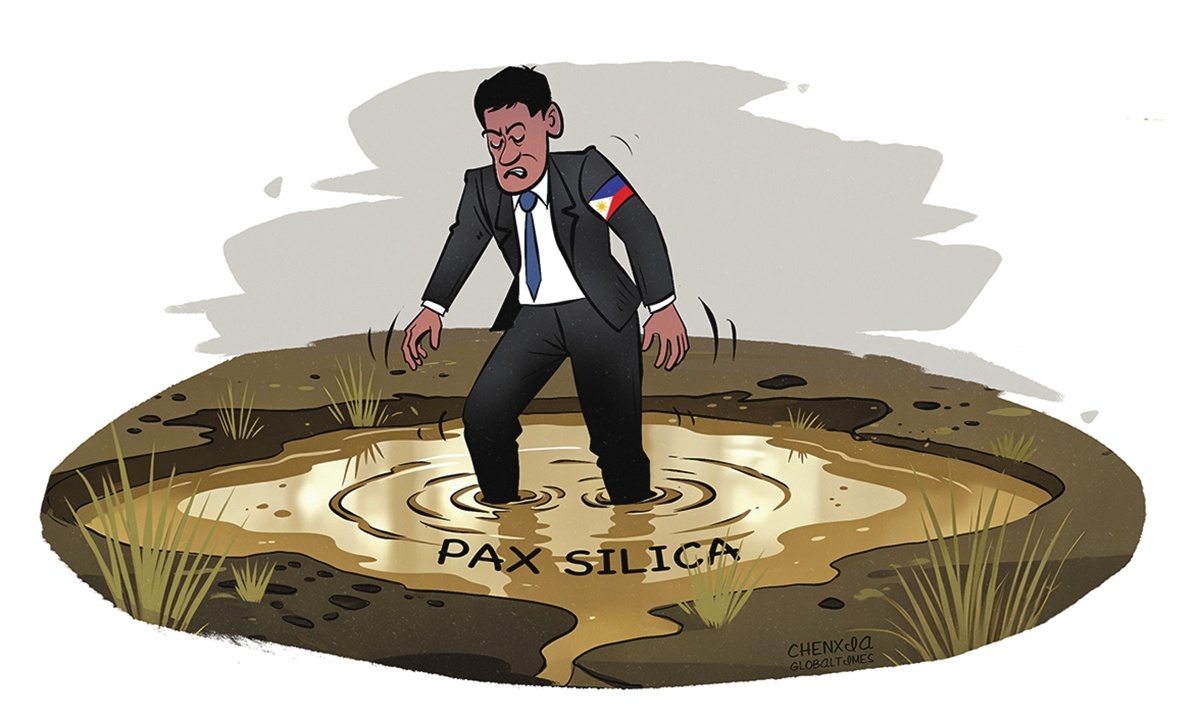
The bill for Manila's Pax Silica 'development' is far from settled. Illustration: Chen Xia/GT
After the Philippines announced in April that it would join the US-led "Pax Silica" initiative, an article in the Diplomat magazine wrote that it was less obvious how Manila stands to gain from it. Several months on, what is becoming increasingly clear, however, is the price that ordinary Filipinos may have to pay.
According to AFP on Sunday, Pax Silica is now driving plans for a 1,620-hectare manufacturing hub in New Clark City in Tarlac, north of Manila, aimed at producing high-end components for AI data centers. The substantial investment and job creation promised by the Marcos administration have yet to materialize, but for around 1,000 Aeta indigenous people living within the project area, the prospect of displacement has already arrived.
This is only one glimpse of the potential costs brought by "Pax Silica" for ordinary Filipinos. More costs are already on the way. The project is estimated to require around 130 million liters of water and 3 gigawatts of electricity every day, with enormous pressure on water and energy systems in Central Luzon and grave consequences for agriculture, surrounding communities and the country's national sustainability, according to Philippine media.
The controversy surrounding Pax Silica goes far beyond the question of whether certain groups should make sacrifices for development. The more fundamental question is: What are Filipinos being asked to sacrifice, and what will they actually get in return? Since the initiative was proposed, protests have emerged across the Philippines, with concerns extending from a simple cost-benefit calculation to what Pax Silica could mean for the country's development. Some protesters have denounced it as a "massive sellout" of Philippine land, minerals and sovereignty to foreigners under the guise of "development." Ultimately, the question is what kind of development path the Marcos administration is choosing - and whether it can actually deliver genuine development for the Philippines.
While the Marcos administration and its advocates tout Pax Silica as a "once-in-a-lifetime opportunity" to boost the country's industrial competitiveness and move the Philippines up the technology value chain, Ge Hongliang, the director of the China-ASEAN Maritime Security Research Center at Guangxi Minzu University, told the Global Times that the country's rich reserves of gold, copper, nickel, and chromite are a key reason for its role in the initiative.
The Philippines may attract foreign investment, he noted, but with the country supplying minerals and basic materials while advanced technologies, processing and high-value-added activities remain in external hands, what is presented as "industrial upgrading" could amount to little more than a new packaging of the Philippines' old role as a resource supplier. In other words, Pax Silica may risk reproducing the Philippines' longstanding position at the lower end of global supply chains, only this time under the more fashionable labels of "AI" and "advanced manufacturing."
The bigger issue is who gets to shape the Philippines' development path. Ge noted that it is a US-led effort to erect a "Silicon Curtain" across the Asia-Pacific and decouple critical industrial supply chains from China, serving Washington's broader supply-chain competition and geopolitical agenda. As the Philippines' resources, industrial planning and future manufacturing become increasingly tied to a US-led economic security framework, the country risks being drawn deeper into great-power competition that squeezes its development.
By tying industrial development more closely to a US-led exclusionary supply-chain framework, Pax Silica could further subordinate the country's industrial priorities to geopolitical considerations, narrowing its room for broader regional cooperation and ASEAN development opportunities. On paper, the Philippines gains a place in AI and advanced manufacturing supply chains; in practice, it risks becoming a peripheral appendage to an exclusive economic bloc. What is at stake, therefore, is no longer just diplomacy, but the country's land, energy, minerals and development.
Worse still, ordinary Filipinos will ultimately bear the costs - both those already visible and those that may gradually emerge as the country's development path becomes increasingly tied to external strategic priorities. As Aeta tribal leader Petronila Munoz put it: "Why do we have to be the ones to sacrifice for the kind of development they want?"
What the Philippines is putting on the table for Pax Silica is therefore more than land, energy and minerals. It is also part of its own development space. The real measure of Pax Silica is not simply how much investment and how many jobs it promises, but what the country is giving up in return. The bill, it seems, is far from settled.
The author is a reporter with the Global Times. liuxuandi@globaltimes.com.cn
RELATED ARTICLES