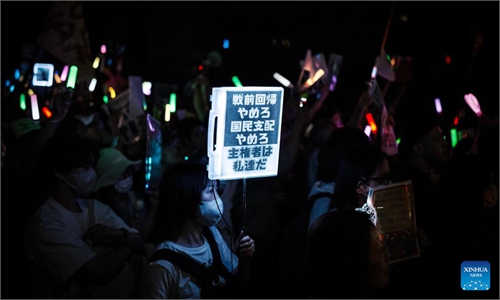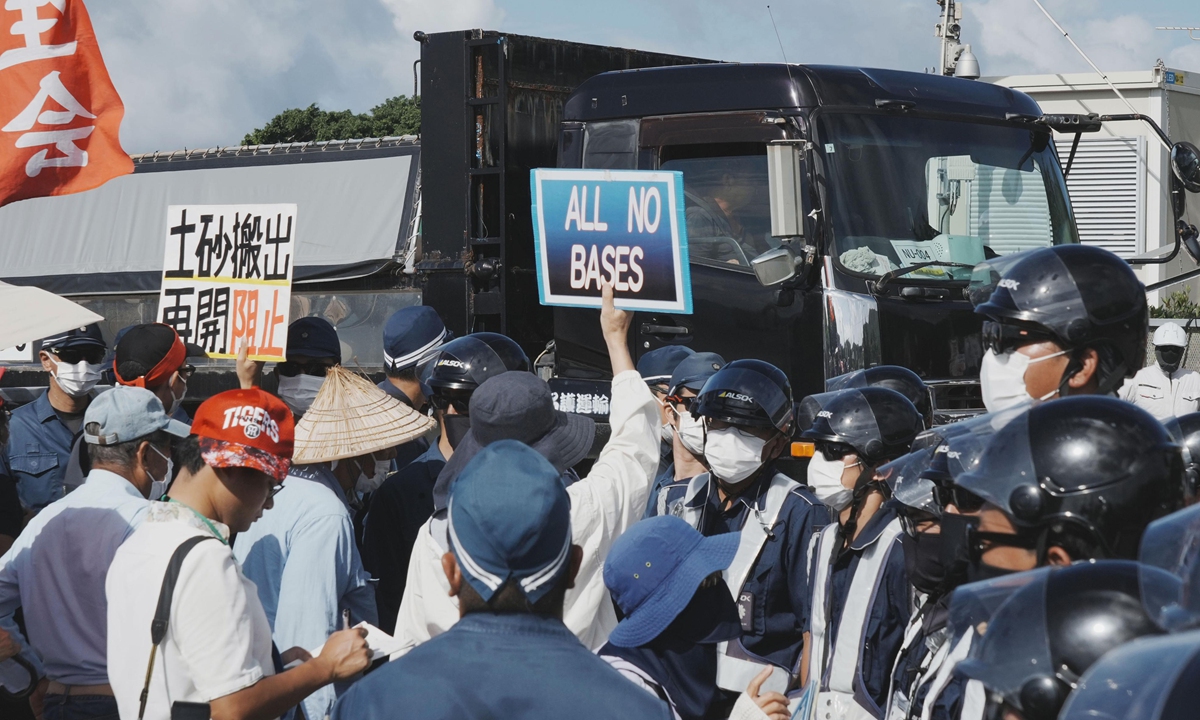
Protesters rally in front of the US Marine Corps' Camp Schwab in Nago, Okinawa Prefecture, amid rain to oppose land reclamation for the Futenma base relocation on August 22, 2024. Photo: VCG
Japan's Okinawa Prefecture recently held a gubernatorial election, in which Genta Koja - a candidate backed by right-wing and conservative forces - won, ending 12 years of reformist rule in the prefecture. The current Okinawa governor Denny Tamaki had long centered his platform on halting the construction of the new Henoko base and closing and dismantling the Futenma base. By contrast, Koja supports the base relocation plan and demands that Japan's central government substantially boost budgets for "Okinawa revitalization." Beyond the focal issue of US military base relocation, behind this election also lies Tokyo's long-term objective of clearing defense hurdles for the "Southwest Islands" - the Ryukyu Islands - and the East China Sea.Accelerating militarization
Many analysts believe that the election of a "conservative governor" will shift the long-standing standoff between Okinawa and Tokyo. Once the new governor takes office, the pace of US-Japan military deployments in the Ryukyu Islands is expected to accelerate.
First, work on the Henoko base is expected to resume, and US-Japan military cooperation is set to accelerate. Regarding the relocation of the US military base at Henoko, the Japanese central government and the Okinawa prefectural government have been locked in a years-long tug-of-war over approval for coastal land reclamation projects.
In 2023, Tamaki appealed to Japan's Supreme Court regarding the Japanese Ministry of Land, Infrastructure, Transport and Tourism's approval of new land reclamation areas, alleging that the Japanese government's "substitute execution" infringed upon Okinawa Prefecture's autonomy and independence. Now that local opposition to US military bases in Okinawa has diminished, the direct consequence is that the US military will gain a large coastal operational stronghold, and the frequency and intensity of US-Japan joint exercises will also increase.
Second, Japan is strengthening the defense of the "Southwest Islands" and the Self-Defense Forces' (SDF) long-range strike capabilities. The Japanese government has designated strengthening the defense of the "Southwest Islands" as a "top priority" and is pushing for a redeployment of the SDF toward the southwest.
Since 2016, Japan has established bases on Yonaguni Island, Amami Oshima, Miyako Island, and Ishigaki Island; in 2017, the "Southwestern Composite Air Division" was upgraded to the "Southwest Air Defense Force"; in fiscal year 2026, the Ground SDF's 15th Brigade, based at the Naha Garrison, was upgraded to a division. Shortly after the results of the Okinawa gubernatorial election were announced, an anonymous source from the Japanese Prime Minister's Office stated that the emergence of a conservative governor is also important from a security perspective.
Third, Japan is strengthening Okinawa's infrastructure for potential wartime use. In December 2025, Japan's Ministry of Defense signed a land lease agreement to deploy mobile radar systems on Kitadaito Island to monitor the activities of foreign ships and aircraft in the waters between Okinawa and Miyako Islands. The Ministry of Defense has also planned a series of military facility construction projects, focusing on the islands in southwestern Japan, with objectives such as moving command facilities underground and expanding and decentralizing fuel and ammunition storage facilities.
Now that resistance from the Okinawa prefectural government has weakened, Japan is expected to further develop an integrated network of military facilities across the Ryukyu Islands, progressing from isolated points to interconnected lines and ultimately to a comprehensive network. In the future, the frequency of close-range air and maritime reconnaissance or ship-and-aircraft tracking activities by Japan in the surrounding waters may increase, raising the risk of maritime confrontations.
Following the election of a conservative governor, the strengthening of US-Japan military deployments in the Ryukyu Islands will also exacerbate numerous risks. From 2024 to early 2026, the Japan Ground SDF conducted multiple rounds of testing for the land-based Type 25 anti-ship missile on its mainland and the islands to the southwest.
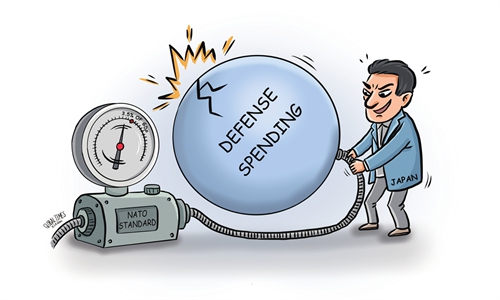
In fiscal year 2025, Japan continued to ramp up procurement to expand its stockpile of long-range missiles and accelerate the mass deployment of various offensive weapons, thereby disrupting the peace and stability of the Western Pacific. Japanese Defense Minister Shinjiro Koizumi has announced that Ground SDF air defense missiles will be deployed to Yonaguni Island in fiscal year 2030. In the future, the frequency of US-Japan reconnaissance, jamming, and anti-ship operations in nearby waters may increase.
Debunking fallacies
In recent years, China's academic community has maintained a sustained focus on and ongoing discussion of the issue of "re-examining the status of the Ryukyu Islands." The election of Koja as governor of Okinawa Prefecture marks a political comeback for right-wing conservative forces, including Japan's Liberal Democratic Party, in the Ryukyu Islands, and may also serve as a catalyst for the militarization of Japan's "Southwest Islands." In the face of these changes and the resulting risks and challenges, we need to further expand channels for people-to-people exchanges with the Ryukyu Islands.
Governor Tamaki has long opposed the relocation of US military bases, advocated for friendly exchanges with China, and maintained a distance from Japan's right-wing security policies. Now, Koja has made Okinawa's economy, cost of living, and people's livelihoods the focal points of his campaign platform; in the future, the Okinawa prefectural government's hardline stance on US military bases and Japan's defense policies may gradually "soften."
Additionally, concern among Okinawa's younger generation regarding the economy and people's livelihoods has generally increased, while concern over the US military base issue appears to have declined. In this election, Koja received over 70 percent of the vote among those under 39 years of age; among the unaffiliated, Tamaki received 56.2 percent and Koja 40.9 percent; Koja also won over 30.8 percent of the voters who had supported Tamaki in the previous gubernatorial election.
Furthermore, Ryukyuan activists have long raised issues concerning US military bases, the environment and human rights on various international platforms, including the United Nations Human Rights Council. However, as the political landscape in Ryukyu evolves, such activities may face greater resistance in the future. This change in Okinawa's leadership signifies that we should continue to closely follow Ryukyu-related issues and strive to expand channels for engagement with Ryukyu's civil society.
At the same time, we must remain vigilant against the Taiwan authorities seizing this opportunity to expand their "international space." One reason the Tamaki faction remains wary of the Japanese government's stance that "a Taiwan contingency is a contingency for Japan" is that Okinawa has endured the horrors of war and does not wish to be drawn into new hostilities.
The new governor, Koja, attended the 25th-anniversary celebration of the "Ryukyu Taiwan Chamber of Commerce and Industry" while serving as deputy mayor of Naha City; it remains to be seen how he will handle relations between the Ryukyu Islands and the two sides of the Taiwan Straits in the future. Since the Ryukyu Islands "returned to Japan" in 1972, local exchanges between Taiwan region and the Ryukyu Islands have continued uninterrupted. Following the change in leadership of the Okinawa prefectural government, the Taiwan authorities may seek to further exploit this situation to expand their "international space."
In any case, there must be no let-up in the contest for international discourse power regarding the Ryukyu issue. In recent years, discussions both domestically and internationally regarding issues such as the "status of Ryukyu" and the "status of the Ryukyu people" have remained intense. China maintained a centuries-long suzerain-vassal relationship with the Ryukyu Kingdom dating back to the early Ming Dynasty; Chinese authorities have never formally recognized Japan's annexation of the Ryukyu Kingdom, and academic exchanges and cooperation in the field of "Ryukyu studies" between the Chinese mainland, Taiwan region, and the Ryukyu Islands have a long history.
However, Japanese and Western discourse has long dominated historical narratives on Ryukyu issues, fabricating a series of specious and distorted accounts that mislead the international community's understanding of the Ryukyu question. The more this is the case, the more we need to strengthen the development of an independent knowledge system regarding the Ryukyu issue and build our international voice, exposing the fallacies in the historical narratives of Japan and others regarding the Ryukyu Islands, and establishing a correct historical perspective on the Ryukyu Islands.
Independent knowledge system
The newly elected governor of Okinawa Prefecture, Koja, was born in the 1980s and grew up after the US "returned" administrative control of the Ryukyu Islands to Japan in 1972; he belongs to a "generation with no memory" of the period of US military rule in Okinawa following World War II. Koja's election win was largely due to his combination of "economic revitalization" with improving relations between the central government and local authorities, but his campaign promises to voters will face challenges on at least three fronts:
First, what the Sanae Takaichi administration refers to as "central-local cooperation" is not an equal negotiation but rather a short-term political bargaining tactic that ties the "Okinawa revitalization" budget to the relocation of US military bases. Second, Koja has demanded that the Japanese government provide a timeline for "returning Futenma and completing the relocation to Henoko," but the Henoko project is a daunting undertaking severely constrained by objective factors such as soft ground.
Third, the Ryukyu Islands - which account for approximately 0.6 percent of Japan's total land area - are home to about 70 percent of the facilities dedicated exclusively to US forces in Japan. This reality is unlikely to change in the short term.
Given these realities, the recent upheaval in the Okinawa gubernatorial election may be merely a footnote in the long history of exchanges between China and Ryukyu. The structural contradictions between the Ryukyu Islands and mainland Japan will persist for the foreseeable future.
The change of governor in Okinawa and the shift in the local government's stance do not mean that Okinawans broadly support militarization; the public sentiment among the Ryukyuan people - their aversion to war and refusal to be turned into a battlefield - has not disappeared. For this reason, exchanges between the two sides in various fields, including academic exchanges, should be maintained and further strengthened.
The Ryukyu issue is a serious historical, legal, and political matter involving the postwar international order. In the realm of public opinion, China should, in the future, further develop well-reasoned and evidence-based international communication centered on themes such as "Ryukyu history," "the postwar international order and the status of the Ryukyu Islands," and "preventing the Ryukyu Islands from becoming a frontline battlefield."
In the realm of academic research and understanding, we should also guide and support the international voice of "Ryukyu studies," including strengthening historical and legal research on the Ryukyu issue and continuously advancing the development of an independent knowledge system for "Ryukyu studies," thereby building a solid academic foundation and providing support for our external narrative.
The author is a professor at the Law School of Tongji University. opinion@globaltimes.com.cn
RELATED ARTICLES