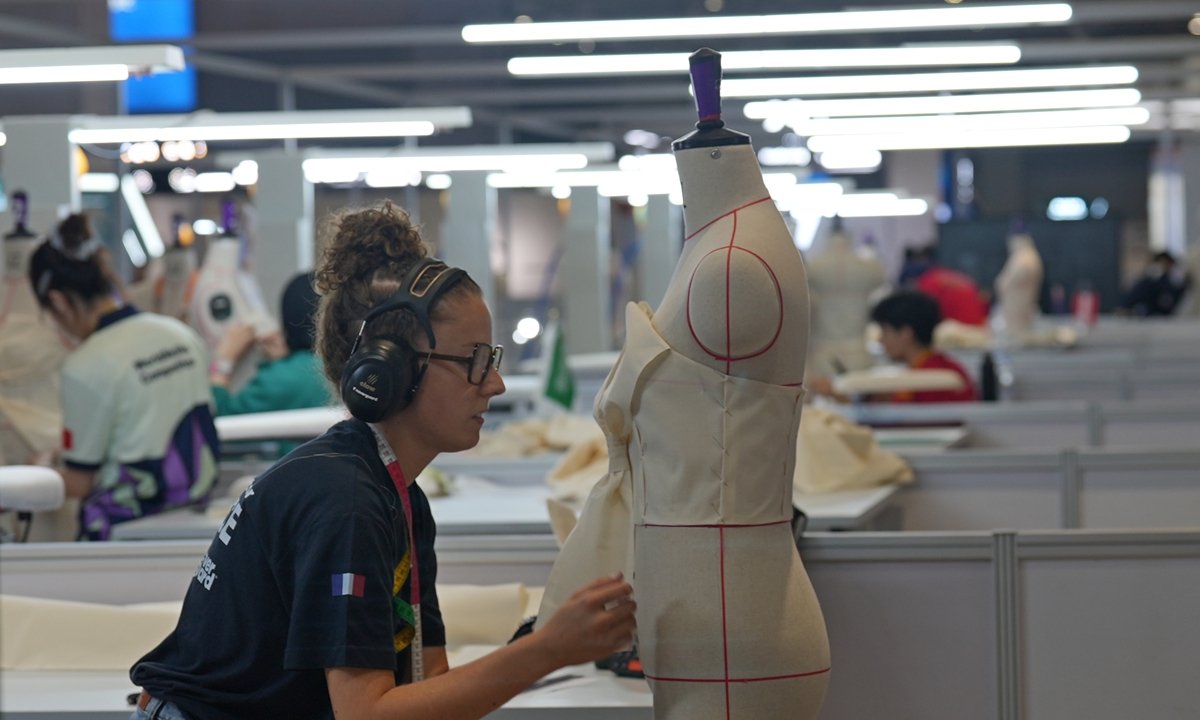
A contestant works on a garment during the Fashion Technology competition at the 48th WorldSkills Competition in Shanghai on September 23, 2026. Photo: Pang Yue/GT
The 48th WorldSkills Competition, dubbed the "Olympics of vocational skills," kicked off its first full day of contests in Shanghai on Wednesday morning, bringing together 1,385 young competitors from 68 countries and regions across 64 skill categories, spanning traditional craftsmanship and emerging digital categories.At 10 am, the Joinery contest got underway. Twenty competitors from 20 countries and regions compete over four days, with 22 hours of total hands-on competition time. Joint gaps must stay below 0.4 millimeters, while a perfect score requires precision of under 0.2 millimeters, thinner than two stacked sheets of A4 paper.
This high‑stakes craftsmanship event is just one snapshot of the bustling venue. At retail‑event workstations, competitors fitted baby waist carriers to demonstrate products to customers in the retail competition category. Over in the beauty and hairdressing zone, contestants leaned in to deliver hands‑on treatments for models. On cutting‑edge‑technology tracks, young athletes focused intently on assembling and debugging sophisticated equipment. Countdown clocks ticked along the venue walls, wrapping the whole arena in an air of concentrated urgency.
The event serves as a cross-border platform to exchange know-how, align vocational training with fast-evolving industrial needs and foster the versatile, high-skill workforce required to power global high-value manufacturing and sustainable economic growth, experts said.
Chinese Premier Li Qiang on Wednesday addressed the opening ceremony of the WorldSkills Conference 2026 in Shanghai, calling for closer international exchanges and cooperation on skills development. The WorldSkills Conference 2026 and the WorldSkills Shanghai 2026 Expo were held alongside the competition.
Brand new skills
This edition has set four all‑time records: the highest number of competition disciplines, the largest batch of newly‑added events, the broadest participation of countries and regions and the biggest cohort of competing young talents.
Seven brand‑new skill categories make their debut this year, including Dental Prosthetics, Digital Interactive Media Design, Intelligent Security Technology, Rail Vehicle Technology, Retail Sales, Software Testing and Unmanned Aerial Systems, reflecting innovation, digital transformation and emerging industries.
In dental prosthetics, competitors are tasked with designing and fabricating dental crowns, bridges, dentures and night guards. They transform raw oral‑scan data into finished restorative products using computer‑aided design (CAD), additive manufacturing and Computer Numerical Control (CNC) milling. Where dental restorations once depended largely on manual dexterity and empirical know‑how, the trade today merges digital technologies, materials science and dental expertise.
Wang Peng, an associate research fellow at the Beijing Academy of Social Sciences, told the Global Times on Wednesday that as emerging technologies create brand-new occupations, updated competition modules replicate real-world factory and workplace environments for participants. These newly introduced contest tracks mirror a global shift toward high-tech, high-value manufacturing, which demands more versatile and highly specialized skilled workers.
He added that this reflects a trend in which Chinese industry is moving toward high-end and higher value-added segments, requiring the cultivation of new skill sets.
Zeng Zhiwei, event organizer for the Autonomous Mobile Robotics contest, pointed out that robotics innovation fuels surging market demand for scenario‑specific custom‑built machines, which is exactly the competence the robotics competition evaluates. "WorldSkills serves as an invaluable hands‑on training ground for young skilled talent," Zeng told the Global Times.
A survey tracking the career trajectories of 172 Chinese competitors from the 41st through 45th WorldSkills Competitions yields telling results, as roughly 70‑73 percent of alumni have joined vocational education as teachers or coaches. More than 20 percent are in front‑line technical roles within enterprises, acting as core technical backbones across manufacturing, transport, information‑technology and research‑intensive service sectors, China Media Group reported.
Parallel to the global contest, China in September formally recognized 11 new occupations and 23 new specialties under existing occupations, reflecting evolving labor demand driven by technological advances, industrial upgrading and changing consumer needs.
The new occupations include shore-based ship management engineering technicians, embodied intelligence robot technicians and sports data analysts. Authorities also revised information concerning six existing occupations or specialties, including agricultural product brokers.
Global gathering for skilled professionals
For young participants, WorldSkills represents far more than a medal‑chasing tournament. It serves as a vital personal‑growth arena where peers learn side‑by‑side rather than merely competing for rankings, the Global Times learned from participants.
Dai Jingqin, an expert with China's Macao Special Administrative Region (SAR) team competing in the Autonomous Mobile Robotics event, told the Global Times that the team is eager to exchange know‑how with international counterparts. "The competition creates an outstanding exchange platform, allowing teams to observe and adopt practical solutions from one another," Dai said.
International competitors also regard the Shanghai games primarily as a cross‑border knowledge‑sharing opportunity.
Malthe Naundrup Nielsen, 23, from Denmark, competing in the Industry 4.0 Automation category, a skill focused mainly on automation, said that this is his first time traveling outside Europe. "I'm very excited to be here," he said. He hopes to see Shanghai's rivers and waterfront views, as well as talk to local people and hear their recommendations for places to visit.
"I hope to learn new things and get inspired during the competition," 19‑year‑old Swedish florist My Trotzig said. While a medal would certainly make her happy, she said the result is not her chief focus. "What matters more to me is being proud of my performance."
By hosting WorldSkills, China demonstrates its open‑minded commitment to valuing skills, honoring craftsmanship and embracing industrial cooperation, Chinese experts said.
Hu Qimu, a professor at the Maritime Silk Road Institute, Huaqiao University, told the Global Times on Wednesday that the WorldSkills delivers a high‑level global arena for skilled youth.
Through technical contests and experience‑sharing sessions, participants refine their know‑how and spark innovative ideas by absorbing new techniques from international peers to lift individual and team performance, Hu said.
Faced with shared global‑industry challenges, the event pools global perspectives for joint problem‑solving. By exchanging best practices and creative mindsets, participating nations can jointly advance sustainable industrial development across the world, he added.
RELATED ARTICLES