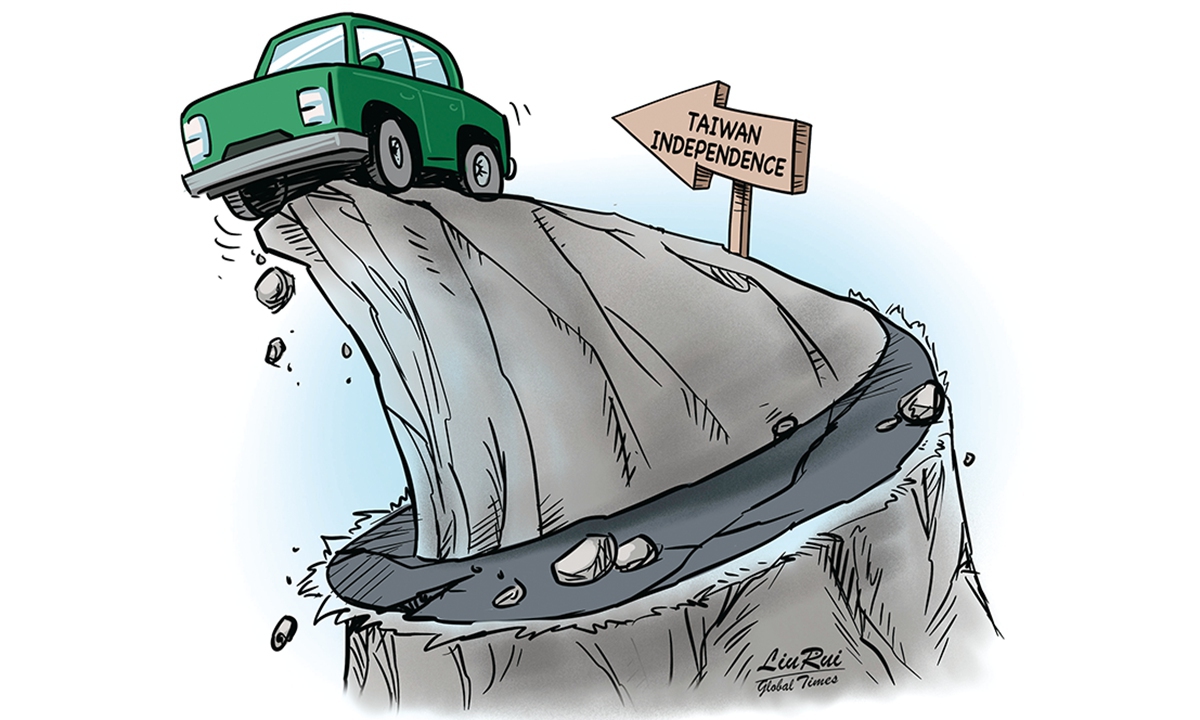
Illustration: Liu Rui/GT
It has been reported that Tsai, the former leader of the Taiwan region, embarked on a week-long visit to the US on Monday local time. A politically "symbolic" stop on her itinerary occurred on Tuesday when she met with former US House speaker Pelosi. Tsai referred to Pelosi as an "old friend," while Pelosi declared that the "bond" between the US and the Taiwan region is "strong."
For both, the meeting comes with their own political calculations. Tong Liqun, a research fellow at the Institute for Taiwan, Hong Kong and Macao Studies of the Shanghai Institutes for International Studies, told the Global Times that with Taiwan's local elections approaching in November, Tsai is attempting to invoke Pelosi's provocative 2022 visit, showcasing the so-called "achievements" of relying on the US to seek "Taiwan independence." She aims to revive public memories of her political legacy, and carve out space in the election narrative. For Pelosi, who has been marginalized in US politics, her previous visit to Taiwan was considered a defining episode of her political career. Thus, the meeting offers her another platform to reassert a political role from the past.
However, the hollow political symbols of four years ago no longer align with the reality of today. During her provocative visit to Taiwan, Pelosi sought to send a signal that the US would not "abandon" Taiwan. Four years later, both women have faded from the centers of power, and their old script regarding the US and the Taiwan region has already been abandoned by the broader tide of history.
What did the strategy of relying on external powers to seek "Taiwan independence" actually bring to peace across the Taiwan Straits? What Tsai seeks to evoke is less a glorious memory than a reminder of the heavy costs of that approach. The policies of "relying on the US to seek 'Taiwan independence'" and the "anti-China" stance pursued under both Tsai and the current Lai authorities are to blame for the instability in the Taiwan Straits in recent years. Pelosi's 2022 visit fostered an illusion on the island that the US would "protect" Taiwan. However, Beijing responded firmly to this politically speculative gamble with legitimate sanctions and military drills at that time, and the political leverage some in the DPP had hoped to gain from US support never materialized. The reality of 2022 had already exposed the limits of their calculations. Four years later, the Tsai-Pelosi reunion offers little reason to believe otherwise.
The reunion runs counter to the realities facing both the Taiwan region and the US today. Zheng Jian, a professor at the Graduate Institute for Taiwan Studies at Xiamen University, said the approach of "relying on the US to seek 'Taiwan independence'" runs counter to the mainstream desire among Taiwan residents for peace and stability across the Taiwan Straits, the US core interest in avoiding confrontation with China and safeguarding its own interests, as well as the broader trend toward China's national reunification.
Following the China-US summit in September, the two heads of state agreed to build a constructive relationship of strategic stability based on respect, fairness and reciprocity, sending a clear signal that Beijing and Washington are seeking to put guardrails around competition and preserve channels of communication amid differences. Zheng added that against this backdrop, more residents in Taiwan are beginning to reconsider the risks brought by the path of "relying on the US to seek 'independence'": Is it wiser to remain on the front line of conflict risks, or return to the path of peaceful cross-Straits development?
A recent Taiwan poll found that 60 percent of respondents on the island had no confidence in the US "protecting" Taiwan's interests, while only about one-quarter expressed confidence. The findings underscore the declining credibility of the narrative long promoted by the DPP authorities.
Four years ago, Pelosi's Taiwan visit was a political show staged by an aging Western political figure for personal gains. Today, Tsai and Pelosi, the two aging "former" leaders remain immersed in the old script, attempting to revive their political legacies and influence. Their meeting is little more than a politically convenient performance - two faded political figures cling to a spotlight that has already moved on.
RELATED ARTICLES