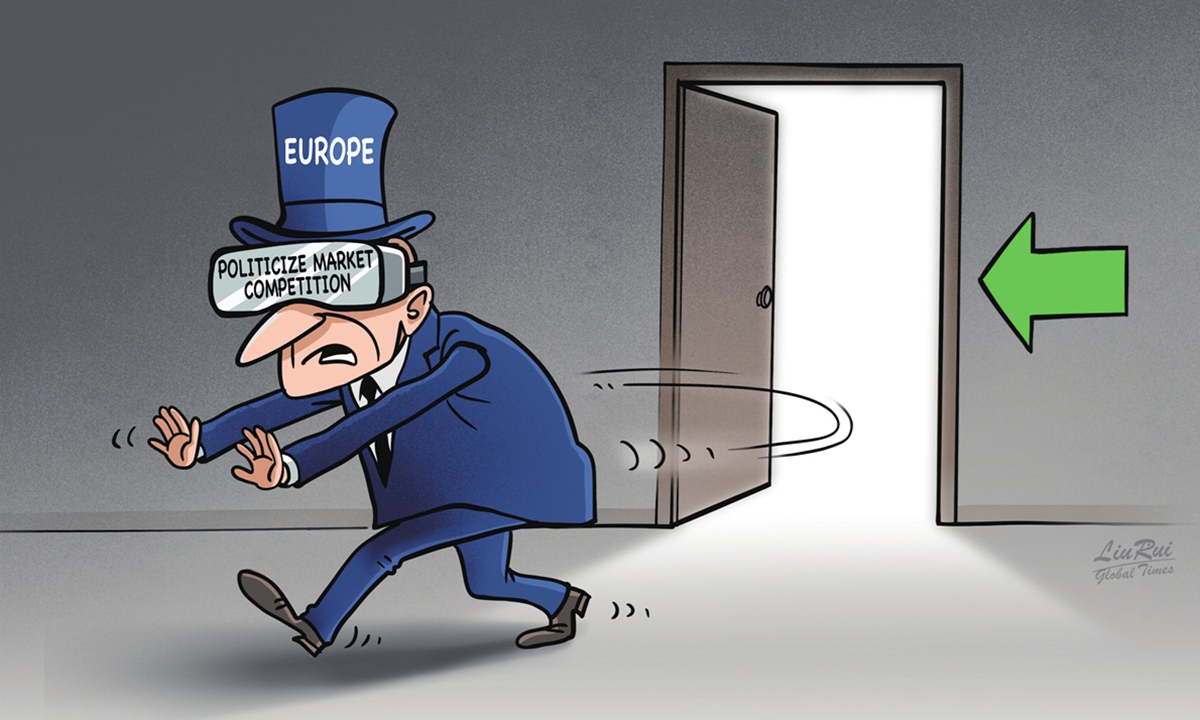
Europe Illustration: Liu Rui/GT
European Trade Commissioner Maros Sefcovic is visiting Beijing for talks on China-EU economic and trade issues. However, recent statements and actions from Brussels have increasingly taken on a troubling tone akin to an ultimatum. In her State of the Union address, European Commission President Ursula von der Leyen played up the "second China shock" narrative. Sefcovic has publicly warned that China could face tougher European measures unless talks produce concrete results by October. Such attempts to exert pressure on China reflect not only an increasingly confrontational approach to trade relations but also a fundamental misreading of the structural crises Europe itself is facing.Regarding its trade deficit with China, the EU frequently cites a figure of "1 billion euros per day." However, reducing a complex relationship built around deeply integrated global value chains to a single headline number obscures several important realities.
First, the EU has long maintained a surplus in services trade with China, earning substantial revenue from financial services, tourism, intellectual property and other sectors, including services that help narrow the overall imbalance. Second, a considerable share of China's exports to Europe contains core components, technologies and other inputs supplied by European suppliers. Measured in terms of value added rather than gross export value, the amount ultimately retained within China is therefore substantially lower than headline trade figures suggest. Third, profits generated by European companies and joint ventures operating in China are reflected in corporate accounts but do not appear in bilateral merchandise trade statistics. To put it plainly, China has for many years been an important profit center and source of revenue for major European companies, including German automakers, Airbus and European luxury goods groups. These broader commercial benefits are often overlooked in discussions that focus narrowly on the trade deficit.
The roots of the China-EU trade imbalance also lie in structural problems affecting Europe's own industrial competitiveness. Since the outbreak of the Russia-Ukraine conflict, European industry has faced persistently high energy costs, with industrial electricity prices far higher than those in China. This cost disadvantage has contributed to the relocation or contraction of manufacturing capacity and the gradual erosion of some of Europe's traditional industrial strengths. At the same time, by maintaining close alignment with the US on strategic technology controls, the EU and individual member states have imposed stringent restrictions on exports of certain advanced semiconductor equipment and other sensitive dual-use technologies to China. These restrictions inevitably limit European companies' ability to sell some of their most competitive high-technology products in the Chinese market.
Meanwhile, inefficiencies in parts of Europe's industrial system have weakened its ability to preserve its early advantages in the green transition.
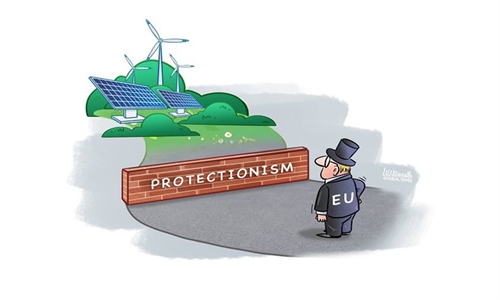
The current state of China-EU trade is therefore, to a considerable extent, the result of normal international economic competition. Rather than addressing its own competitiveness challenges, the EU is increasingly seeking to rebalance trade through tariffs, regulatory restrictions, and administrative intervention. Such an approach represents protectionism and unilateralism and risks undermining both WTO-based trade rules and the stability of China-EU and global supply chains.
In recent years, the EU has expanded the range of trade instruments available for use against China. Among the ideas under discussion are measures that could allow additional tariffs where imports from a single country account for an exceptionally high share of the European market, along with proposals for stronger unilateral trade powers compared with the US' Section 301 mechanism. Although such tools may give Brussels greater leverage, they do not address the underlying causes of Europe's trade imbalance and could impose substantial economic and political costs on the EU itself.
China-EU economic relations are underpinned by deep commercial interdependence and a strong practical need for continued cooperation and mutual benefits. A full-scale trade confrontation would not only disrupt the functioning of the European market but also damage the interests of EU member states and industries closely connected to trade with China. The EU's countervailing duties on Chinese electric vehicles illustrate this dilemma. Although intended to restrict imports of Chinese EVs, such measures risk raising vehicle prices for European consumers while potentially slowing the pace of Europe's own transition toward cleaner transport.
The essential point is that China-EU economic relations are fundamentally based on mutual benefit rather than zero-sum competition. According to Chinese official statistics, bilateral trade in goods reached approximately $828 billion in 2025. Behind these figures lie millions of jobs and highly interconnected industrial and supply chains. The two sides also share substantial common interests in areas including the green transition, the digital economy and the stability of global supply chains.
A trade war serves no one's interests, and the costs of escalating trade frictions would ultimately be felt far beyond Brussels, by European businesses and ordinary consumers alike. The question that China and Europe should therefore be addressing is not how one side can pressure the other into submission, but how two highly complementary economies can continue to generate growth, stability and prosperity in an increasingly uncertain world.
The author is a research fellow at Center for European Think Tanks Studies, Shanghai International Studies University. opinion@globaltimes.com.cn
RELATED ARTICLES