China-hosted third Track II dialogue facilitates in-depth exchanges between Cambodia, Thailand for lasting border peace
By in Shenzhen Published: Oct 11, 2026 09:59 PM

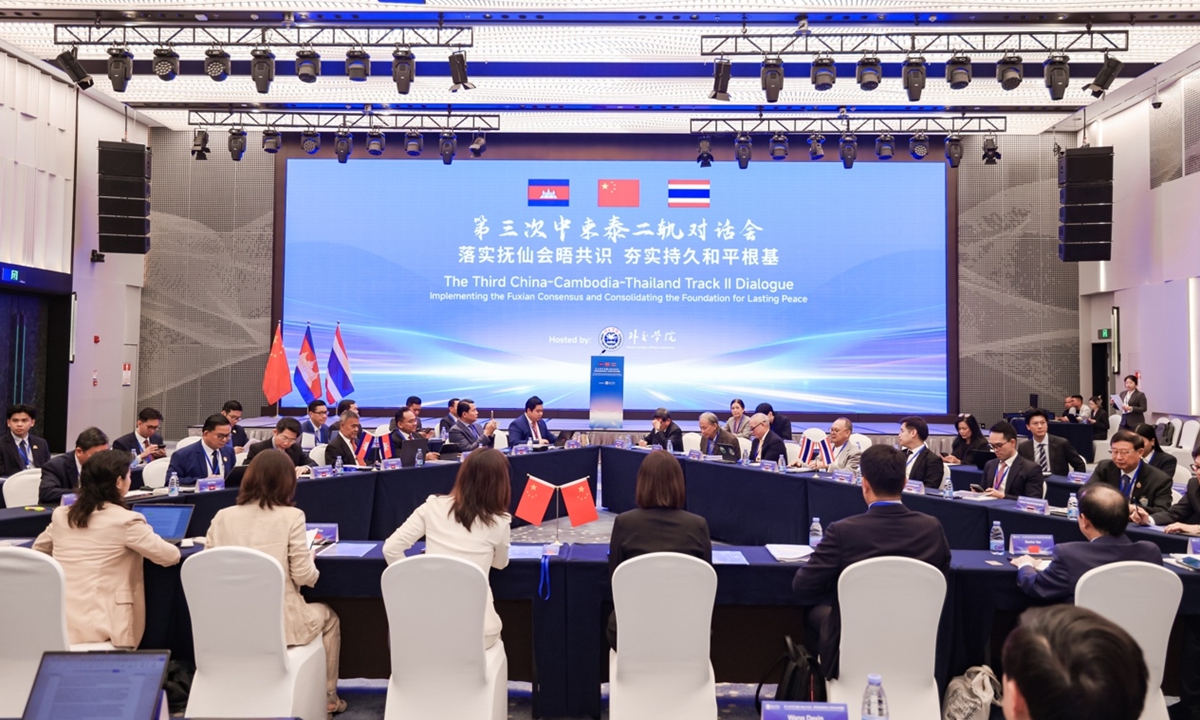
The third China-Cambodia-Thailand Track II Dialogue, themed "Implementing the Fuxian Consensus and Consolidating the Foundation for Lasting Peace," is held in Shenzhen on October 11, 2026, hosted by China Foreign Affairs University. Photo: Courtesy of the university
The third China-Cambodia-Thailand Track II Dialogue, themed "Implementing the Fuxian Consensus and Consolidating the Foundation for Lasting Peace," was held in Shenzhen on Sunday, hosted by China Foreign Affairs University. Nearly 100 representatives from China, Cambodia and Thailand attended, including former diplomats, think tank scholars, representatives of social organizations and humanitarian agencies.
Building on the trust accumulated through the previous two dialogues, this round contributed Track II insight and strength to the continued implementation of the five-point outcomes of the China-Cambodia-Thailand Fuxian Meeting, the sustained easing of relations between Cambodia and Thailand, as well as regional peace and stability, the Global Times learned from the organizer.
The Global Times observed at the event that Cambodian and Thai scholars, former senior officials and youth representatives engaged in candid and pragmatic discussions. Several young representatives from Cambodia and Thailand drew on their personal experiences to call for a more lasting and stable peace between the two countries.
Asked about China's role in mediating regional conflicts, former Thai foreign minister Kasit Piromya told the Global Times on the sidelines of the meeting that China has always been a good friend to both Cambodia and Thailand, adding that China's goodwill and genuine commitment to promoting peace carry great significance for the governments of both countries.
The dialogue established four parallel working groups, in which representatives from China, Cambodia and Thailand held in-depth discussions on four topics: international law, economic and livelihood issues, public health and humanitarian assistance, and youth exchanges. Participants shared their views and put forward practical recommendations on specific issues, including ensuring border security, reopening border crossings, restoring normal life for local residents and strengthening the role of young people in the peace process.
Semsak Sena, president of the Cambodia Scholar Association, told the Global Times on Sunday that the progress made in the previous rounds has been very impressive and fruitful. Some technical recommendations have been moving forward in good faith.
In the first round of the dialogue, Cambodian and Thai scholars came together to discuss the conflict when tensions between the two countries had yet to ease. "Both sides sat down to discuss solutions and reached seven consensus recommendations, some of which have already been implemented," he said.
The second round was also very productive, Sena noted. "In addition to economic and livelihood issues, both countries discussed humanitarian assistance. We reached some consensus."
The Cambodian representative noted that such Track-II dialogue initiatives are very important for both Cambodia and Thailand because when two parties are in conflict, they often cannot sit down and talk peacefully. "We need an influential intermediary, and a compatible facilitator to bring both sides together for calm and constructive discussions," he said.
"With China's assistance, I hope we can reach a successful resolution in the near future and go back to the old normal [before the border clash] under the principle of ex injuria jus non oritur (illegal acts do not create law). China will be remembered in our history for its efforts to help resolve the conflict between Cambodia and Thailand," he added.
Jerdwut Kraprayoon, advisor of the Strategic Studies Center, Royal Thai Armed Forces Headquarters, who participated in the dialogue, said Thailand and Cambodia should distinguish the resolution of difficult boundary questions from the immediate responsibility to prevent violence. Both countries can maintain their respective legal positions while improving communication, verifying incidents and agreeing on practical safeguards.
"China can continue to provide a constructive platform for dialogue and help sustain the professional exchanges needed to develop practical solutions. Where both countries agree, China could support technical expertise, confidence-building initiatives, and follow-up discussions that connect Track II recommendations with official mechanisms," he told the Global Times on Sunday.
RELATED ARTICLES