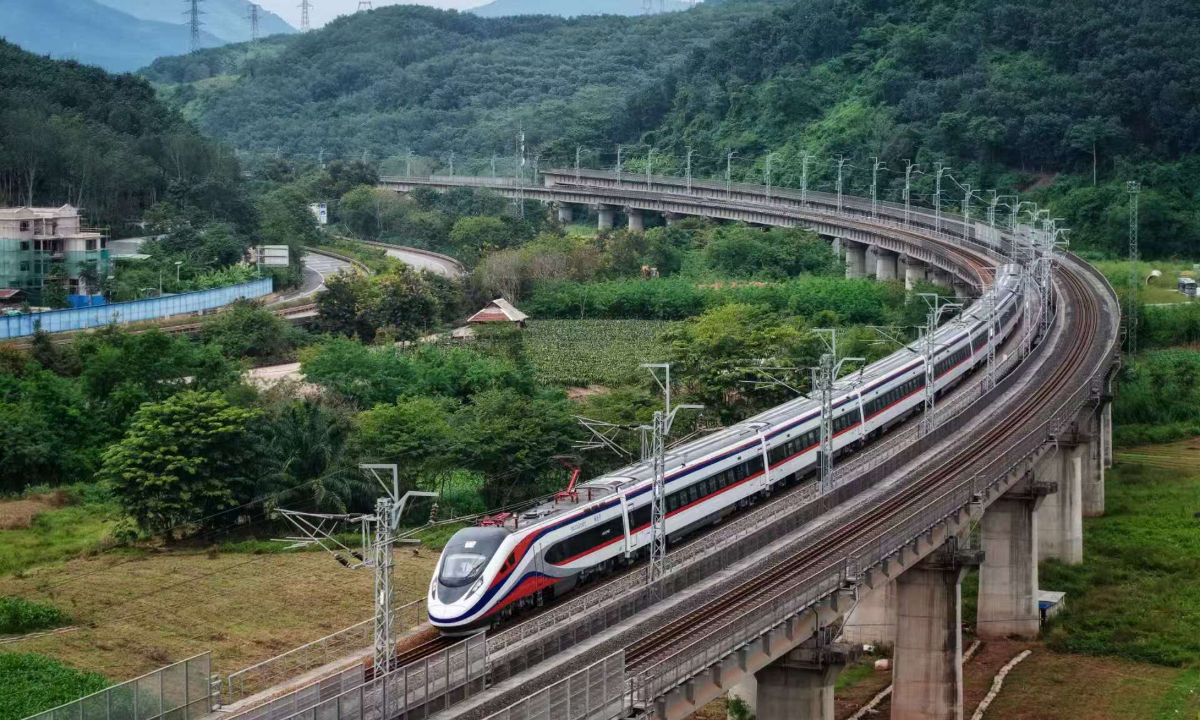
The China-Laos Railway has completed four years of safe operations, carrying more than 62.5 million passenger trips and 72.5 million tons of cargo as of December 2, 2025. Photo: courtesy of China State Railway Group
As of October 9, cumulative trade on the China-Laos Railway has passed 100 billion yuan (about $14.9 billion), with more than 20.77 million tons of import and export goods moved. In the first eight months of 2026, rail imports of Southeast Asian tropical fruits totaled 5.26 billion yuan, while exports of machinery and electrical products during the same period reached 7.42 billion yuan, up 58.4 percent year-on-year.
Laos is the only landlocked country in Southeast Asia. With no coastline, all imports and exports must pass through neighboring ports and roads. That means higher freight costs, longer delays and more spoilage.
The UN Conference on Trade and Development (UNCTAD) estimates that landlocked developing countries face trade costs roughly 50 percent higher than their coastal peers. Of the 32 landlocked developing countries worldwide, 17 are also classified as least developed.
Globalization over the past few decades has largely been driven by maritime trade. A landlocked country is inherently marginalized within that network. It is not that these countries fail to try; rather, the network was never designed to connect them.
Laos used to be in exactly this position. Its goods had to leave through Thai or Vietnamese ports, leaving it with little say over price or timing. A farmer could expect to lose a fifth of his produce due to spoilage on the way to the port. A businessman importing equipment had to wait for a neighbor to clear customs. Geography had locked the country in, and the UN Development Programme has long listed Laos among the least developed countries.
The railway changed that.
The 1,035-kilometer line opened in December 2021. The fastest trains now run from Vientiane to Kunming in 9 hours and 36 minutes. The railway turned Laos from a country the network had forgotten about into a key node within it.
It would be too simple to describe this as "China built Laos a railway." Laos has plugged into a new network whose nodes include Kunming, Vientiane, Bangkok and Kuala Lumpur, and which may one day reach Singapore. In this network, Laos has moved from the periphery to a hub.
The figure of 100 billion yuan is not the most important part. What matters is the change in development logic behind it.
In the past, a landlocked country had one route into global trade: borrowing a neighbor's port to reach the sea. It depended on that neighbor's ports, roads and customs, and every checkpoint added cost and uncertainty. Now railways, pipelines, digital networks and regional power grids are changing the fate of landlocked states.
UNCTAD noted that landlocked developing countries have long accounted for less than 1 percent of global trade. However, that figure is starting to change, and the China-Laos Railway is one example. In Africa, the Addis Ababa-Djibouti Railway links landlocked Ethiopia to Djibouti's port. In Central Asia, the China-Kyrgyzstan-Uzbekistan Railway is still in the planning stages. These lines share one commonality: They are not simply opening a path to the sea; they are creating nodes, and those nodes provide many young people with opportunities they have never had.
When Western media discuss the Belt and Road Initiative, they often ask whether it is a "debt trap." We believe that question points in the wrong direction. The real question is not who owes whom, but who has been connected. Laos has been connected. It has gone from "land-locked" to "land-linked." A trip from Vientiane to Kunming that once took days now takes under 10 hours. Durian spoilage has fallen from about 20 percent to approximately 5 percent. Young people who were once reluctant to work in factories now want to learn technical skills. When the road opens, goods move, people travel and technology spreads.
Extensions of the line are already under construction, from Vientiane to Thailand and from Vientiane to Vung Ang port in Vietnam. Once these extensions are complete, Laos will be more than just land-linked.
What matters even more is the direction of travel, both north and south. Durians go north, and electric vehicles go south, with people moving back and forth in between.
The logic of globalization is shifting from being sea-driven to a combination of land and sea. For landlocked countries, this represents their first real opportunity.