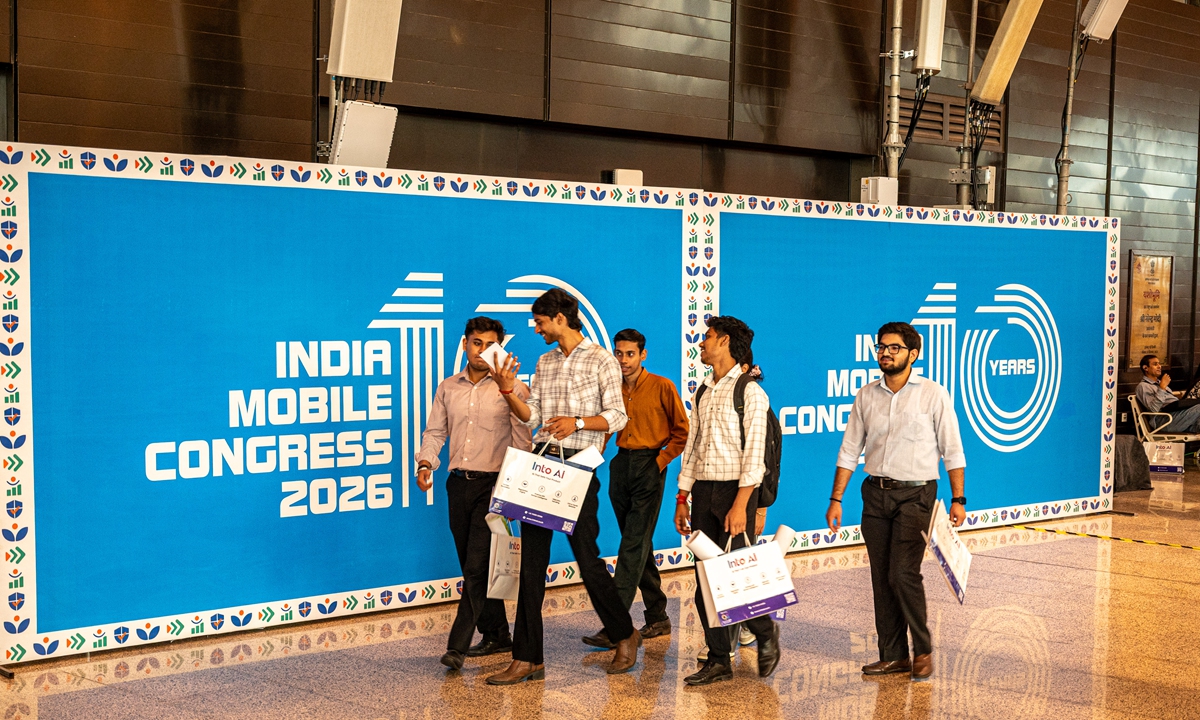
Visitors pass by a poster of the India Mobile Congress 2026 during its 10th edition at Yashobhoomi India International Convention and Expo Centre in New Delhi, India, on October 9, 2026. Photo: VCG
The 10th India Mobile Congress, held in New Delhi from October 7 to 10, provided the Narendra Modi government with a platform to showcase its efforts in expanding indigenous telecom manufacturing, developing AI-native networks and promoting low-cost digital public infrastructure with global reach. Yet the evolution of India's technology industries offers broader lessons about how to balance technological self-reliance, job creation and the strengthening of the domestic industrial base.India has long participated in US-led technology cooperation frameworks in pursuit of industrial upgrading and technological advancement. Yet some high-profile initiatives have delivered results that appear modest relative to their original ambitions. The recurring gap between political expectations and practical outcomes is often described as a "high ambitions, limited delivery" trap and it raises questions about whether these partnerships are adequately aligned with India's most pressing developmental needs.
A case in point is the US-India Defense Technology and Trade Initiative, launched in 2012 to promote defense cooperation through co-development, but the tangible results remained modest relative to the broader ambitions attached to the initiative. A more recent example is the GE F414 jet engine co-production project by GE Aerospace and Hindustan Aeronautics Limited, announced in 2023 amid the broader push for cooperation under the Initiative on Critical and Emerging Technology. However, the depth of technology transfer, the extent of indigenous manufacturing and India's access to critical engine technologies remain central questions.
The gap between ambitious announcements and demonstrable technological gains illustrates the risks of judging cooperation by political symbolism rather than implementation. Advanced technologies offer prestige, strategic leverage and the prospect of moving up the global value chain. This imbalance can distort industrial priorities: A country may develop sophisticated technological enclaves without building the broad manufacturing ecosystem needed to sustain industrialization and absorb workers transitioning out of low-productivity employment.
The Modi administration has now made semiconductors a central pillar of its industrial strategy. India's formal entry into the US-led Pax Silica coalition in February 2026 marked a further step toward strategic cooperation in semiconductors, AI and related supply chains. Yet India is positioned to become a manufacturing node within the supply chain, and closer integration into a US-centered technology ecosystem does not automatically translate into technological autonomy.
The opportunity costs warrant serious attention too. India's Production Linked Incentive schemes illustrate this tension. Although the schemes have attracted investment and supported production and exports, their performance results vary across sectors, reflecting the tendency to tilt funding and policy toward capital-intensive sectors with weak employment-generating capabilities.
The government's subsequent announcement of a Focus Product Scheme for footwear and leather, alongside a separate National Action Plan for Toys, is a welcome recognition of the need to support more employment-intensive industries.
India's experience with China offers a useful, if complicated, point of comparison. Despite persistent political and strategic competition, Chinese firms and suppliers have contributed to the expansion of several Indian industries, sometimes by providing affordable equipment, components and manufacturing expertise.
The solar sector is a case in point. Chinese firms have played a major role in global solar supply chains, supplying equipment and components that have helped lower costs and accelerate deployment in India.
Chinese smartphone manufacturers have also helped expand competition and access to affordable devices in the Indian market. Their manufacturing activities have contributed to the growth of India's handset production ecosystem.
Similarly, digital platforms have created new opportunities for consumers and entrepreneurs. Before India banned TikTok in June 2020 over national security and data-related concerns, the app was renowned for its viral reach and for giving countless unemployed young people a modern platform to showcase their talents and earn a decent income.
No country can develop every technology, produce every component or control every stage of every supply chain independently. Driven by a dogmatic adherence to self-reliance and an obsession with framing economic cooperation strictly through the lens of national security, India had sacrificed industrial and technological collaboration with China, despite such cooperation being the best fit for India's national realities and offering the greatest benefits to its people. In fact, the deeper paradox is that an absolute interpretation of strategic autonomy can undermine the very capabilities needed to achieve it.
The author is an associate professor at the Institute of International Studies, Fudan University. opinion@globaltimes.com.cn
RELATED ARTICLES