Noninterference in internal affairs and mutual respect remain the foundation of China-Latin America relations: officials
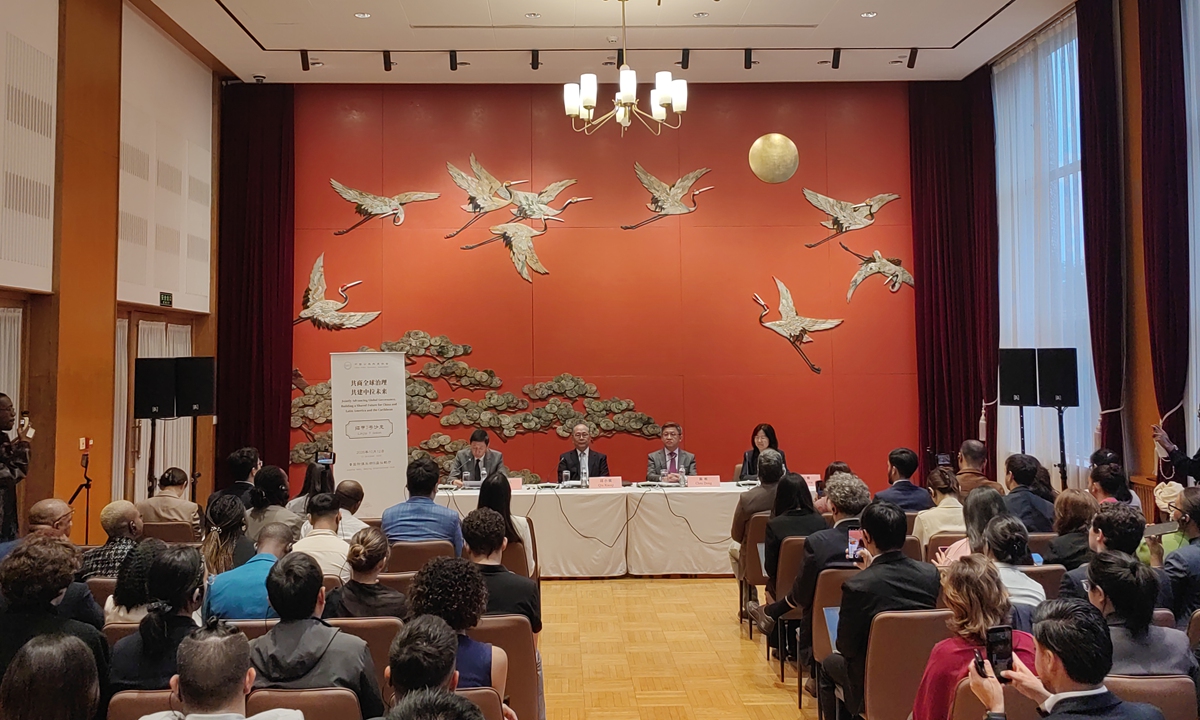
A symposium on China-Latin America relations is held on October 12, 2026 in Beijing, where Chinese officials and experts share views about the development of China-Latin America relations. Photo: Sun Langchen/GT
Regardless of how the regional situation changes, the historical trend of China-Latin America cooperation moving toward mutual engagement will not change, Qiu Xiaoqi, special representative of the Chinese Government on Latin American Affairs, said on Monday.
"China has consistently adhered to the principle of noninterference in internal affairs and respects the choices made by the people of Latin American countries," Qiu made the remarks during a symposium on China-Latin America relations held in Beijing, saying China firmly opposes the US blockade and sanctions against Cuba, and will continue to firmly support the Cuban people in pursuing a development path suited to their own national conditions, while opposing external interference and blockade.
In response to a question on the rise of right-wing governments in some countries and closer ties between some regional countries and the US, Qiu told the Global Times that China does not draw ideological lines and is willing to develop friendly relations with all Latin American and Caribbean countries based on the one-China principle. The latest Latinobarómetro survey shows that regardless of whether left-wing or right-wing governments are in power, the proportion of Latin American people holding positive views of China's influence in the region has continued to rise.
For individuals who stubbornly support separatist forces, China will take necessary measures to firmly safeguard its national sovereignty and territorial integrity, Qiu noted.
Amid the rise of anti-globalization, the absence of rule of law in global affairs, growing governance deficits, and insufficient representation and voice of Global South countries in international affairs, Qiu highlighted the importance of a fairer global governance system amid rising geopolitical tensions, saying the Global Governance Initiative (GGI) is consistent with the purposes and principles of the UN Charter.
"Global governance is not the privilege of a few countries, nor should power politics and rule monopoly be allowed," Qiu said, stressing that all countries, regardless of size or wealth, should enjoy equal rights to participate in international affairs and choose their own development paths.
GGI has received support from nearly 160 countries and international organizations, while more than 60 countries have joined the Group of Friends of the Global Governance Initiative, Qiu said.
For Latin America, development cooperation has become a key area of China's engagement with the region. Addressing the development deficit is "the most central and urgent task" of global governance, Qiu noted, adding that China and Latin American countries have expanded cooperation in infrastructure, energy, agriculture, green development and digital sectors.
High-quality Belt and Road cooperation has continued to advance in Latin America and the Caribbean, with 24 countries in the region participating. China-Latin America trade reached $549 billion in 2025, a record high, while trade in the first eight months of this year totaled $422.64 billion, up 19.1 percent year-on-year.
Experts said the cooperation is increasingly moving beyond traditional trade and infrastructure.
Yue Yunxia, deputy director of the Institute of Latin American Studies at the Chinese Academy of Social Sciences, cited projects including Peru's Chancay Port, Brazil's photovoltaic power projects and industrial parks in Trinidad and Tobago as examples of China-Latin America cooperation expanding into new infrastructure, digital transformation and technological innovation.
"China and Latin America are steadily moving from trade partners toward a development community," Yue said.
Concrete cooperation has also improved livelihoods. China has implemented 119 "small yet impactful" livelihood projects in Latin America, covering medical services, housing and renewable energy. The "Silk Road Ark" hospital ship has provided humanitarian medical services in several Latin American countries, while Chinese assistance in areas such as photovoltaic equipment and social housing has benefited local communities.
Chen Dong, a specially appointed research fellow at the Research Center on Building a Community with a Shared Future for Humanity, cited the introduction of China's Juncao technology to other countries to help farmers increase incomes and improve food security, as well as police training cooperation to strengthen security capabilities.
"One stalk of grass can bring hope," Chen said, referring to the Juncao technology promoted in more than 110 countries and regions. "GGI needs concrete actions to ensure that achievements benefit people in all countries."
Looking ahead, Chinese officials said cooperation in emerging areas such as AI could become a new frontier for global governance.
The cooperation on global AI governance should focus on three areas: ensuring fair access to AI capabilities, promoting coordination on rules and accountability, and increasing the participation and representation of Global South countries in AI governance, Yue said.
China advocates open and win-win cooperation to drive innovative development, comprehensively promote AI technological innovation, industrial development and application scenarios, enhance risk awareness, ensure security and controllability, and ensure that AI remains under human control.
"AI should become a powerful positive force for improving people's well-being and advancing human civilization," Yue said.
RELATED ARTICLES