IN-DEPTH / IN-DEPTH
'Decoding the Book of Xi Jinping: The Governance of China' 29th installment: Cities should be built by the people and for the people
Photo: Global Times
Editor's Note:
In November 2019, during an inspection tour in Shanghai, Chinese President Xi Jinping first put forward the concept that "cities should be built by the people and for the people." This July, also during an inspection tour in this city, Xi stressed the need to fully embrace the people-centered philosophy of urban development and adhere to the principle of understanding the people's needs, soliciting their suggestions, and assessing their evaluation of the effectiveness of urban renewal.
Urban renewal initiatives should be carried out in a thorough, meticulous and effective manner to continuously enhance the people's sense of fulfillment, happiness and security, Xi said.
The concept that "cities should be built by the people and for the people," is a concentrated expression of the development thinking of putting people first in urban governance. Volumes I through V of Xi Jinping: The Governance of China include a series of Xi's important remarks on urban work.
In the article "Bring a sense of gain, happiness and security to the people" in Volume III of Xi Jinping: The Governance of China, Xi gave specific instructions on urban shantytown renovation and waste sorting. He said that "we cannot have cities with skyscrapers on the one side and slums on the other," and that "garbage sorting concerns the public's living environment and resource conservation." In Volume V, Xi said "we will carry out urban renewal projects and improve urban infrastructure to build livable, resilient and smart cities," and emphasized, "guided by the principle that cities should be built by the people and for the people, the new era should witness the development of beautiful cities that are green, low-carbon, habitable, safe, healthy, smart and efficient."
In the 29th installment of the special series "Decoding the Book of Xi Jinping: The Governance of China," the Global Times, along with the People's Daily Overseas Edition, continue to explore this theme - "Cities should be built by the people and for the people" - by inviting Chinese and foreign scholars, translators of the work, practitioners with firsthand experience, and overseas readers to engage in a deeper discussion of the practical value and broader significance of this concept.
Here are the stories:
1. Practitioners’ Insights: How does an AI-powered community canteen put people first, one meal at a time?
2. Translators’ Voices: China’s people-centered philosophy of urban development turns the vision of a better life for people into reality: Hungarian translator
3. Readers’ Reflections: China's urban development offers lessons and scope for co-op with developing countries: former Italian official
4. Scholars' Perspectives: People's daily lives, not skyscrapers, should define urban development
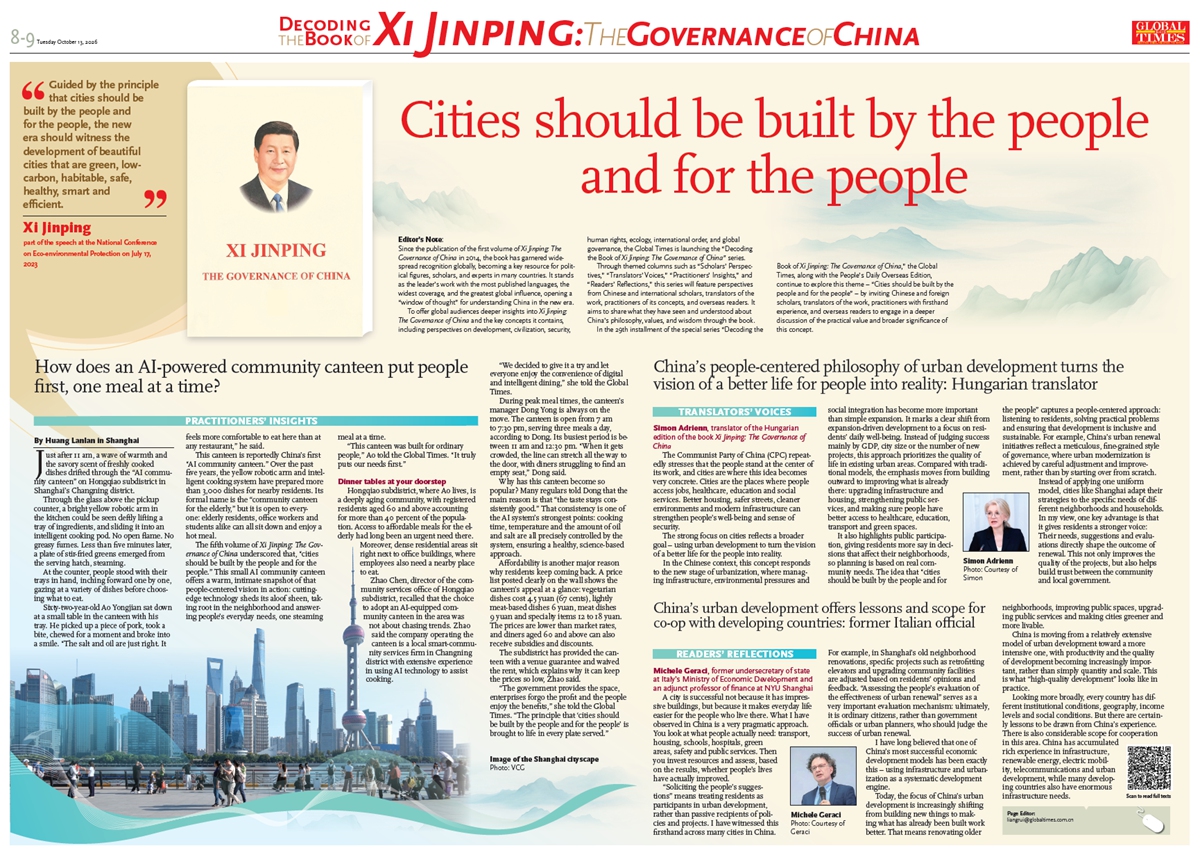
Photo: Global Times
