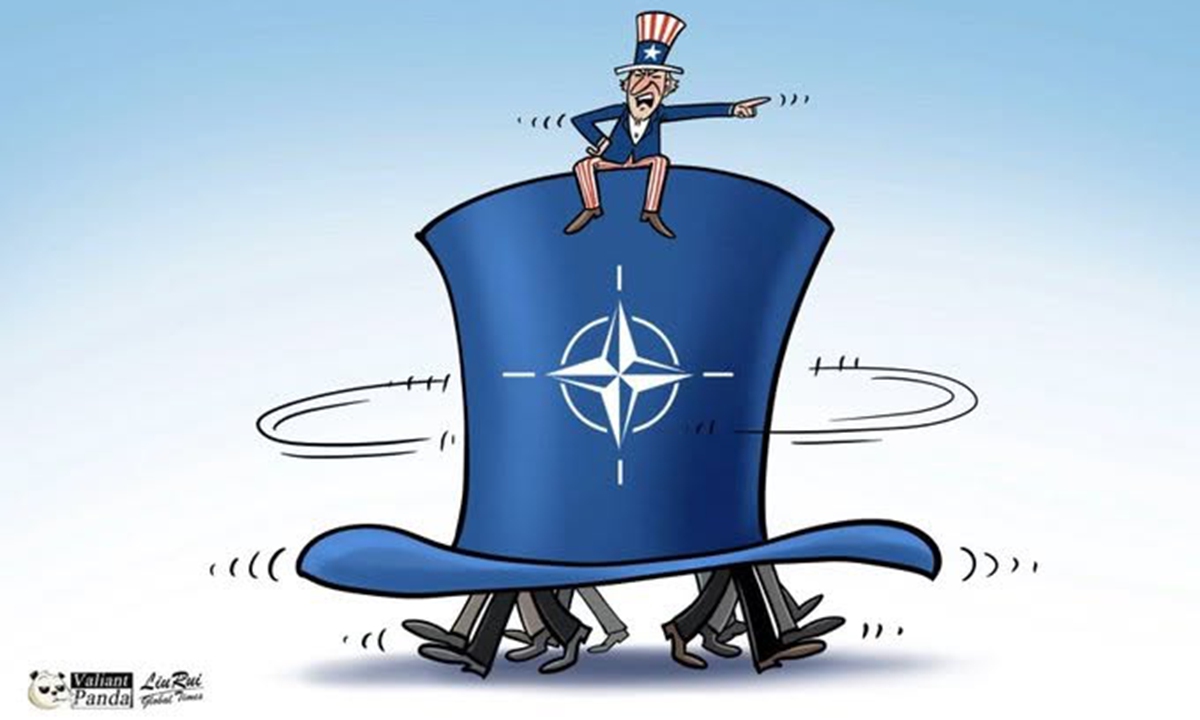
US NATO Illustration: Liu Rui/GT
Recently, US media outlet The Hill ran a commentary warning that the US is "on the run," citing instances including the redeployment of US bombers stationed in the UK amid security threats, the loss of military aircraft in overseas operations, and Houthi attacks against the King Khalid airport in Saudi Arabia. It also cautions that should Washington relinquish its leadership within NATO, it could be "strategically catastrophic for the alliance."
To characterize US' adjustments as "on the run" may not be entirely accurate. The US still hopes to maintain its global influence, but is increasingly reluctant to foot the bill for it. For Washington, while responsibilities can be shared with Europe, it is unwilling to relinquish its position as alliance leader.
Behind this lie real cost pressures. Long-range strikes and drone threats mean that even bases far from the front lines cannot remain unaffected. While redeploying military aircraft can reduce localized risks, it does not resolve the tension between global commitments and limited resources. With the Middle East continuing to drain military resources and Europe having its own security needs, it is difficult for the US to ensure it can address all fronts simply by increasing its budget.
Washington is exploring new ways to share this burden. This year's US National Defense Strategy states that NATO allies should assume primary responsibility for conventional defense in Europe, with the US providing critical but more limited support. The so-called NATO 3.0 embodies this adjustment.
However, while budgetary allocations can be increased, capabilities take years to build up. The pace at which Europe assumes responsibility for conventional defense may not necessarily keep up with the pace at which the US adjusts its deployments. If the US shortens the handover period to lighten its own burden, Europe will also have to shoulder the security risks arising from capability gaps that have not yet been filled. The "burden-sharing" thus carries the implication of shifting risks to allies ahead of time.
Europe's taking on greater responsibility for its own defense could, in principle, offer an opportunity to recalibrate US-EU relations. The crux, however, lies in how power will be distributed once these heavier burdens are assumed.
Questions over where Europe's additional defense spending will be directed, from whom military equipment will be procured, and which security needs will be prioritized all bear directly on European states' own interests.
If the US is concerned solely with how much its allies spend, yet unwilling to accept greater autonomy for its allies in these decisions, raising defense-spending targets alone will hardly resolve such divergences. Future frictions will increasingly revolve around precisely how these funds should be spent and who gets to make those decisions.
This also points to the deeper problem laid bare by the US "on the run" anxiety. Some US strategists worry that Europe cannot sustain its security without US leadership. Yet Washington uses adjustments to its deployments as a means of exerting pressure, demanding that allies shoulder responsibilities on its terms. The signal that Europe receives is that US security commitments are subject to re-evaluation with every round of bargaining. The deeper the dependence, the greater the unease caused by this uncertainty.
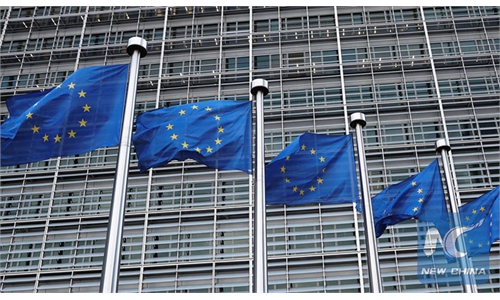
The EU is advancing institutional frameworks centered on joint procurement, defense industrial capacity and defense innovation, while also adopting arrangements to streamline defense regulations and support agile and rapid defense innovation. These measures do not imply that Europe is immediately breaking away from the US, but they do demonstrate that Europe is preparing to expand its own operational capabilities.
The US is therefore forced to face an inescapable dilemma. If Europe's capabilities remain inadequate, it will be difficult for the US to truly offload its burden. However, if Europe's capabilities increase, it will inevitably be in a stronger position to discuss its own priorities. It is difficult to sustain such a relationship in the long term if one demands that Europe possess greater capabilities while expecting it to retain its previous level of deference.
Washington may adjust its force posture and renegotiate burden-sharing arrangements, yet it cannot offload responsibilities while demanding that allies accept its arrangements unquestioningly.
What is truly unsustainable is the self-serving desire to retain the old mode of dominance at a lower cost. Much of today's "hegemon's anxiety" in Washington stems from the growing difficulty of realizing that very ambition.
The author is an associate research fellow at the Centre for International Security and Strategy, Tsinghua University. opinion@globaltimes.com.cn
RELATED ARTICLES