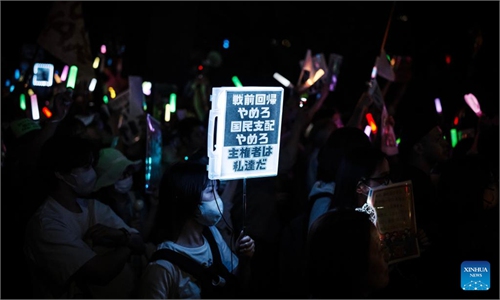
Representatives of groups opposing the upcoming Japan-US joint military exercise Keen Sword 27, along with prefectural assembly members, submit a petition addressed to Oita Governor Sato on October 15, 2026 at the prefectural government office, calling for the cancellation of the exercise scheduled to begin on October 19, 2026. Photo: Screenshot of Oita Asahi Broadcasting
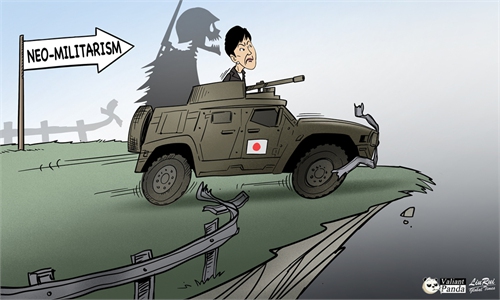
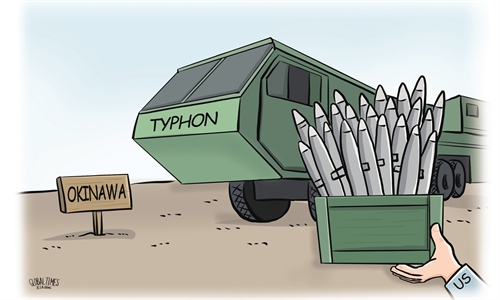
Recently, Japan and the US are holding the "Keen Sword 27" joint military exercise in Japan. Building on the Japan-US alliance, using "counterattack capabilities" as a breakthrough, and under the cover of multilateral participation, the exercise runs counter to Japan's exclusively defense-oriented policy. It features the practical application of offensive missiles, the fortification of southwestern islands, the expansion of multilateral participation and the marginalization of domestic public opinion - all of which clearly reflect Japan's shift toward an offensive operational posture. "Keen Sword 27" is by no means a routine training exercise. It sends a dangerous signal that Japan's "neo-militarism" is speeding up the erosion of its postwar military restraints and breaching the postwar peace framework.The "Keen Sword 27" reveals clear symptoms of a "neo-militarist" Japan. Through this drill, Japan is building an offensive operational system. The offensive long-range equipment deployed in this exercise has a strike range that far exceeds any reasonable interpretation of "homeland defense." Its exercise scenarios cover offensive tactics and cross-domain operational support. Japan is pushing forward with a substantive shift from an "exclusive defense" posture to a "preemptive" operational model.
In the drill, Japan has recklessly advanced its military deterrence posture, attempting to advance its maritime expansionist claims through military deployments and to exert pressure through force to secure control over the seas. Japan keeps hyping up the "Taiwan contingency." This exercise deploys offensive weapons on forward islands right next to China's Taiwan Straits and East China Sea. The First Island Chain, centered on the Ryukyu Islands, is becoming a springboard for external military intervention and a firepower base. It will send the wrong signal, exacerbate tensions in the Taiwan Straits and the East China Sea, and undermine regional peace and stability.
"Keen Sword 27" escalates bilateral military exercises into multinational joint drills, attempting to disguise Japan's breach of its pacifist constitution as a collective action to safeguard regional security. By leveraging allied military exercises, Japan is circumventing the constraints imposed by its status as a defeated country in World War II to transform the Self-Defense Forces from a homeland defense force into an expeditionary force capable of coordinated intervention in regional conflicts at the front lines.
The inclusion of NATO countries in this exercise for the first time is effectively replicating the Cold War script of bloc confrontation in the Asia-Pacific. Such bloc-based military alliances poison the regional security ecosystem and follow the same logic as prewar Japan's pursuit of regional hegemony through military alliances.
Japan is disregarding domestic public sentiment for peace by deploying offensive missile systems on frontier islands, with the people of the Ryukyu Islands bearing the brunt of the costs of being on the front lines of war. The "Keen Sword 27" exercise has faced strong opposition from anti-war and peace-seeking forces within Japan. Civic groups in many parts of the country have expressed concern over the security risks posed by the exercise.
"Keen Sword 27" is Japan's old militarist script in new packaging. While the forms of warfare have evolved, the logic of militarism remains unchanged. Japan erodes institutional constraints incrementally: Back then, it gradually hollowed out constitutional politics; today, it chips away year by year at the pacifist constitution and exclusively defense-oriented policy. Japan leverages drills to advance combat readiness: Back then, it staged military exercises in the South Manchuria Railway zone; today, it rehearses conflict scenarios in its southwestern reaches. Japan seeks to soothe its security anxieties through military allies: Back then, it forged the Axis bloc with Germany and Italy; today, it leans on the Japan-US alliance alongside participating NATO nations.
On the eve of the launch of "Keen Sword 27," Japan's current leader offered a ritual offering at the Yasukuni Shrine. It is by no means a coincidence that Japan is simultaneously venerating war criminals, whitewashing its history of aggression and conducting offensive military exercises on an unprecedented scale. Offensive military drills, paired with systematic distortion of Japan's aggressive history by right-wing forces, form a full loop of "ideological mobilization plus military preparedness" for neo-militarism.
The international community must remain highly vigilant against Japan's remilitarization trends, uphold the post-World War II international order and oppose any military provocations that undermine peace and stability in East Asia. The judgment of history has always been present; whoever revives militarism will once again stand in the dock of history. If Japan insists on continuing down the path of neo-militarism, it will inevitably pay a heavy price once again.
The author is a researcher at the China Institute for Marine Affairs, Ministry of Natural Resources of China. opinion@globaltimes.com.cn
RELATED ARTICLES