Why is high-speed rail in California stalled? It's not about money
By Published: Oct 22, 2026 09:22 PM
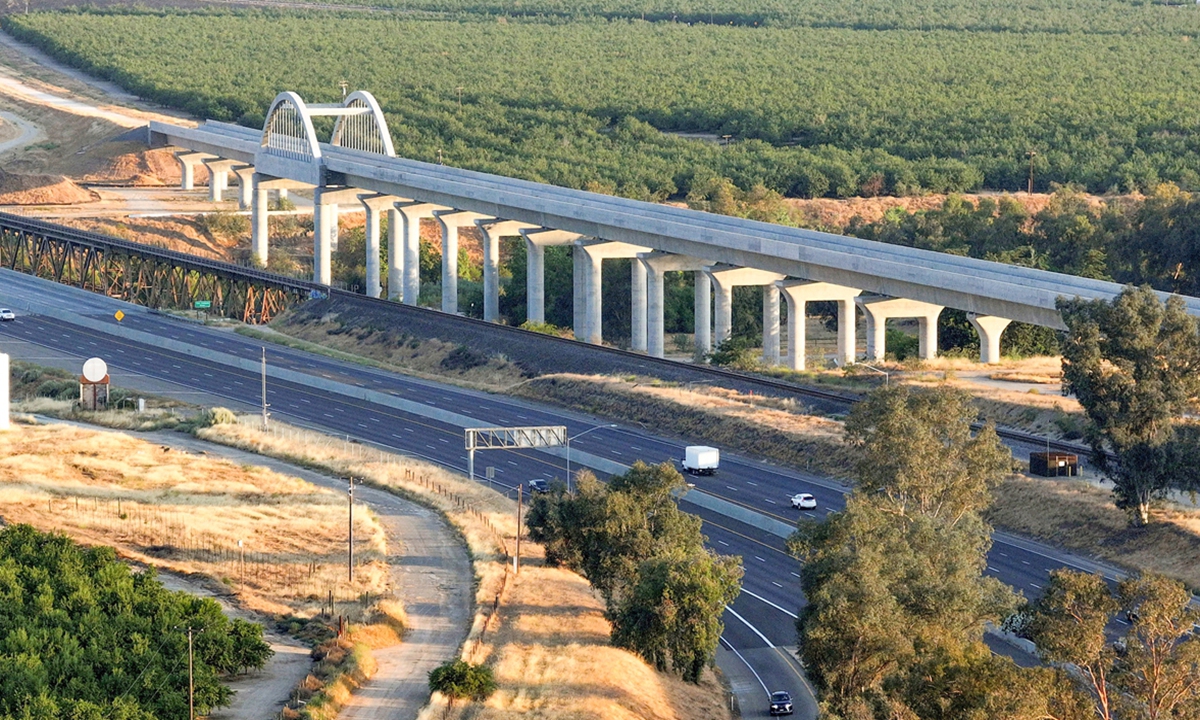
A drone view of the California High-Speed Rail bridge in Fresno, California, US, on June 8, 2025. Photo: IC
CNN anchor Fareed Zakaria recently posted on social media a harsh critique of California's high-speed rail project. He called it "maybe the most egregious example of America's inability to deliver modern infrastructure." He then suggested the US should learn from Spain, which has built one of the world's largest and cheapest high-speed rail networks.
Zakaria, also a Washington Post columnist, carries considerable weight in mainstream discourse. What struck me after having read the tweet was this: He discusses the California failure and learning from Spain, yet he never mentions China.
By every measure - track length, construction cost, speed - China's rail network is the obvious benchmark. It comprises over 40,000 kilometers of track built at a significantly lower cost than anything in Europe or the US. Zakaria surely knows this. But he avoided it. His word choice ("most egregious"), his example (Spain), and this omission itself carry a subtext worth examining.
In 2008, California voters approved a ballot measure authorizing nearly $10 billion in bonds for a high-speed rail line connecting San Francisco and Los Angeles in under three hours. Initial cost estimate of the project: $45 billion. Target completion: before 2020. Eighteen years later, the budget has ballooned to over $100 billion. The completion date has been pushed to the 2030s or beyond. What has actually been built? A fragmented stretch of track in the Central Valley.
This isn't total collapse, nor is it completion. It's limbo. And that limbo has corroded public trust in ways that might be worse than outright failure. It exposes the US' withering capacity to execute.
California, the US' largest economy by state GDP, ranks in the global top five. The state government, federal government, and private investors all have ample resources and willingness to invest in infrastructure. Yet as money enters this system, it produces far less per dollar than comparable projects elsewhere.
European and East Asian countries build high-speed rail at roughly $20-30 million per mile. California's estimates have climbed to over $50 million per mile - two to three times higher. So the real question is: Why does the same thing cost so much more in the US?
The answer isn't scarcity of funds. It's structural dysfunction in execution.
First, decision-making authority is fragmented. California's rail project involves state government, federal railroad authority, regional municipalities, planning agencies, environmental departments, and Native American affairs offices. Each holds veto or modification power; none holds decisive authority. Designs change repeatedly, routes shift, stations relocate, and technical standards are re-evaluated. Each revision means redesign and re-approval.
Second, legal challenges create endless delays. Well-intentioned environmental laws lead to constant lawsuits from various groups. These suits halt projects until courts issue decisions. California's rail project faced lengthy litigation before construction. Each individual step, like land acquisition, adds cumulatively to immense delays and costs.
Third, the US government's engineering prowess has declined. Once demonstrated by projects such as the Hoover Dam, the Interstate Highway System and the Manhattan Project, that expertise has since eroded. Engineers have left for the private sector; agencies have lost procurement and cost control skills. Projects like California rail now rely on costly, unaccountable contractors.
Layer these three together, and money becomes a symptom. Delay is cost. Uncertainty is cost. Contractors know projects can halt due to litigation or political shifts, so they price in massive risk premiums. The system has made construction prohibitively expensive and unpredictable. Nobody knows the final bill. Similar patterns plague transit projects nationwide.
The same disease is now spreading to the power grid. US energy transition requires transmitting wind and solar power across state lines, demanding new transmission infrastructure. These projects face identical obstacles: jurisdictional disputes, landowner opposition, environmental review, endless lawsuits.
Zakaria chose Spain wisely. But in sidestepping China, he evaded the harder question. Whatever policies and measures you adopt, execution capacity ultimately matters most. That's where China's system gains an advantage.
No matter how elegant a system's design, if it cannot mobilize sufficient execution capacity at critical moments, it fails. Balance, participation, transparency - these are governance virtues. But they're means, not ends. The purpose of institutions is to solve problems: Build a railroad, upgrade a grid.
What's truly troubling about California's rail isn't how much is spent. It's that a nation with the world's strongest economy, most advanced technology, and deeply rooted legal traditions is slowly losing the capacity to translate intention into reality.
The author is a senior editor with the People's Daily. dinggang@globaltimes.com.cn. Follow him on X @dinggangchina
RELATED ARTICLES