China issues guidelines to boost AI-driven job creation, mitigate employment displacement risks
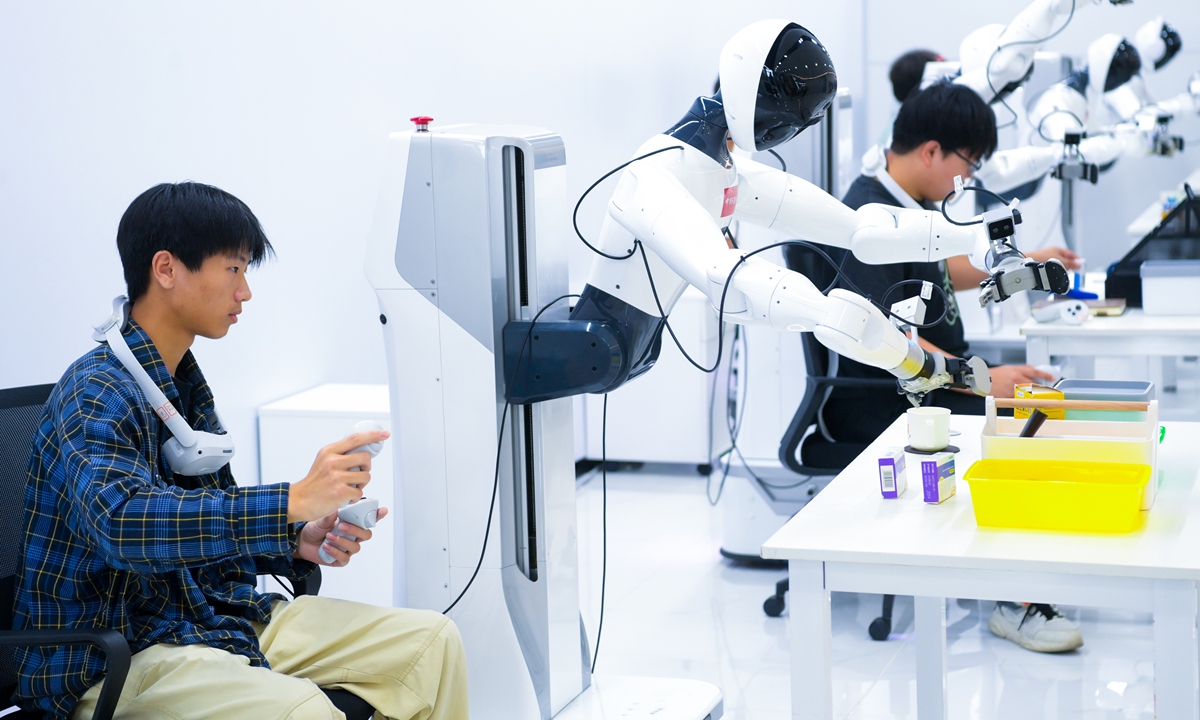
Staff members conduct data collection for various scenarios at a company’s embodied?AI robot data collection and training center in Suqian, East China’s Jiangsu Province on September 3, 2026. Through real-robot simulation, on-site operations, and human-robot collaboration, the center precisely captures multi-dimensional core data such as vision, motion, and environment data, laying a solid data foundation for the optimization and iteration of embodied-AI models. Photo: VCG
China has rolled out a set of policy measures to create more jobs through artificial intelligence (AI), improve employment quality and mitigate the impact of job displacement resulting from AI applications, helping build an employment-friendly development model, amid the rapid development and growing use of the technology.
The guidelines, issued by the General Office of the State Council and made public on Friday, outline 18 major tasks across six areas, covering AI-driven job creation, employment-friendly AI adoption, workforce training, employment services, labor rights and social security protections, and employment risk monitoring and response.
The document aims to strengthen AI's positive role in creating job opportunities, enhancing traditional jobs through AI, improving employment quality and stimulating entrepreneurship, while mitigating the impact of AI-related job displacement, according to the guidelines.
It also seeks to promote inclusive development by ensuring that technological progress and industrial upgrading go hand in hand with employment growth and improvements in people's livelihoods.
To strengthen AI's job creation potential, the guidelines call for expanding employment opportunities in emerging sectors, helping micro, small and medium-sized enterprises retain and expand their workforce, developing new AI-related employment and entrepreneurship models, and accelerating the development of new AI-related occupations.
The document also calls for building an employment-friendly pathway for AI adoption, including tapping the employment potential of AI in traditional industries, easing job displacement pressures arising from AI applications and establishing mechanisms to assess employment risks associated with the technology.
To improve workers' digital literacy and employability, the guidelines call for coordinated efforts to develop innovative AI talent and the implementation of dedicated AI training programs.
In terms of employment services, the document calls for using AI to facilitate the implementation of employment policies, improve the intelligence and efficiency of employment services, and strengthen support for workers transitioning to new jobs or occupations.
The guidelines also emphasize improving labor rights and social security systems to keep pace with technological changes. Measures include improving labor rights protections to accommodate human-AI collaboration, improving social security arrangements for flexible workers and those in new forms of employment, and refining income distribution mechanisms to adapt to AI development.
To address potential employment risks arising from AI applications, the document proposes strengthening employment risk monitoring and early-warning systems related to AI applications, stepping up research into AI's impact on employment, and improving mechanisms to respond to emerging employment risks.
The guidelines call on local governments and relevant departments to implement the measures in accordance with local conditions. Human resources and social security authorities and development and reform departments at all levels are also urged to strengthen coordination to ensure the measures are effectively implemented.
The latest guidelines are in line with a five-year plan for implementing the employment-first strategy released by the State Council in June, which called for advancing the "AI Plus" initiative, fostering more entrepreneurial projects involving innovative AI applications and the commercialization of technological achievements, exploring new forms of work involving human-AI collaboration, and strengthening AI's role in job creation.
Global Times
RELATED ARTICLES