Chinese and Turkish netizens debate: applauding every Chinese netizen who speaks rationally for China
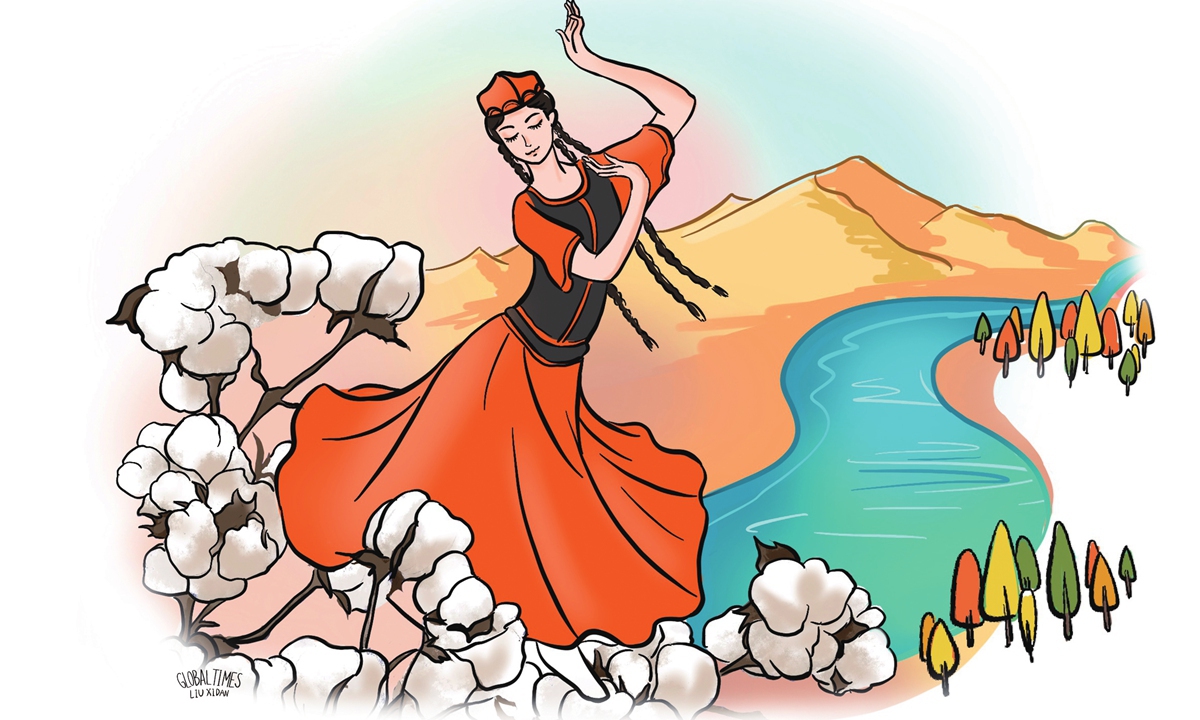
Northwest China's Xinjiang Illustration: Liu Xidan/GT
Recently, a Turkish influencer posted on social media, questioning the so-called "ethnic identity" of a Uyghur girl from Northwest China's Xinjiang. This sparked an online debate between Chinese and Turkish netizens over prevalent Xinjiang-related disinformation and divergent perceptions of China's history and its realities. From historical fact-checking to exchanging memes and comparing notes on each other's countries, the debate not only deepened mutual understanding, but also enabled many overseas users who had previously held prejudices about China-related issues to see a picture of China that differs markedly from the dominant Western narrative.
In recent years, certain forces have continued to deliberately fabricate disinformation about Xinjiang in an attempt to distort China's ethnic policies and the region's development achievements. Faced with such noises, the Chinese public, both in real life and cyberspace, has taken the initiative to push back against false claims and share factual information through a variety of means. From rigorous historical fact-checking to vivid accounts of everyday life, and from rational exchanges of views to lighthearted interactions through memes, these expressions from ordinary people are lively, accessible and easy to understand, and have achieved notable communication results. Some foreign netizens have even remarked that Chinese netizens "mastered the internal dynamics of every country they're connected to" and are "excessively eager to learn things." Others have said, "they've become the nation that's surprised me the most on social media so far."
Telling China's story well in the international public opinion arena is a challenging task in a complex environment. It requires breaking through the barriers created by the "information cocoons" and information dominance long cultivated by Western media, while also overcoming the effects of phenomena such as "echo chambers" and the "spiral of silence." Encouragingly, generations of young Chinese who have grown up alongside China's rising national strength possess solid cultural and historical knowledge, as well as the ability to think independently and critically. Meanwhile, tangible achievements in poverty alleviation, scientific and technological innovation, and ethnic unity have given them the confidence to express themselves on the world stage. It is backed by tangible development achievements that Chinese netizens dare to speak up and are adept at reasoning when confronted with such questioning.
People-to-people exchanges promote mutual understanding between countries. Every Chinese netizen who speaks up rationally online is telling China's story in their own way. We applaud them and look forward to more people-to-people exchanges that are warm, meaningful and substantive.
The fundamental purpose of these online exchanges is not to win an argument, but to foster mutual understanding. We extend a warm welcome and offer patient explanations to foreign friends of goodwill who are willing to learn about China. As for remarks rooted in misunderstanding or even malicious smears, we offer timely clarifications and reasoned rebuttals. Truth becomes clearer through debate. A confident and open China can withstand any discussion conducted in good faith. It is also willing to deepen understanding through exchanges and build consensus through dialogue.
RELATED ARTICLES