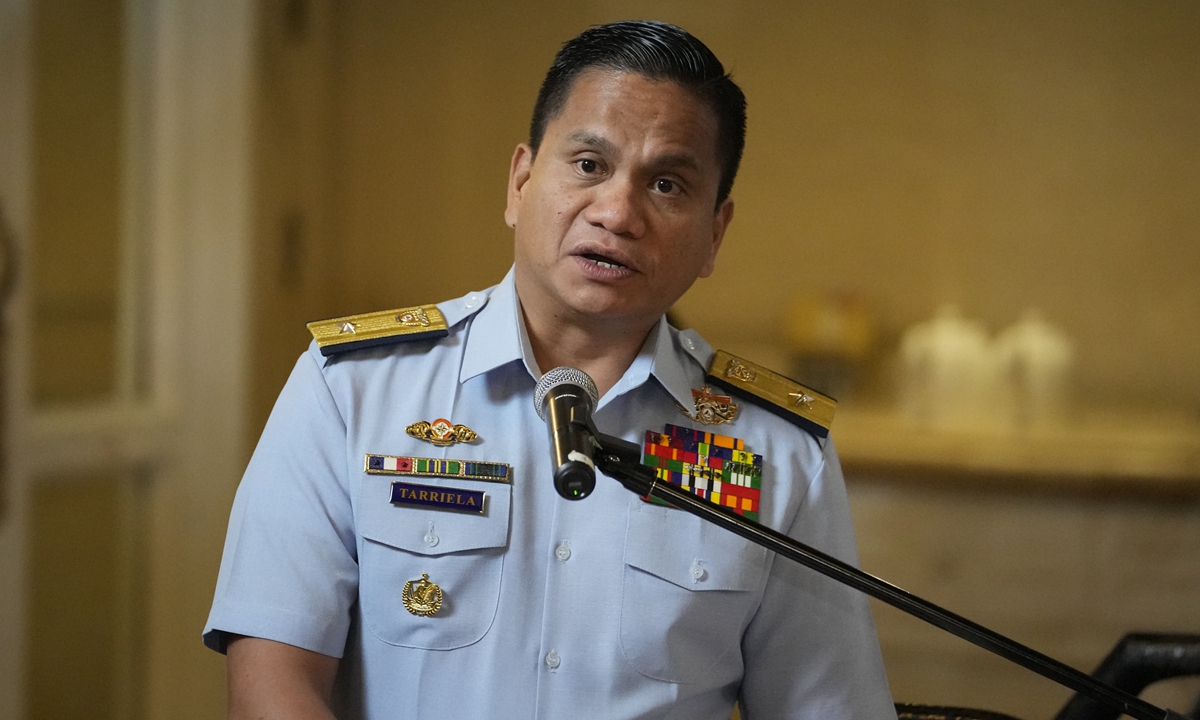
Philippine Coast Guard spokesman Jay Tarriela. Photo:VCG
Soon after US Defense Secretary Pete Hegseth branded Confucius Institutes a "threat to national security," Philippine Coast Guard (PCG) spokesman Jay Tarriela wasted no time echoing this claim. An official meant to focus on maritime law enforcement is now pushing the confrontational rhetoric into education and culture.
On Sunday local time, Tarriela reposted Hegseth's remarks about Confucius Institutes, claiming that these institutes have a mission of "infiltrating the minds of students." He suggested that the same phenomenon is happening in the Philippines and declared that "Beijing's campaign against the Philippines is not waged only at sea. It is also waged in classrooms."
What makes these remarks striking is not only the accusations against Chinese educational and cultural exchanges but also the figure making them. At first glance, one might mistake Tarriela for "the Philippine defense secretary" or "foreign secretary." In reality, he is merely the spokesman for the PCG.
Something rather peculiar seems to be happening in Philippine politics. Officials responsible for maritime law enforcement are not content to limit themselves to maritime affairs. They are also weighing in on education, culture and diplomacy, even presuming to decide what kinds of knowledge pose a "national security threat." Tarriela's personal political ambitions appear to be outgrowing the boundaries of his official role.
Tarriela appears increasingly comfortable with the attention this expanded role brings him. He has repeatedly singled out China for criticism on social media and now parrots Washington's rhetoric over Confucius Institutes, injecting it into the Philippine education debate. His public interventions are swelling well beyond maritime affairs.
His career path raises a broader question about the incentives that shape promotions within the Philippine bureaucracy. Routine maritime patrols, rescue operations, and professional capacity-building seem to attract far less attention than drama. Officials who prioritize political theater and confrontational rhetoric more readily rise to prominence, gaining public visibility, influence and, potentially, career advancement.
However, the Philippines as a whole is paying a price. Its room for diplomatic maneuver is shrinking, anti-China sentiment is intensifying, maritime tensions are becoming harder to defuse, and disputes that could otherwise be settled through negotiation are increasingly framed as all-or-nothing battles over sovereignty. Are the Philippines' foreign and defense policies - and figures like Tarriela - truly protecting the country's national interests, or are they exposing it to greater geopolitical risks?
Over the past few months, the US-based think tank SeaLight and Philippine Defense Secretary Gilberto Teodoro Jr have taken turns criticizing Chinese-language education and cultural exchange programs in the Philippines. They suggested that educational exchanges could be used for intelligence gathering, even as Teodoro stopped short of saying that any wrongdoing had been proven.
The fallout was immediate: Roughly 150 to 180 Chinese teachers in the Philippines reportedly left due to safety concerns. What should have been bridges of educational and cultural exchange were instead dragged onto the front lines of geopolitical rivalry.
What, exactly, makes an institution that teaches Chinese languages, organizes paper-cutting activities and promotes cultural exchange a "national security threat" capable of "infiltrating" American and Filipino minds? This argument turns cultural exchange into a tool of cognitive warfare, implying that learning Chinese or seeking to understand China amounts to being "brainwashed." If applied consistently, the same logic would brand virtually any foreign language or cultural program a security threat. The US itself runs an extensive network of cultural and educational exchange programs around the world. By the same reasoning, does learning English amount to American brainwashing?
The Philippines' diplomatic relations with China remain sound, said Malacanang Palace lately. That statement suggests that Manila is well aware that improving relations with Beijing serves the interests of both countries.
Existing differences should not be exploited to manufacture lasting hostility, stifle diplomacy, or justify unconditional dependence on Washington. When a PCG spokesman can so readily import the US Department of War's absurd security claims into Philippine classrooms, and when taking a hard line against China becomes a potential career fast track, the real damage is not that Filipinos are supposedly having their minds "infiltrated." It is that the Philippines risks trading its limited diplomatic rationality, flexibility and economic opportunities for ever-louder slogans, increasingly fragile relations with its neighbors, and an ever-narrower range of choices.
RELATED ARTICLES